

Remittance Meaning in Bank
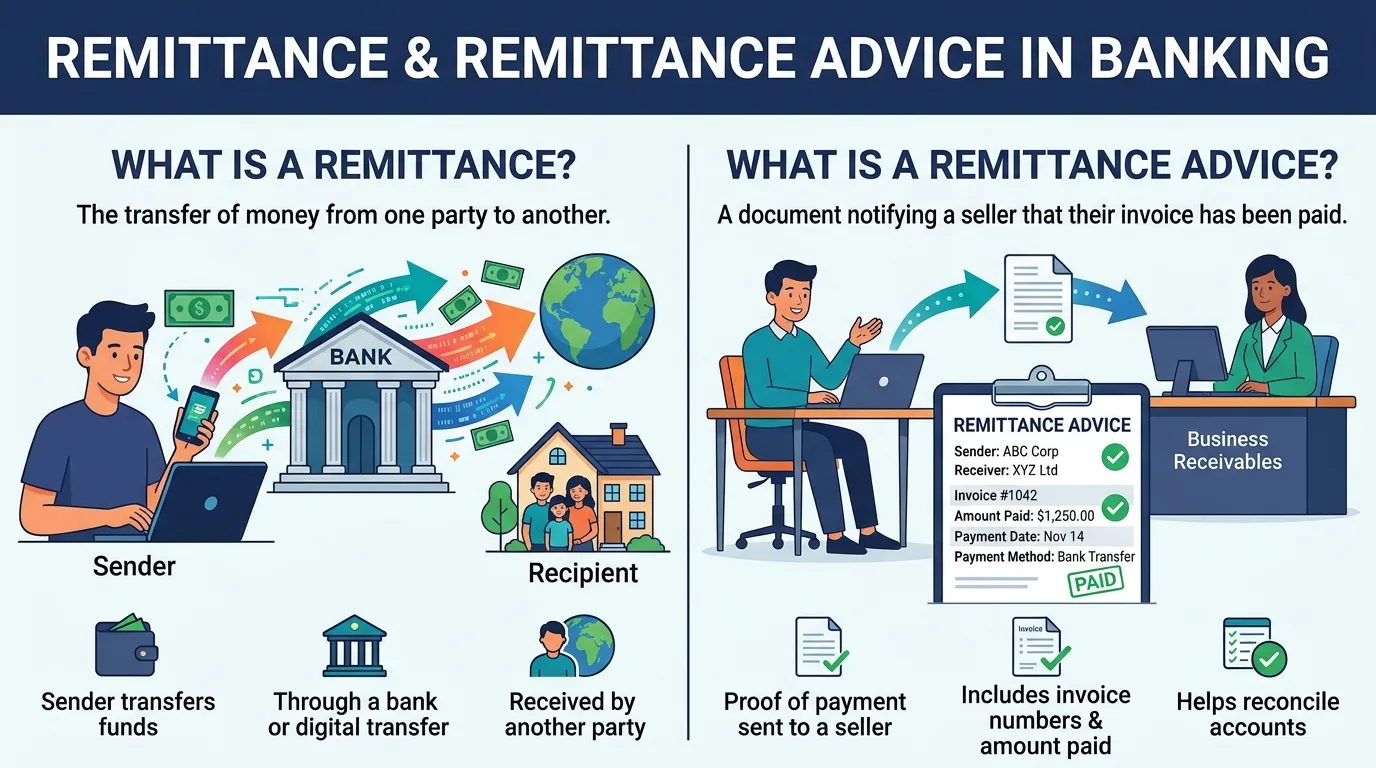
In banking, remittance means sending or transferring money from one person, bank account, or location to another. It often refers to money sent to another country, but it can also describe domestic money transfers.
In simple English, remittance means money sent to someone through a bank or money transfer service.
Common types of bank remittances:
Inward Remittance: Money received from another country into a local bank account.
Outward Remittance: Money sent from a local bank account to someone in another country.
Domestic Remittance: Money transferred between people or accounts within the same country.
International Remittance: Money transferred across international borders.
Example:
A person working in Saudi Arabia sends money to their family in Pakistan through a bank. This transaction is called an international remittance.
Example sentences:
The bank received an international remittance from the United States.
My brother sends a monthly remittance to our family.
The bank provides services for receiving and sending remittances.
Payment Remittance Advice Meaning
Payment remittance advice is a document or electronic message sent by a person or business to explain the details of a payment. It tells the recipient how much money has been sent and which invoice or bill the payment is intended to cover.
In simple words, remittance advice is a payment information notice that helps the receiver understand why money was sent.
Information included in remittance advice:
Name of the person or company making the payment.
Name of the payment recipient.
Total payment amount.
Payment date.
Invoice or reference number.
Payment method.
Any deductions, discounts, or adjustments.
Example:
A company receives an invoice of $2,000 from a supplier. The company sends \$2,000 and emails the supplier a remittance advice explaining which invoice the payment covers.
Example sentences:
Please send the payment remittance advice after completing the bank transfer.
The supplier received remittance advice from the customer.
The accounting department uses remittance advice to match payments with invoices.
Important: Remittance advice is not necessarily proof that the money has reached the recipient’s bank account. It mainly explains the payment and helps with accounting records.
Remittance vs Payment
Remittance and payment are related financial terms, but they do not have exactly the same meaning.
A payment is money given to settle a bill, debt, purchase, or financial obligation. A remittance is the sending or transferring of money to another person, business, or location.
Remittance | Payment |
|---|---|
Refers to sending or transferring money | Refers to settling an amount owed |
Often involves sending money to another location or country | Can happen locally or internationally |
May be sent to family, businesses, or individuals | Usually made for goods, services, bills, or debts |
Can be made through banks or transfer services | Can be made through cash, cards, banks, or other methods |
Example: Sending money to family abroad | Example: Paying a shopping bill |
Example:
A worker sends $500 from the UK to their family in Pakistan. This is a remittance.
A customer pays $500 for a new laptop. This is a payment.
Are remittance and payment the same?
Not exactly. A remittance is a type of money transfer that can also serve as a payment. However, not every payment is called a remittance.
What Is Remittance Meaning?
Remittance means money sent or transferred from one person or place to another. It is commonly used when someone sends money to family members, friends, businesses, or other recipients.
The word can also describe money sent to settle an invoice, bill, or financial obligation.
Common examples of remittance:
A worker sends money from another country to their family.
A parent transfers money to a child studying abroad.
A company sends money to an overseas supplier.
A customer sends money to pay an outstanding bill.
A migrant sends financial support to relatives in their home country.
Example sentences:
My uncle sends a monthly remittance to his family.
The company received a remittance from its international customer.
She visited the bank to collect her remittance.
International remittances help many families manage their expenses.
In simple terms, remittance means sending money to someone, often across a distance or international border.
Remittance Recipient Meaning
A remittance recipient is the person or organization that receives money sent by another person or business.
In simple English, the remittance recipient is the person who gets the transferred money. The sender is the person who sends it.
Examples of remittance recipients:
A family member receiving money from a relative working abroad.
A student receiving financial support from parents.
A business receiving money from an international customer.
A supplier receiving payment from a company.
A person receiving money through a bank or money transfer service.
Example:
Ahmed works in Dubai and sends money to his mother in Pakistan.
Sender: Ahmed
Remittance recipient: Ahmed’s mother
Amount: $500
Transfer method: Bank transfer
Example sentences:
Enter the correct remittance recipient’s name before sending money.
The recipient received the international transfer.
The bank asked for the recipient’s account information.
The remittance recipient may also be called the beneficiary or payee, depending on the financial transaction.
Remittance Information Meaning
Remittance information refers to the details or message attached to a money transfer. It helps the recipient understand who sent the money, why it was sent, and which bill or transaction it relates to.
In simple words, remittance information is the description or reference added to a money transfer.
Common details included in remittance information:
Information | Meaning |
|---|---|
Sender Name | Person or business sending money |
Recipient Name | Person or business receiving money |
Amount | Total money transferred |
Currency | Currency used for the transfer |
Payment Reference | Identification number for the transaction |
Invoice Number | Bill or invoice being paid |
Transfer Date | Date the money was sent |
Payment Purpose | Reason for sending the money |
Example of remittance information:
A customer transfers $800 to a supplier and enters this reference:
“Payment for Invoice INV-2045 – Office Equipment.”
This information helps the supplier identify the purpose of the transfer and update the correct account.
Example sentences:
Please include the invoice number in the remittance information.
The bank requested additional remittance details.
Correct remittance information helps businesses track incoming payments.
Remittance Invoice Meaning
A remittance invoice generally refers to an invoice or payment document that includes information about how and where a payment should be sent. However, the phrase is not always used as a formal accounting term.
It is important to understand the difference between an invoice and remittance advice.
Invoice: A document requesting payment for goods or services.
Remittance Advice: A document explaining which invoice or invoices a payment is intended to cover.
Remittance Information: Details that help identify and process the payment.
Example:
A supplier sends a company an invoice for $1,500 for office supplies. The company pays the amount and sends remittance advice identifying the invoice number.
Document | Example Information |
|---|---|
Invoice | $1,500 for office supplies |
Payment | $1,500 transferred to supplier |
Remittance Advice | Payment covers Invoice INV-105 |
What is a remittance invoice used for?
People may use this phrase when referring to:
An invoice containing payment instructions.
A bill showing where to send money.
Payment details used to match a transfer with an invoice.
Documents exchanged between buyers and suppliers.
For accurate business communication, it is better to use the specific term invoice or remittance advice, depending on the document you mean.
Remittance Meaning in Economics
In economics, remittance refers to money that individuals send to other people, often family members, in another region or country. International remittances commonly involve migrant workers sending part of their earnings back to their home countries.
These money transfers are an important source of income for many households and can contribute to economic development.
Importance of remittances in economics:
1. Household Income
Families use remittances to pay for food, housing, education, healthcare, and everyday expenses.
2. Poverty Reduction
Money received from relatives abroad can help families meet basic needs and improve their living conditions.
3. Foreign Exchange
International remittances bring foreign currency into the recipient country.
4. Economic Growth
Remittance money can support local businesses, household spending, education, and investment.
5. Financial Stability
For some households, remittances provide financial support when local income is limited or employment opportunities are scarce.
6. Support During Emergencies
Families may receive money from relatives abroad during illness, natural disasters, unemployment, or other difficult situations.
Example of remittance in economics:
A Pakistani worker living in the United Kingdom sends money every month to their family in Pakistan. The family uses this money for rent, food, school fees, and medical expenses.
This transfer is an international remittance. When many people send money to their home country, these transfers become an important part of the country’s economy.
Example sentences:
International remittances contribute to household income in developing countries.
Remittances are an important source of foreign exchange for many economies.
The government studies remittance flows to understand money entering the country.
In economics, remittance is more than a simple money transfer. It can support families, improve living conditions, and influence the financial position of a country.
What Does Payment Remittance Mean?
Payment remittance generally means sending money to a person, business, organization, or other recipient to fulfill a payment obligation or transfer funds. In everyday financial language, remittance can refer to the transfer itself or the money sent.
The State Bank of Pakistan’s financial glossary defines remittance in terms of transferring a payment through different instruments. The exact meaning of the phrase can vary depending on whether it appears in a bank statement, an invoice, an international transfer service, or an accounting document. State Bank of Pakistan
Quick Definition
Term: Payment remittance
Part of speech: Noun phrase
Basic meaning: Money sent to another party as a payment or transfer.
Common purposes: Paying invoices, settling debts, sending family support, and transferring funds internationally.
Common methods: Bank transfers, electronic money transfer services, and other permitted payment channels.
Related terms: Remittance advice, money transfer, payment settlement, and bank transfer.
Common contexts: Banking, accounting, commerce, payroll, and personal finance.
For example, if a business sends $2,000 to a supplier to settle an outstanding invoice, that transfer may be described as a payment remittance.
In another situation, a worker living overseas may send money to family members in their home country. This is commonly called a family remittance.

How Does Payment Remittance Work?
The process depends on the payment method and the recipient’s location, but most remittances involve a sender, a recipient, and a way to move the funds.
1. The Sender Initiates the Payment
The sender decides how much money to send and identifies the recipient. For a business payment, this may involve an invoice number, supplier details, and the amount due. For a personal transfer, the sender may provide the recipient’s bank or money transfer details.
2. The Sender Chooses a Transfer Method
The sender selects a suitable payment channel. Options may include a bank transfer, an authorized money transfer provider, or another available electronic payment service.
The available methods depend on the countries involved, the service provider, and the purpose of the transfer.
3. The Payment Is Processed
The bank or payment provider processes the transaction according to its procedures. Depending on the method, the sender may need to verify their identity, provide supporting information, or pay a transfer fee.
International transfers may also involve currency conversion and additional processing requirements.
4. The Recipient Receives the Funds
The recipient may receive the money in a bank account, through a supported mobile or digital service, or by collecting it from an authorized payout location.
The time required varies by payment method, provider, destination, and any necessary checks.
5. The Payment Is Recorded
The sender may retain a receipt, transaction reference, or remittance advice. Businesses often use these details to match payments with invoices and update their accounting records.
A completed transfer and the correct allocation of that payment to a specific invoice are related but distinct tasks.
Examples of Payment Remittance in Everyday Life
Payment remittance appears in personal finance, banking, and business transactions.
Family support: A worker in another country sends money to parents to help cover household expenses.
Supplier payment: A company sends money to a supplier to settle an unpaid invoice.
Utility bill: A customer transfers money to a service provider to pay an electricity bill.
Freelance income: A client sends payment to a freelancer for completed work.
International transfer: A person sends money from one country to a recipient in another country through a bank or money transfer service.
Loan repayment: A borrower sends money to a lender to pay an installment.
Business settlement: A retailer transfers funds to a wholesaler after receiving goods.
Rent payment: A tenant sends the monthly rent to a landlord.
Invoice reconciliation: A business sends a payment and includes a reference number so the recipient can identify the invoice being paid.
Overseas family transfer: A family member abroad sends funds to relatives for education, healthcare, or daily living costs.
These examples show that remittance is not limited to international money transfers. In a broader business or accounting context, it can describe money sent to settle a payment.
What Does Payment Remittance Mean on a Bank Statement?
When the words remittance or payment remittance appear on a bank statement, they generally indicate a payment or transfer of funds. However, the label alone does not always identify the sender, recipient, reason, or final status of the transaction.
Depending on the bank and its transaction-description system, the entry could relate to:
Money sent to another bank account.
Funds received from another person or business.
An international transfer.
A supplier or invoice payment.
A transaction processed through a payment service.
To understand a specific entry, check the transaction date, amount, reference number, sender or recipient information, and any accompanying bank notification.
Important: The precise meaning of a transaction label depends on the financial institution. If you do not recognize a remittance entry, contact your bank through its official channels before assuming it is legitimate or fraudulent.
What Is Remittance Advice?
Remittance advice is information sent to a recipient explaining a payment, particularly in business transactions. It helps the recipient understand which invoice, invoices, or outstanding balances the money is intended to cover.
For example, a company might pay a supplier $5,000 and send a remittance advice document listing three invoices included in that payment.
A remittance advice may include:
The sender’s name and business details.
The recipient’s name.
The payment amount.
The payment date.
Invoice numbers or account references.
Any deductions, adjustments, or balances being settled.
A transaction reference, where available.
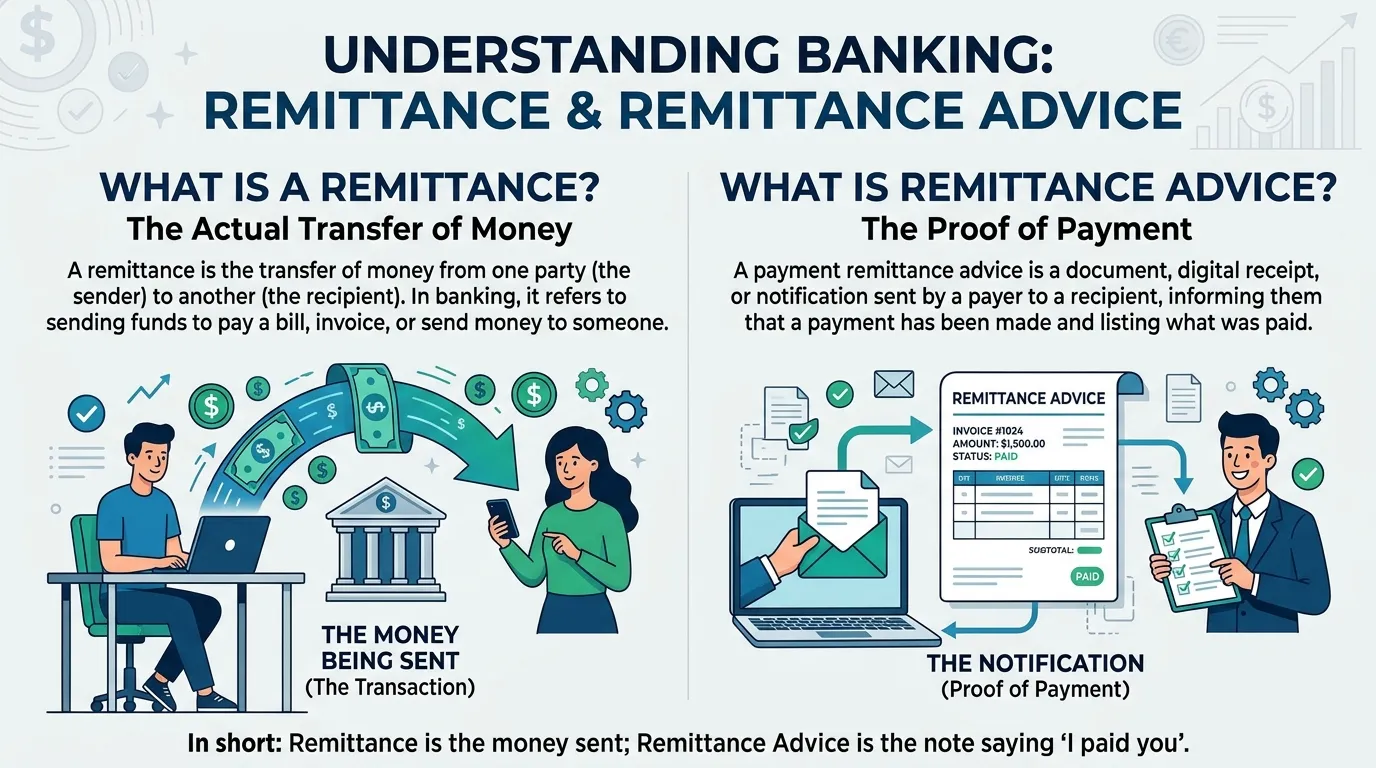
Remittance advice is not necessarily the money itself. It is the accompanying information that helps the recipient identify and allocate the payment.
Payment Remittance vs. Remittance Advice
| Feature | Payment remittance | Remittance advice |
|---|---|---|
| Main meaning | Money sent or the transfer of funds | Information explaining a payment |
| Purpose | Transfers or settles money | Helps identify and reconcile a payment |
| Example | A business pays a supplier $5,000 | The business sends a list of invoices covered by the $5,000 |
| Does it move money? | Yes, when referring to the actual transfer | No, not by itself |
The distinction is particularly important in accounting because receiving payment information does not necessarily mean the funds have arrived.
Payment Remittance vs. Payment vs. Bank Transfer
These terms overlap, but they do not always mean exactly the same thing.
| Term | Meaning | Example |
|---|---|---|
| Payment | Money given to fulfill an obligation or purchase | Paying for groceries |
| Remittance | Money sent or the act of sending money | Sending funds to a supplier |
| Bank transfer | Moving funds between bank accounts | Transferring money to a landlord |
| Money transfer | A broad term for moving money between parties | Sending funds through a transfer service |
| Payment settlement | Completing or finalizing a payment obligation | Settling an outstanding invoice |
A payment is the broadest concept. A remittance emphasizes sending funds, while a bank transfer identifies one possible method of moving them.
The terminology may overlap in actual banking systems. A bank transfer can be a remittance, and a remittance can be made to settle a payment obligation.
What Is an International Payment Remittance?
An international payment remittance is a transfer of funds across national borders. It may involve an individual sending money to family members or a business paying a supplier in another country.
International remittances are commonly processed through banks, money transfer companies, and other authorized providers. The U.S. Consumer Financial Protection Bureau describes remittance transfers in its consumer guidance as electronic money transfers sent through providers to recipients abroad, within the scope of the relevant U.S. rules. Consumer Financial Protection Bureau
Common Reasons for International Remittances
Supporting family members living in another country.
Paying overseas suppliers.
Sending money for education or living expenses.
Transferring personal savings where permitted.
Paying eligible international business obligations.
What to Consider Before Sending Money
Before making an international remittance, check the total cost and the recipient’s details.
Transfer fee: The amount charged by the bank or provider.
Exchange rate: The rate used if the money is converted into another currency.
Delivery time: How long the transfer is expected to take.
Recipient details: Whether the name, account information, or payout details are correct.
Transfer limits: Any restrictions on the amount that can be sent.
Regulatory requirements: Identity verification or supporting documents that may be required.
A provider advertising a low transfer fee may still use an exchange rate that changes the total cost. Comparing the final amount the recipient will receive is often more useful than comparing the fee alone.

Inward Remittance vs. Outward Remittance
Banks and financial institutions often use the terms inward remittance and outward remittance to describe transfers from different perspectives.
Inward Remittance
An inward remittance is money received from another location, often from abroad, into the country or financial system being discussed.
For example, if a person working in Saudi Arabia sends money to their family in Pakistan, the funds may be described as an inward remittance from Pakistan’s perspective.
Outward Remittance
An outward remittance is money sent from the country or financial system being discussed to a recipient elsewhere.
For example, if a business in Pakistan sends a permitted payment to an overseas supplier, the transaction may be described as an outward remittance.
The terms depend on the perspective of the bank or country recording the transaction. They do not, by themselves, explain the purpose of the transfer or confirm that it has been completed.
Common Synonyms and Related Terms
The best alternative to payment remittance depends on the situation.
| Term | How it differs |
|---|---|
| Money transfer | A broad, everyday expression for moving funds |
| Funds transfer | A more formal term for moving money between parties or accounts |
| Money remittance | A service or process for transferring money to a recipient |
| Payment transfer | A transfer made as part of a payment |
| Wire transfer | A particular type of electronic transfer, depending on local usage |
| Invoice payment | Money sent to settle an invoice |
| Family remittance | Money sent to relatives, often across borders |
| Payment settlement | Completion of a payment obligation |
These terms are related rather than perfectly interchangeable. For instance, invoice payment identifies the purpose of a payment, while wire transfer identifies a transfer method.