

Bullet List Meaning in English
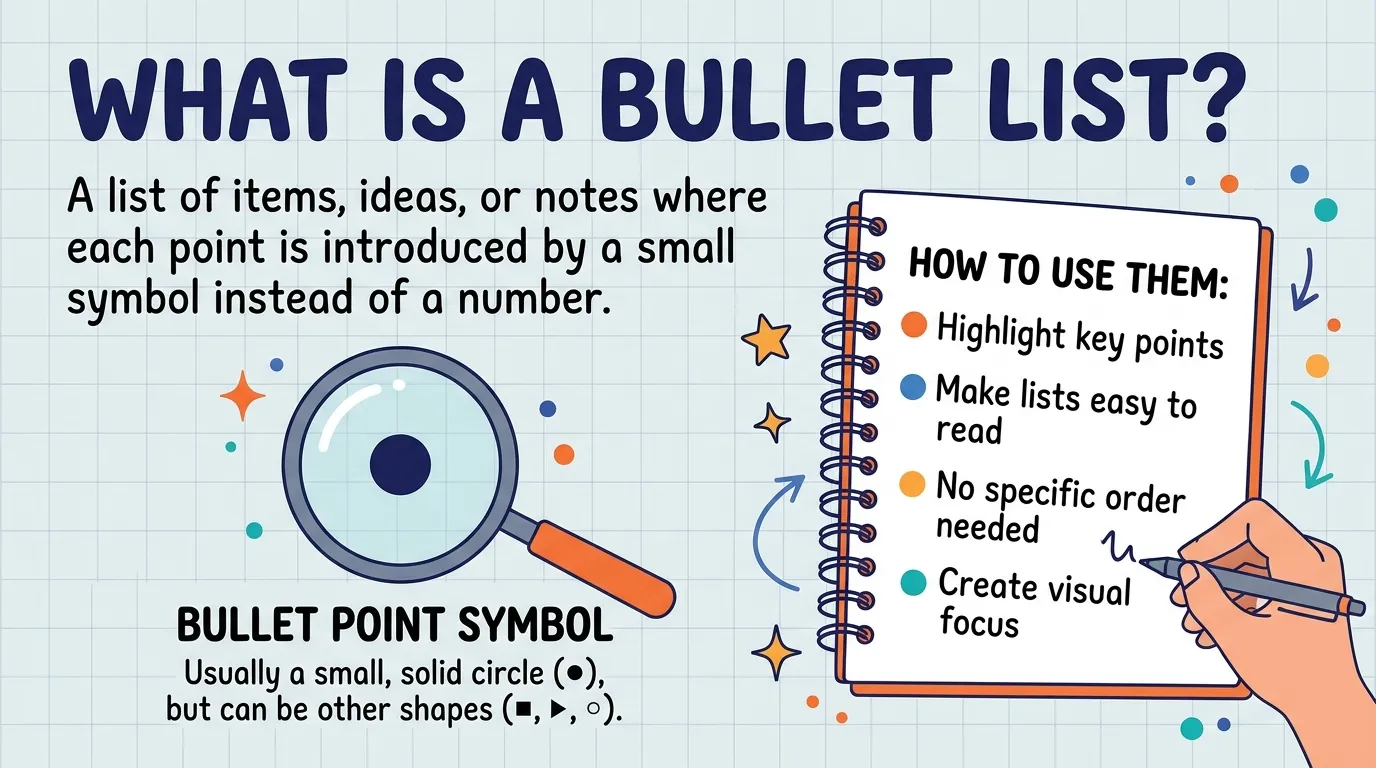
A bullet list is a way of organizing information using small symbols, such as dots, circles, squares, or dashes, before each item. It makes written information easier to read, understand, and remember.
In simple English, a bullet list is a list of items where each point starts with a symbol instead of a number.
Example of a bullet list:
Apple
Banana
Orange
Mango
Grapes
Bullet lists are commonly used in:
School notes and assignments.
Blog posts and articles.
Business reports.
Presentations and slides.
Shopping lists.
Instructions and guides.
A bullet list is especially useful when the items do not need to follow a particular order.
Bullet Point Symbol
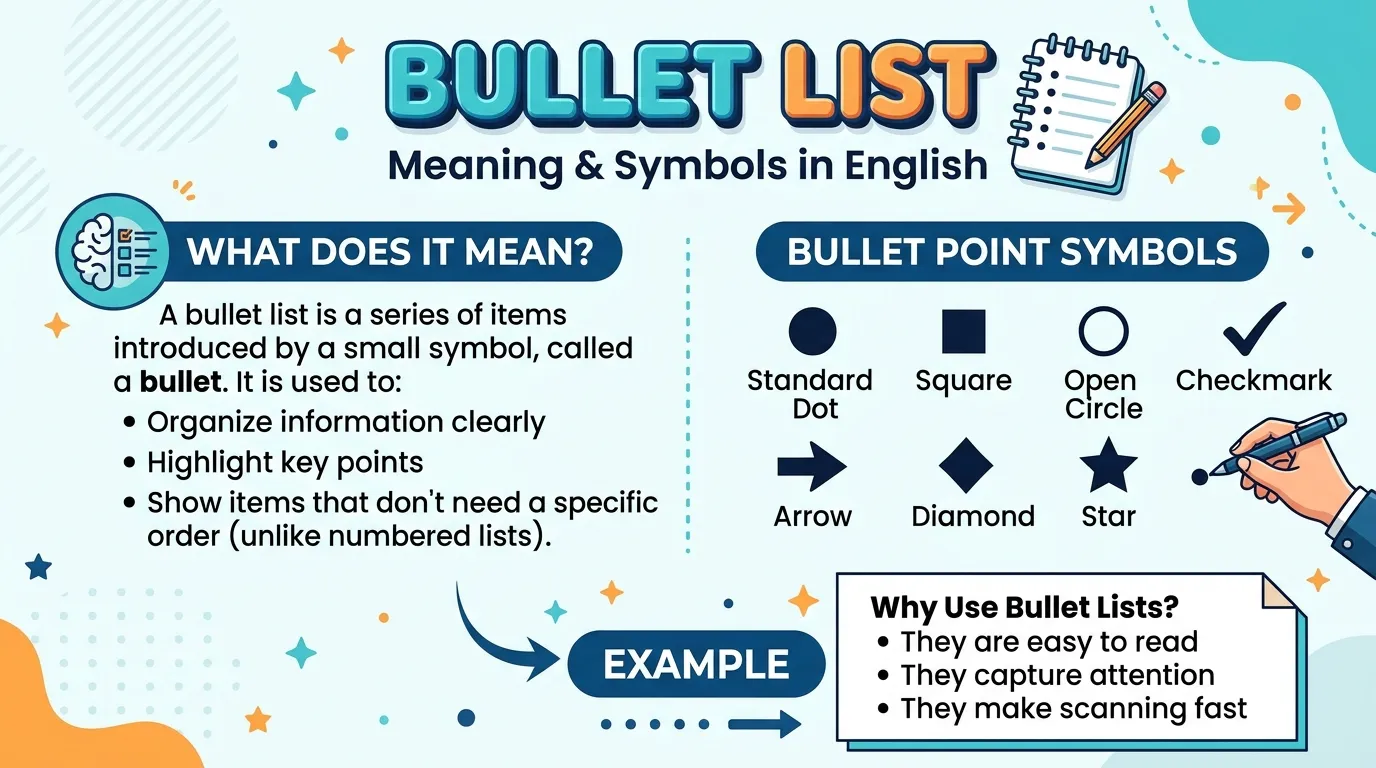
A bullet point symbol is a small mark placed before an item in a list. It helps separate different points and makes information easier to scan.
The most common bullet point symbol is the solid round dot:
•
Other popular bullet symbols include:
Symbol | Name |
|---|---|
• | Solid circle |
◦ | Open circle |
▪ | Small square |
■ | Solid square |
◆ | Diamond |
► | Right-pointing triangle |
○ | Open circle |
✓ | Check mark |
➤ | Arrow bullet |
★ | Star |
Example:
First point
Second point
Third point
Bullet symbols can be changed depending on the document’s style. They are commonly available in Microsoft Word, Google Docs, PowerPoint, and other writing applications.
Bullet Points Meaning and Examples
Bullet points are individual items in a list that begin with a small symbol. They are used to highlight important information without writing long paragraphs.
For example, if someone describes the benefits of exercise using bullet points, each benefit becomes a separate item.
Common examples of bullet points:
1. Benefits of Exercise
Improves physical fitness.
Supports heart health.
Helps manage stress.
Builds stronger muscles.
2. Shopping List
Milk
Bread
Eggs
Rice
Apples
3. School Subjects
English
Mathematics
Science
History
Geography
4. Job Responsibilities
Answer customer questions.
Prepare daily reports.
Manage office records.
Attend team meetings.
5. Travel Essentials
Passport
Clothes
Phone charger
Travel documents
Toiletries
These examples show how bullet points divide information into small, clear sections.
Bullet Point Copy and Paste
If you need bullet symbols for a document, social media post, email, or presentation, you can copy and paste the symbols below.
Basic bullet symbols:
•
Solid bullet
Copy◦
Open bullet
Copy▪
Small square
Copy■
Solid square
Copy◆
Diamond
Copy➤
Arrow bullet
Copy✓
Check mark
Copy★
Star bullet
CopyCopy a complete bullet list:
• First item
• Second item
• Third item
• Fourth item
Bullet List Example
A bullet list example shows how information can be arranged using symbols instead of numbers. It is useful when you want to present several related ideas clearly.
Example 1: Healthy Foods
Fresh fruits
Green vegetables
Whole grains
Nuts and seeds
Lean protein
Example 2: Daily Routine
Wake up early.
Drink a glass of water.
Eat a healthy breakfast.
Complete daily tasks.
Exercise regularly.
Get enough sleep.
Example 3: Advantages of Reading
Improves vocabulary.
Builds knowledge.
Supports better writing.
Improves concentration.
Encourages creativity.
Example 4: Office Supplies
Pens
Pencils
Notebooks
Paper clips
Folders
Bullet list vs. numbered list
Bullet List | Numbered List |
|---|---|
Uses symbols | Uses numbers |
Order is usually flexible | Order is usually important |
Shows related items | Shows steps or sequence |
Example: • Apple | Example: 1. Apple |
Use bullet lists for unordered information and numbered lists when the sequence matters.
Bullets Meaning
The word bullets has two common meanings in English. Its meaning depends on the context in which it is used.
1. Bullets in Writing
In writing, bullets are small symbols used to introduce items in a list. They help organize information and make important points easier to notice.
Example:
Books
Pens
Notebooks
2. Bullets as Ammunition
In weapons-related language, bullets are small metal projectiles fired from guns. They are designed to travel at high speed when a firearm is discharged.
Example sentences:
The report uses bullets to organize its main points.
The writer added bullets to make the instructions easier to read.
The police found bullets at the scene.
The soldier carried ammunition for his firearm.
Therefore, bullets can refer to list symbols or firearm ammunition, depending on the sentence.
Bullet Points Examples
Bullet points can be used in almost any type of writing where information needs to be organized. They are especially helpful for explaining ideas, listing features, and summarizing important details.
Here are more practical examples:
1. Product Features
Lightweight design.
Easy to use.
Long battery life.
Modern appearance.
2. Meeting Agenda
Welcome and introductions.
Review of previous work.
Discussion of new projects.
Planning future activities.
3. Classroom Rules
Listen to your teacher.
Respect your classmates.
Complete your homework.
Keep the classroom clean.
4. Website Content
Easy navigation.
Helpful information.
Mobile-friendly design.
Clear headings.
Updated articles.
5. Personal Goals
Learn a new skill.
Read more books.
Exercise regularly.
Save money.
Spend quality time with family.
6. Advantages of Technology
Faster communication.
Easy access to information.
Improved productivity.
Online learning opportunities.
Good bullet points are short, clear, and focused on one main idea. Keeping the same grammatical style throughout a list also makes it easier to read.
Bullet List Meaning Gun
The phrase bullet list meaning gun can refer to confusion between a bullet list and a bullet used in a firearm. Although both use the word bullet, they have different meanings.
Bullet in a list: A small typographical symbol, such as •, placed before an item to organize written information.
Bullet in a gun: A metal projectile fired from a firearm. It is a physical object associated with ammunition.
Difference between the two meanings:
Bullet List | Gun Bullet |
|---|---|
Used in writing and documents | Used as firearm ammunition |
Usually shown as a small dot (•) | Usually a small metal projectile |
Organizes information | Designed to be fired from a gun |
Example: • Important points | Example: A bullet was found at the scene |
Example sentences:
Please use bullet points to organize your school assignment.
The document contains a bullet list of important instructions.
A bullet is a projectile fired from a gun.
The word bullet has different meanings in writing and weapons-related contexts.
In short, a bullet list is a writing format, while a gun bullet is a physical projectile. They share a word but describe two completely different things.
What Does Bullet List Mean?
A bullet list is a group of related items displayed on separate lines, with each item preceded by a bullet symbol or another visual marker. It is also called a bulleted list or bullet-point list. In digital writing, a bullet list is commonly known as an unordered list because its items do not normally need to appear in a particular order.
According to the Yale University Library’s web design guidelines, bullet lists are a form of unordered list, whereas numbered lists are ordered lists. The Australian Government’s Style Manual similarly recommends bullet lists when the order of items is not important.
Quick Definition Box
Term: Bullet list
Part of speech: Noun
Primary meaning: A list of items, each marked with a bullet or similar symbol.
Related term: Bulleted list
Pronunciation: Approximately BUL-it list
Main purpose: To organize information and make it easier to read.
Common symbols: •, ◦, ▪, –, or other suitable markers.
Typical contexts: Articles, reports, presentations, emails, educational materials, and websites.
Example:
A student preparing for an exam might make this bullet list:
Review class notes
Read the assigned chapter
Complete practice questions
Prepare a list of questions for the teacher
Each item is separated visually, allowing the student to scan the tasks quickly. The list does not necessarily indicate which task must come first.
What Is a Bullet Point?
A bullet point can refer to the symbol that introduces a list item or, in everyday usage, to the individual item itself.
For example, in the list below, the dot is the bullet symbol, while the words after it form the list item:
Fresh vegetables
Whole grains
Lean protein
The Oxford Learner’s Dictionaries defines a bullet point as an item in a list marked by a symbol such as a circle, square, or diamond. The term is therefore closely connected to the broader concept of a bullet list.

The Deeper Meaning and Nuance of Bullet List
The meaning of bullet list is primarily practical rather than emotional or symbolic. It describes a method of presenting information. However, its purpose and effect can change depending on the context.
1. Bullet Lists as an Organization Tool
Bullet lists divide a larger topic into smaller pieces of information. Instead of presenting several details in one long sentence, a writer gives each detail its own line.
For example, a paragraph describing a product’s features might be difficult to scan. A bullet list can present those features separately:
Lightweight construction
Long battery life
Fast charging
Compact design
This format makes the individual features easier to locate.
2. Bullet Lists in Writing and Editing
Writers use bullet lists to highlight essential information, summarize an explanation, or present several examples. In an article, a list can help readers identify the main points without reading every paragraph closely.
However, bullet lists should support the explanation rather than replace it. Complex ideas may still require paragraphs that explain relationships, evidence, and reasoning.
3. Bullet Lists in Business Communication
In professional settings, bullet lists are common in meeting notes, project proposals, reports, job descriptions, and emails.
For example, a meeting summary might include:
Approve the proposed budget
Confirm the project deadline
Assign responsibilities to team members
Schedule the next meeting
This format helps colleagues identify decisions and action items quickly.
4. Bullet Lists in Digital Content and SEO
Website writers often use bullet lists to organize product benefits, summarize important points, explain requirements, and present frequently asked questions.
Well-structured lists can improve readability and help visitors find relevant information. They can also make important details easier for search systems to identify, although using bullets alone does not guarantee better search rankings.
For accessibility and accurate document structure, website developers should use genuine list markup instead of simply inserting bullet characters to imitate a list. Yale’s web design guidance explains the distinction between ordered, unordered, and definition lists.
5. Bullet Lists and Visual Hierarchy
A bullet list creates visual separation between items. This helps readers distinguish individual points from the surrounding explanation.
The bullet symbol is not necessarily a sign that an item is more important than the others. Usually, the list presents items at the same level. If priority matters, the writer can arrange the items deliberately or use a numbered list when an explicit ranking or sequence is needed.
How to Use Bullet List in a Sentence
The phrase bullet list commonly appears in instructions, writing advice, educational discussions, and workplace communication.
Here are natural examples across different contexts:
[Everyday conversation] “Can you put the shopping items in a bullet list?”
[Academic writing] “The teacher asked us to summarize the main arguments in a bullet list.”
[Business communication] “Please include a bullet list of the project’s main objectives.”
[Email writing] “I used a bullet list to make the important details easier to understand.”
[Content writing] “The article includes a bullet list of practical tips for beginners.”
[Web development] “The developer used an unordered list to display the product features.”
[Presentation design] “Keep each bullet list short so the audience can read it quickly.”
[Editing] “The editor changed the long paragraph into a bullet list.”
[Education] “Students created a bullet list of the causes of climate change.”
[Instructions] “Follow the bullet list below to check the required documents.”
These examples show that the phrase can be used as the subject or object of a sentence. It can also follow verbs such as create, write, organize, include, format, and convert.
Different Ways to Say Bullet List: Synonyms and Alternatives
Several expressions have a similar meaning, but their suitability depends on the context.
Exact or Close Synonyms
Bulleted list: The most common direct alternative to bullet list.
Bullet-point list: A slightly longer expression emphasizing the bullet points.
List with bullets: A plain-English description of the format.
Unordered list: A technical term frequently used in web development and digital publishing.
Formal or Professional Alternatives
Itemized list: A list that presents individual items separately; it may or may not use bullet symbols.
List of key points: A description suitable for summaries and reports.
Summary list: A list that condenses the main information.
List of requirements: A format for presenting conditions, expectations, or necessary items.
Casual Alternatives
List of points: A simple phrase for a collection of separate ideas.
Point-form list: An expression commonly used when information is written as short points rather than paragraphs.
List of items: A broad term that can refer to many kinds of lists.
Quick list: An informal description of a short, easy-to-scan list.
Related but Different Terms
Numbered list: Uses numbers or other ordered markers, usually when sequence matters.
Checklist: Uses checkboxes or other markers to track completion.
Outline: Organizes topics and subtopics into a hierarchy.
Table: Arranges information in rows and columns for comparison.
Paragraph: Presents connected sentences as continuous prose rather than separate list items.
Antonyms and Contrasting Formats
Bullet list has no exact antonym, but several formats contrast with it:
Continuous prose: Information presented in connected paragraphs.
Numbered sequence: Items explicitly ordered by number.
Narrative text: Information presented as a connected account or story.
Unstructured text: Text without a clear organizational format.
These are contrasting presentation methods rather than strict dictionary antonyms.
Bullet List in Context: Common Phrases and Collocations
The following phrases appear frequently in writing, editing, and digital communication.
| Phrase | Meaning |
|---|---|
| Create a bullet list | Make a list using bullet symbols. |
| Write a bullet list | Present related information as separate bulleted items. |
| Bullet list of features | A list highlighting a product’s or service’s features. |
| Bullet list of requirements | A list of conditions or items that must be met. |
| Bullet list format | A presentation style that separates items with bullets. |
| Convert a paragraph into a bullet list | Break continuous prose into individual list items. |
| Nested bullet list | A list containing subordinate bullet items beneath a main item. |
A nested bullet list is useful when one point contains related subpoints. For example:
Fruits
Apples
Bananas
Oranges
Vegetables
Carrots
Spinach
Broccoli
The indented items belong to a broader category. This hierarchy is useful for outlines, study notes, and technical documentation.
When to Use a Bullet List vs. Its Alternatives
Choosing the right format depends on whether the information is sequential, hierarchical, or comparative.
| Format | Best use | Example |
|---|---|---|
| Bullet list | Related points with no required sequence | Product benefits |
| Numbered list | Steps that must be followed in order | Instructions for installing software |
| Checklist | Tasks that need to be completed or verified | Moving-house preparation |
| Table | Comparing several options across categories | Comparing product prices and features |
| Paragraph | Explaining connected ideas or complex reasoning | An explanation of how a system works |
| Outline | Showing main topics and subordinate topics | A research paper plan |
Bullet List vs. Numbered List
A bullet list is generally appropriate when the items can be read in any order. A numbered list is better when the order affects the meaning.
For example:
Bullet list — ingredients
Flour
Milk
Eggs
Sugar
Numbered list — recipe steps
Mix the flour and sugar.
Add the milk and eggs.
Stir until smooth.
Cook the mixture.
The ingredients do not require a specific reading order, but the recipe steps do. The Australian Government’s Style Manual recommends using ordered lists when sequence matters and unordered lists when it does not.
Bullet List vs. Checklist
A bullet list communicates information, while a checklist is designed to help people track tasks or verify requirements. A checklist often uses checkboxes, though other markers may be used.
For example, a packing checklist might include:
Pack clothes
Charge the phone
Confirm the reservation
Bring identification
The empty boxes make it possible to mark each task as complete.
Bullet List vs. Paragraph
Use a bullet list when readers need to identify individual details quickly. Use a paragraph when the relationship between ideas requires explanation.
For example, a list can identify three causes of a problem, but a paragraph may be needed to explain how those causes interact. In many documents, the clearest solution is to introduce the topic in a paragraph, list the key points, and then explain their significance.
Related Concepts and Semantic Network
Understanding related terms helps writers use lists accurately.
Bullet point: The marker or individual item in a bulleted list.
Unordered list: A list whose items do not have a required sequence.
Numbered list: A list in which numbers or other ordered markers identify the items.
Nested list: A list with subordinate items arranged beneath broader items.
Formatting: The process of arranging text and other content for clarity and presentation.
Suggested internal links for a meaning website include [link: bullet point meaning], [link: numbered list meaning], and [link: formatting meaning].