

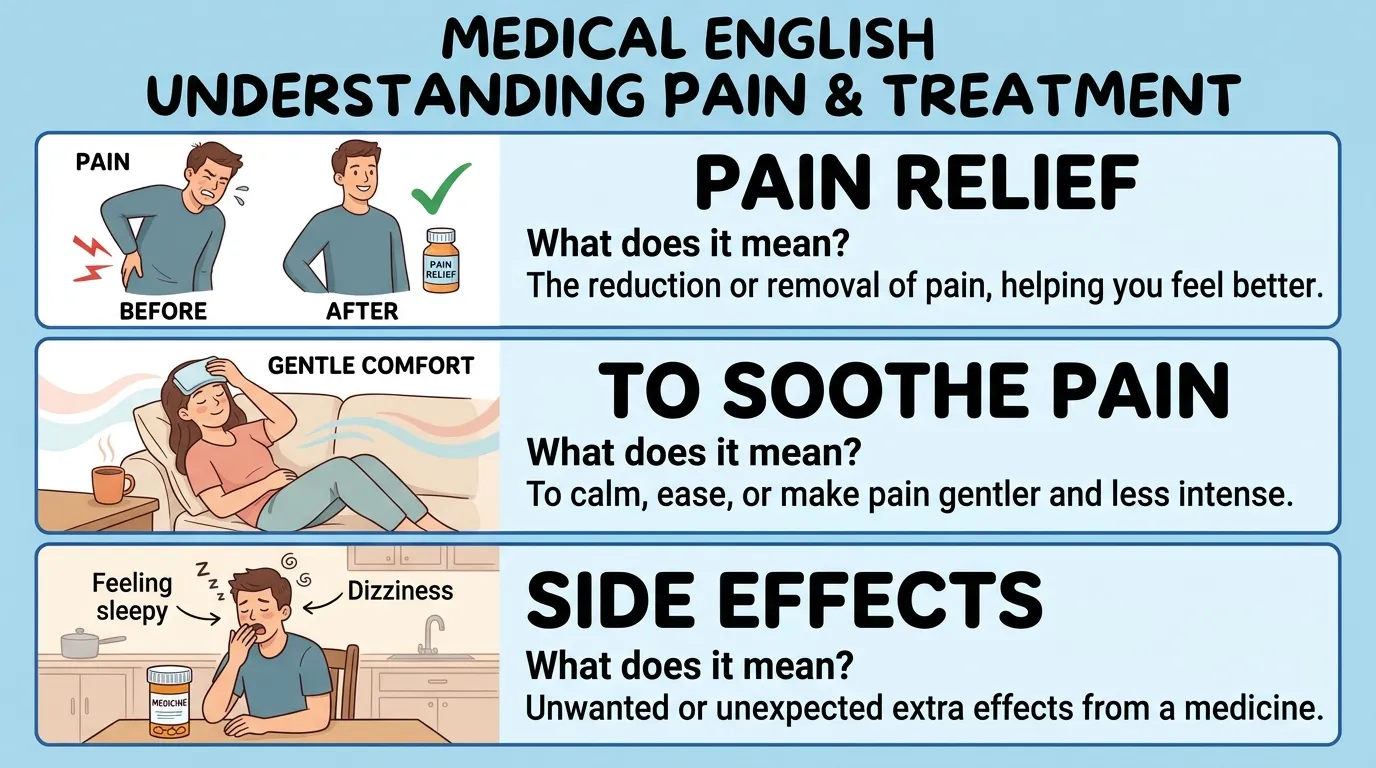
Pain Relief Meaning in English
Pain relief means reducing or stopping physical pain. It refers to the comfort a person feels when pain becomes less severe or disappears. Pain relief can come from medicines, medical treatments, rest, or other methods.
In simple English, pain relief means making pain better or helping someone feel less pain.
Examples of pain relief:
Taking medicine to reduce a headache.
Applying a cold pack to a swollen area.
Getting treatment for back pain.
Resting after a muscle injury.
Receiving pain-relieving treatment after surgery.
Example sentences:
This medicine provides quick pain relief.
The patient asked the doctor for pain relief.
A warm bath gave me some relief from muscle pain.
The treatment helped reduce her toothache.
Common synonyms:
Pain reduction
Pain management
Pain alleviation
Pain control
Relief from pain
To Soothe Pain Meaning
To soothe pain means to make pain less severe or provide comfort to someone who is hurting. The word soothe can also mean to calm someone who feels upset, worried, or uncomfortable.
In simple words, to soothe pain means to ease discomfort and make someone feel better.
Examples of ways to soothe pain:
A warm compress may help soothe sore muscles.
A soothing cream may reduce skin irritation.
Rest can help soothe discomfort after physical activity.
A doctor may recommend suitable medicine to soothe pain.
Gentle massage may help ease certain types of muscle tension.
Example sentences:
She used a warm towel to soothe her aching shoulders.
The cream helped soothe the pain caused by dry skin.
He took a rest to soothe his tired muscles.
The nurse tried to soothe the patient’s pain.
Synonyms for soothe pain:
Ease pain
Relieve pain
Reduce discomfort
Calm soreness
Alleviate pain
Comfort
Side Effects Meaning
Side effects are unwanted or additional effects that happen when a person uses a medicine or receives a medical treatment. They are different from the main effect that the medicine or treatment is intended to produce.
In simple English, side effects are extra changes in the body or mind that may happen after taking medicine or receiving treatment. Some are mild, while others can be serious.
Common examples of side effects:
Side Effect | Simple Meaning |
|---|---|
Nausea | Feeling like you may vomit |
Dizziness | Feeling lightheaded or unsteady |
Headache | Pain in the head |
Drowsiness | Feeling sleepy |
Dry mouth | Having less moisture in the mouth |
Constipation | Difficulty passing stool |
Skin rash | Redness, bumps, or irritation on the skin |
Stomach pain | Discomfort or pain in the stomach |
Not everyone experiences side effects, and they can vary depending on the medicine, dose, and person’s health.
Example sentences:
This medicine may cause mild side effects.
The doctor explained the possible side effects before treatment.
Some people experience dizziness as a side effect.
Always read the medicine label to understand its possible side effects.
Common synonyms and related terms:
Unwanted effects
Adverse effects
Unintended reactions
Medication reactions
Important: A side effect is not always harmless. Seek medical advice if you experience an unusual or worrying reaction after taking medicine. Get emergency help for serious symptoms such as difficulty breathing or swelling of the face or throat.
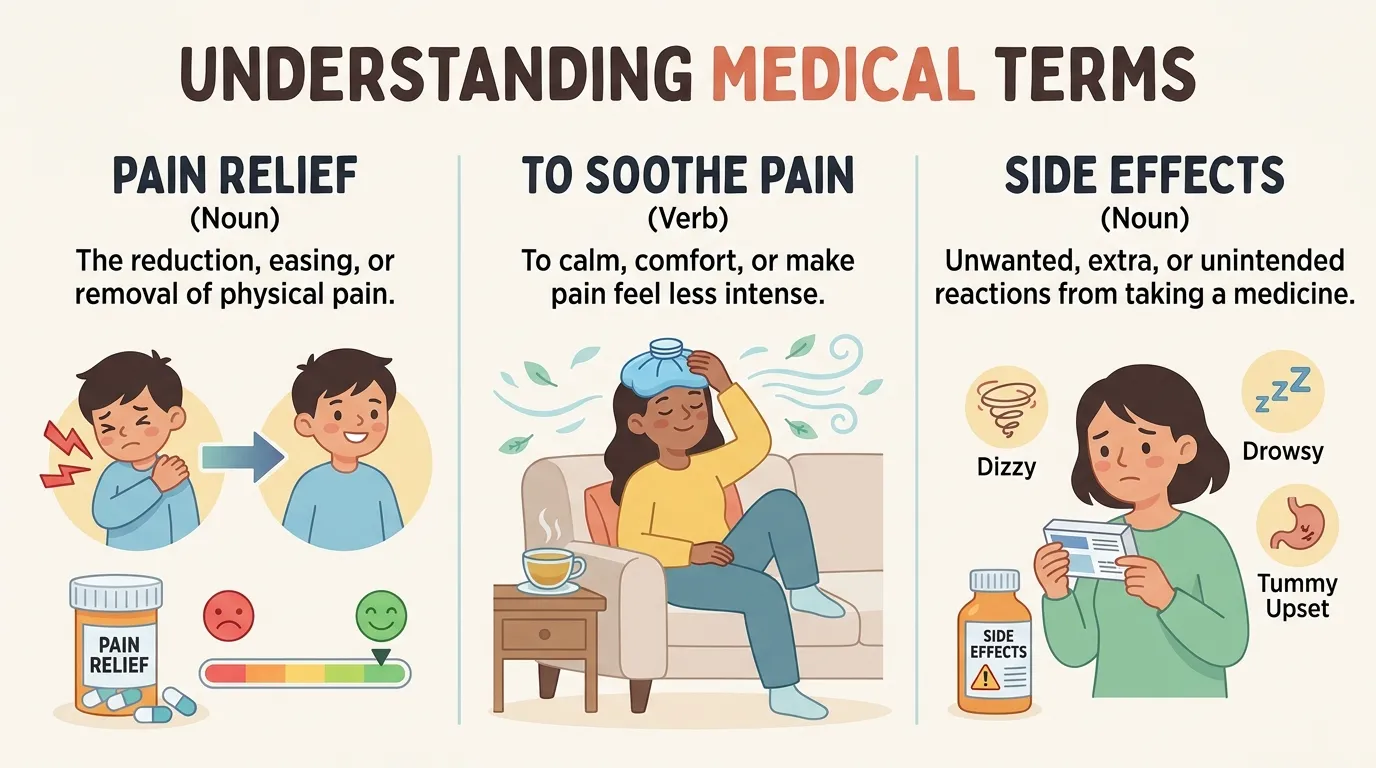
What Does Pain Relief Mean?
Pain relief means reducing or easing pain or physical discomfort. It does not always mean that the pain disappears completely; sometimes, it simply becomes less intense or easier to manage.
Quick definition:
Simple meaning: Lessening or easing pain.
Part of speech: Noun phrase.
Common context: Healthcare, medicine, injuries, and physical discomfort.
Example: “This medicine provides pain relief for a headache.”
Deeper Meaning and Nuance of Pain Relief
Pain relief describes an improvement in how a person feels when pain becomes weaker or more manageable. It can refer to temporary relief, such as feeling better after resting, or longer-lasting relief following appropriate treatment.
The phrase is often used when discussing medicines, physical therapy, relaxation techniques, and other approaches intended to reduce discomfort. However, pain relief is different from curing the underlying cause of pain. For example, a treatment may ease toothache temporarily without fixing the dental problem.
The term can also describe the result of an action rather than a specific treatment. Someone might experience pain relief after applying a cold pack to a minor injury or changing their position to reduce pressure on a sore area.
The exact meaning depends on the context. In medical discussions, pain relief may refer to the effectiveness of a treatment, while in everyday conversation, it usually means simply feeling less pain.

Pain Relief in Example Sentences
The doctor recommended a treatment to provide pain relief.
She took medicine for pain relief after consulting her healthcare professional.
A warm compress may provide pain relief for some types of muscle discomfort.
He experienced pain relief after resting his injured foot.
The patient asked the nurse about options for pain relief.
Gentle stretching helped provide some relief from back pain.
The cream is designed to offer temporary pain relief.
Finding effective pain relief made it easier for her to sleep.
The treatment reduced his discomfort but did not cure the underlying condition.
Different people may respond differently to pain relief methods.
Synonyms and Antonyms of Pain Relief
Synonyms
The most suitable synonym depends on the sentence and context.
Pain alleviation: The process of making pain less severe.
Pain reduction: A decrease in the intensity of pain.
Pain management: Strategies used to control or cope with pain.
Relief from pain: A general expression meaning less pain.
Comfort: A state of reduced discomfort or distress.
Ease of discomfort: A reduction in unpleasant physical sensations.
Symptom relief: A reduction in symptoms, which may include pain.
Antonyms
Pain relief does not have one exact opposite in every context, but these terms express contrasting ideas:
Pain: An unpleasant physical sensation.
Discomfort: A feeling of physical unease.
Aggravation of pain: An increase in pain severity.
Worsening pain: Pain that becomes more intense.
Pain intensification: An increase in the strength of pain.
Common Collocations With Pain Relief
Collocations are words that commonly appear together in natural English.
Collocation | Meaning |
|---|---|
Pain relief medication | Medicine used to reduce pain |
Pain relief treatment | A treatment intended to ease pain |
Immediate pain relief | Pain relief that occurs quickly |
Temporary pain relief | Relief that lasts for a limited time |
Effective pain relief | Relief that noticeably reduces pain |
Natural pain relief | Approaches intended to ease pain without conventional medicines |
Long-term pain relief | Relief intended to last over an extended period |
Seek pain relief | Look for ways to reduce pain |
Provide pain relief | Help reduce someone’s pain |
Pain relief options | Different available methods for easing pain |

Pain Relief vs. Related Concepts
Term | Meaning | Key Difference |
|---|---|---|
Pain relief | Reducing or easing pain | Focuses on making pain less severe |
Pain management | Controlling or coping with pain | May involve several strategies over time |
Pain treatment | Care intended to address pain | May target pain, its cause, or both |
Healing | Recovery from injury or illness | Refers to the recovery process, not just reduced pain |
Cure | Resolving a disease or condition | Usually aims to eliminate the underlying problem |
Symptom relief | Reducing one or more symptoms | Can include pain as well as other symptoms |