

What Does Tenebrae Service Mean?
A Tenebrae service is a Christian worship gathering that commemorates the suffering, crucifixion, and death of Jesus Christ through Scripture readings, prayers, hymns, silence, and the gradual extinguishing of candles. Traditionally associated with the final days of Holy Week, it uses the symbolism of darkness to invite reflection on Christ’s Passion, human grief, and the apparent triumph of death before the celebration of Easter.
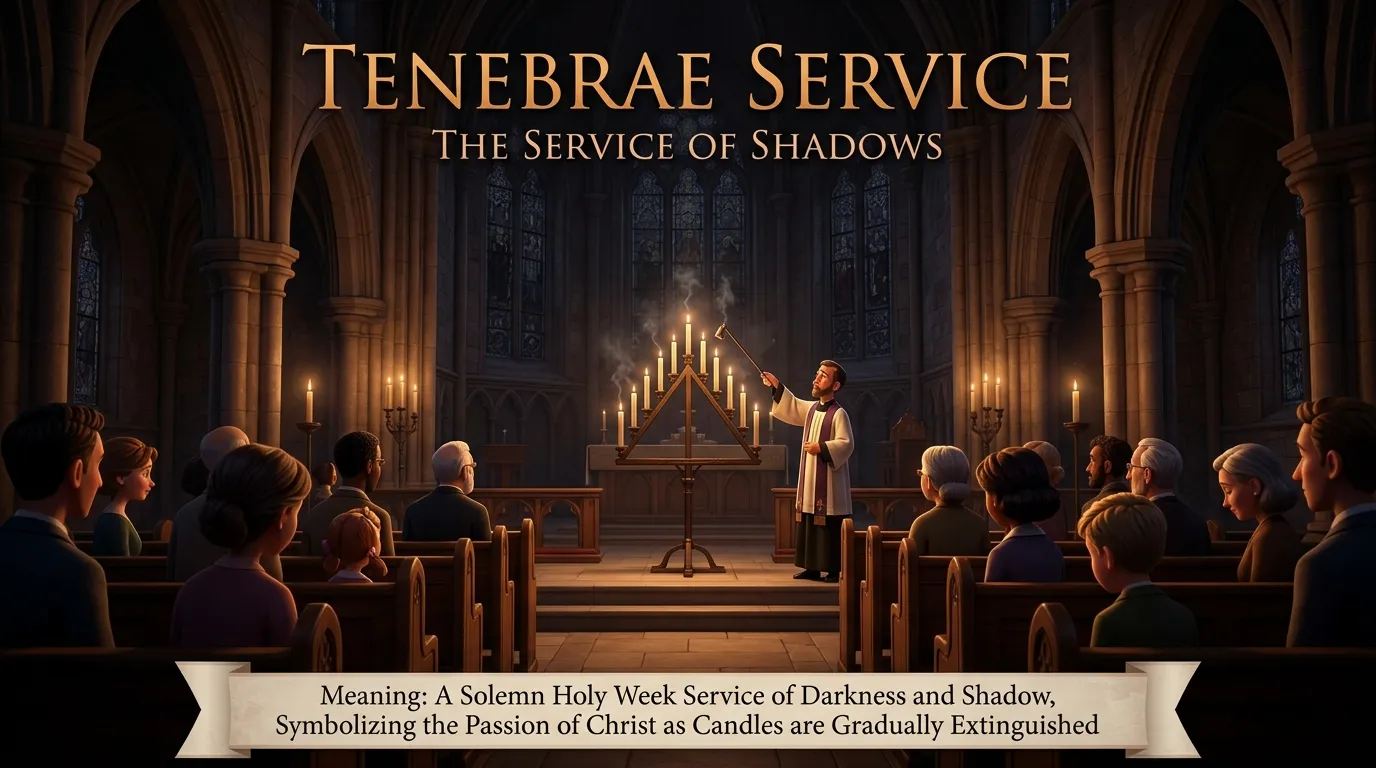
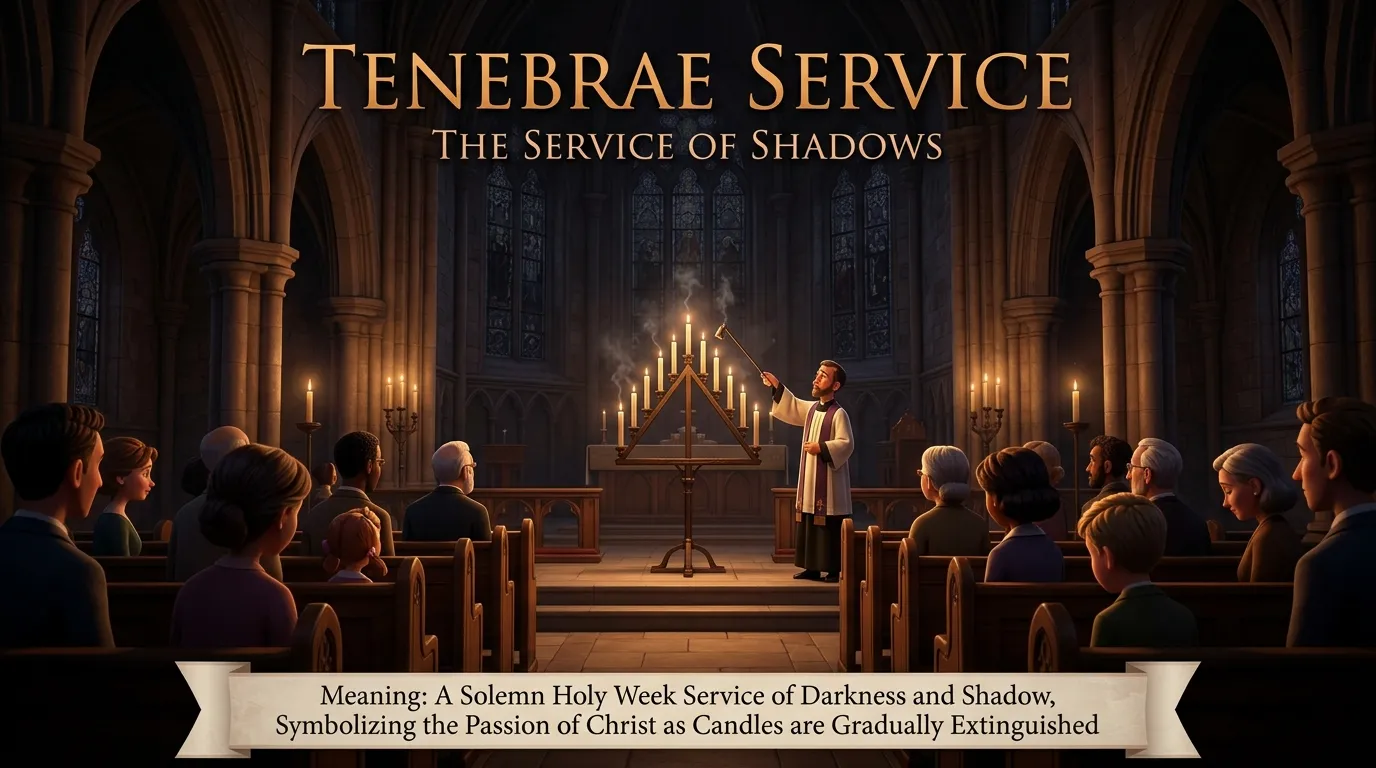
The word Tenebrae is Latin for “darkness” or “shadows.” The name reflects the service’s most recognizable feature: the church grows progressively darker as candles are extinguished throughout the liturgy.
Quick Definition Box
Part of speech
Noun phrase: Tenebrae service
Primary definition
A solemn Christian service during Holy Week that remembers Jesus Christ’s suffering and death, often through readings and the progressive extinguishing of candles.
Secondary meanings and associations
A traditional Holy Week office of prayer; a candlelit liturgy of lament; a devotional observance centered on darkness, silence, repentance, and the hope of resurrection.
Pronunciation
Tenebrae: approximately TEN-uh-bray in English. Pronunciation varies by language and church tradition.
Typical observance
Wednesday of Holy Week, Maundy Thursday, or Good Friday, depending on the church and the form of the service.
Origin and Etymology of Tenebrae
Tenebrae comes from Latin, where the word means darkness, shadows, or gloom. It belongs to a broader semantic family involving night, obscurity, mourning, and the absence of light.
Historically, Tenebrae referred to a special arrangement of the Church’s daily prayers known as Matins and Lauds, traditionally observed during the last three days of Holy Week. These prayers included psalms, readings, and responsories—musical or spoken responses connected with Scripture. The services became closely associated with darkness as lights and candles were gradually extinguished.
The historic observance developed over centuries, with medieval Christian practice helping shape the form familiar today. Modern churches frequently use adapted versions rather than reproducing the complete traditional office.
The word’s historical and religious meanings are closely connected: darkness is both a physical feature of the ceremony and a metaphor for sorrow, abandonment, and death.
The Deeper Meaning and Nuance of Tenebrae Service
Understanding the Tenebrae service meaning requires looking beyond its literal translation. The service uses a physical experience—watching a room grow darker—to communicate theological ideas that words alone may not fully express.
1. The symbolism of darkness
Darkness represents the grief surrounding Jesus’ arrest, suffering, crucifixion, and burial. It can also evoke the spiritual confusion and fear experienced by Jesus’ disciples as the events of the Passion unfolded.
Christian worshippers may interpret this darkness through biblical passages such as Matthew 27:45, which describes darkness coming over the land during Jesus’ crucifixion, and John 1:5, which presents light shining in darkness.
The symbolism is not simply that darkness is evil. In Tenebrae, darkness creates space to acknowledge suffering honestly before celebrating the hope of resurrection.
3. The emotional and spiritual significance
Tenebrae has a deliberately somber atmosphere. Its silence, lamentations, subdued music, and dimming lights encourage contemplation rather than celebration.
The service may help worshippers reflect on:
Suffering: The physical and emotional pain associated with Christ’s Passion.
Abandonment: The loneliness and uncertainty experienced during the final hours of Jesus’ life.
Repentance: An examination of personal actions, moral responsibility, and the need for forgiveness.
Mourning: The grief associated with death, loss, and broken relationships.
Hope: The Christian belief that death and darkness do not have the final word.
For many participants, the service provides a way to acknowledge grief without rushing toward reassurance. Its emotional force comes partly from allowing sorrow to remain unresolved until the Easter celebration.
4. How the meaning changes by context
In a formal liturgical setting, Tenebrae refers to a particular Christian observance with historical prayers, psalms, readings, and ceremonial actions.
In a general conversation, someone might describe a Tenebrae service as a “candle-extinguishing service” or a “Good Friday meditation.” These phrases explain aspects of the event but do not fully capture its historical identity.
In a literary or symbolic context, tenebrae can evoke shadows, spiritual darkness, mourning, or a period of uncertainty. However, the standalone Latin word should not automatically be treated as the name of a church service in every context.
Regional and denominational practices also differ. Episcopal churches may observe Tenebrae on Wednesday of Holy Week, while some Protestant congregations hold an adapted service on Maundy Thursday or Good Friday.
5. A real-world analogy
Imagine a room illuminated by fifteen candles. After each passage describing the suffering of Jesus, one candle is extinguished. The room becomes darker, the music quieter, and the remaining light more noticeable.
This gradual change resembles the experience of moving through grief: familiar sources of comfort seem to disappear, and silence takes the place of certainty. The ceremony does not claim that darkness is permanent; instead, it places the congregation in the emotional landscape of the Passion before Easter announces the Christian hope of resurrection.
That is the deeper purpose of Tenebrae: to make the meaning of Christ’s suffering tangible through light, darkness, sound, and silence.
How to Use Tenebrae Service in a Sentence
The phrase Tenebrae service is most often used in Christian worship announcements, church calendars, religious education, and discussions of Holy Week. The following examples show how it works in different contexts.
[Formal] The parish will hold a Tenebrae service on Wednesday evening to commemorate the final days of Christ’s earthly ministry.
[Academic] The Tenebrae service illustrates how Christian liturgy uses symbolic actions to communicate theological meaning.
[Casual] We’re attending a Tenebrae service this week because we want to reflect on the meaning of Good Friday.
[Church announcement] All members of the congregation are invited to the annual Tenebrae service, followed by a period of silent prayer.
[Historical] The traditional Tenebrae service developed from the Church’s Holy Week offices of Matins and Lauds.
[Professional] The worship committee has included a Tenebrae service in the church’s Holy Week program.
[Literary] The final candle disappeared during the Tenebrae service, leaving the sanctuary wrapped in solemn darkness.
[Theological] Through Scripture readings and extinguished candles, the Tenebrae service invites Christians to contemplate Christ’s Passion.
[Descriptive] The choir’s solemn chants gave the Tenebrae service a deeply contemplative atmosphere.
[Conversational] I’d never experienced a Tenebrae service before, and the gradual darkness made the story of the crucifixion feel especially immediate.
These examples demonstrate common collocations such as attend a Tenebrae service, traditional Tenebrae service, Holy Week Tenebrae service, and Tenebrae service of prayer.
Different Ways to Say Tenebrae Service (Synonyms & Alternatives)
There is no perfect synonym for Tenebrae service because the phrase names a particular liturgical tradition. Alternatives can describe its purpose, setting, or ceremonial features, but they may refer to different kinds of worship.
Exact or close alternatives
Tenebrae liturgy: The closest formal alternative, emphasizing the service’s structured prayers, readings, and ceremonial elements.
Office of Tenebrae: The traditional liturgical name associated with the historic Holy Week offices of Matins and Lauds.
Holy Week Tenebrae: A descriptive variant that emphasizes the service’s place within the Christian calendar.
Formal and academic alternatives
Holy Week observance: A broad term for a religious practice held during Holy Week; it does not necessarily involve extinguishing candles.
Passion service: A worship gathering focused on Jesus’ suffering and death, which may or may not follow the Tenebrae tradition.
Liturgical meditation: A structured period of reflection within worship, although it need not include the historical Tenebrae readings or rituals.
Casual and informal alternatives
Candle-extinguishing service: An accessible description of the ceremony’s most recognizable feature, rather than its complete theological meaning.
Good Friday reflection service: An informal label for a gathering centered on Christ’s crucifixion and sacrifice, usually held on Good Friday.
Holy Week prayer service: A broad, conversational phrase for communal prayer during the days before Easter.
Powerful or more evocative alternatives
Service of darkness: Emphasizes the gradual dimming of the church and the symbolism of Christ’s suffering.
Service of lament: Highlights grief, repentance, and the expression of sorrow through prayer or music.
Passion vigil: Suggests a solemn period of prayer focused on Christ’s Passion, although a vigil is not necessarily the same as Tenebrae.
Milder or more accessible alternatives
Contemplative worship service: Emphasizes quiet reflection and spiritual attentiveness without foregrounding the darker imagery.
Holy Week prayer gathering: Suitable for general audiences who may not recognize the Latin term.
Reflective Good Friday service: Communicates the devotional purpose in familiar language without claiming a specific liturgical format.
Antonyms and contrasting concepts
Because Tenebrae service names a religious ceremony, it has no direct antonym. These terms contrast with its atmosphere or theological emphasis.
Easter celebration: Focuses on the joy of Christ’s resurrection rather than the sorrow of his Passion.
Festive worship: Describes joyful, celebratory services rather than the subdued mood typical of Tenebrae.
Service of thanksgiving: Centers on gratitude and praise rather than lament and mourning.
Easter vigil: A distinct Holy Saturday liturgy that anticipates the resurrection; it is related to the Easter story but is not simply the opposite of Tenebrae.
Tenebrae Service in Context: Common Phrases and Collocations
These expressions help readers recognize how Tenebrae service appears in church calendars, announcements, and religious writing.
Phrase or collocation | Meaning |
|---|---|
Tenebrae service on Wednesday | A service held on Holy Wednesday, a common scheduling choice in some churches. |
Tenebrae service on Good Friday | A Passion-focused observance held on the day Christians commemorate Jesus’ crucifixion. |
Traditional Tenebrae service | A form that draws on historic prayers, psalms, readings, and candle rituals. |
Tenebrae candle ceremony | The gradual extinguishing of candles during the service. |
Tenebrae Scripture readings | Biblical passages used to reflect on suffering, lament, and Christ’s Passion. |
Tenebrae service of shadows | A descriptive expression emphasizing darkness and the symbolism of diminishing light. |
Attend a Tenebrae service | To participate in the observance as a member of the congregation or visitor. |
These collocations are useful for both everyday communication and editorial writing because they clarify whether the discussion concerns the date, ritual, readings, or purpose of the service.
When to Use Tenebrae Service vs. Its Synonyms
Choosing the right expression depends on whether you need historical precision, a general description, or wording accessible to people unfamiliar with Christian liturgy.
Situation | Best term | Why it fits |
|---|---|---|
Explaining the specific Christian tradition | Tenebrae service | Identifies the established observance. |
Writing a church calendar entry | Tenebrae liturgy | Emphasizes the formal worship structure. |
Addressing a general audience | Candle-extinguishing service | Makes the distinctive ritual immediately understandable. |
Describing a broader Good Friday gathering | Passion service | Covers worship centered on Christ’s suffering without implying one specific format. |
Discussing the historical prayer office | Office of Tenebrae | Connects the observance to its traditional liturgical roots. |
Advertising quiet, reflective worship | Contemplative worship service | Emphasizes the experience rather than the historical name. |
Announcing an Easter celebration | Easter service | Correctly identifies worship focused on the resurrection rather than the solemn Tenebrae observance. |
Editorial recommendation: Use Tenebrae service when discussing the named tradition, and explain it as a solemn Holy Week service involving readings, prayer, and diminishing candlelight at first mention. This preserves accuracy while making the term understandable to readers unfamiliar with liturgical Christianity.
Related Concepts and Semantic Network
Several related terms help explain the Tenebrae service meaning and provide useful opportunities for further reading.
[link: Holy Week] — The Christian week leading up to Easter, during which Jesus’ final days, crucifixion, and resurrection are commemorated.
[link: Good Friday] — The day Christians remember Jesus’ crucifixion and death, often observed with solemn worship and prayer.
[link: Maundy Thursday] — The day associated with the Last Supper and Jesus’ final evening with his disciples before his arrest.
[link: Easter Vigil] — A distinctive Holy Saturday liturgy that anticipates and celebrates the resurrection of Jesus.
[link: Passion of Christ] — The events surrounding Jesus’ suffering and death, which provide the central narrative focus of Tenebrae.
Together, these concepts situate Tenebrae within the Christian liturgical calendar and distinguish it from other Holy Week services.