

What Does SBAR Communication Mean?
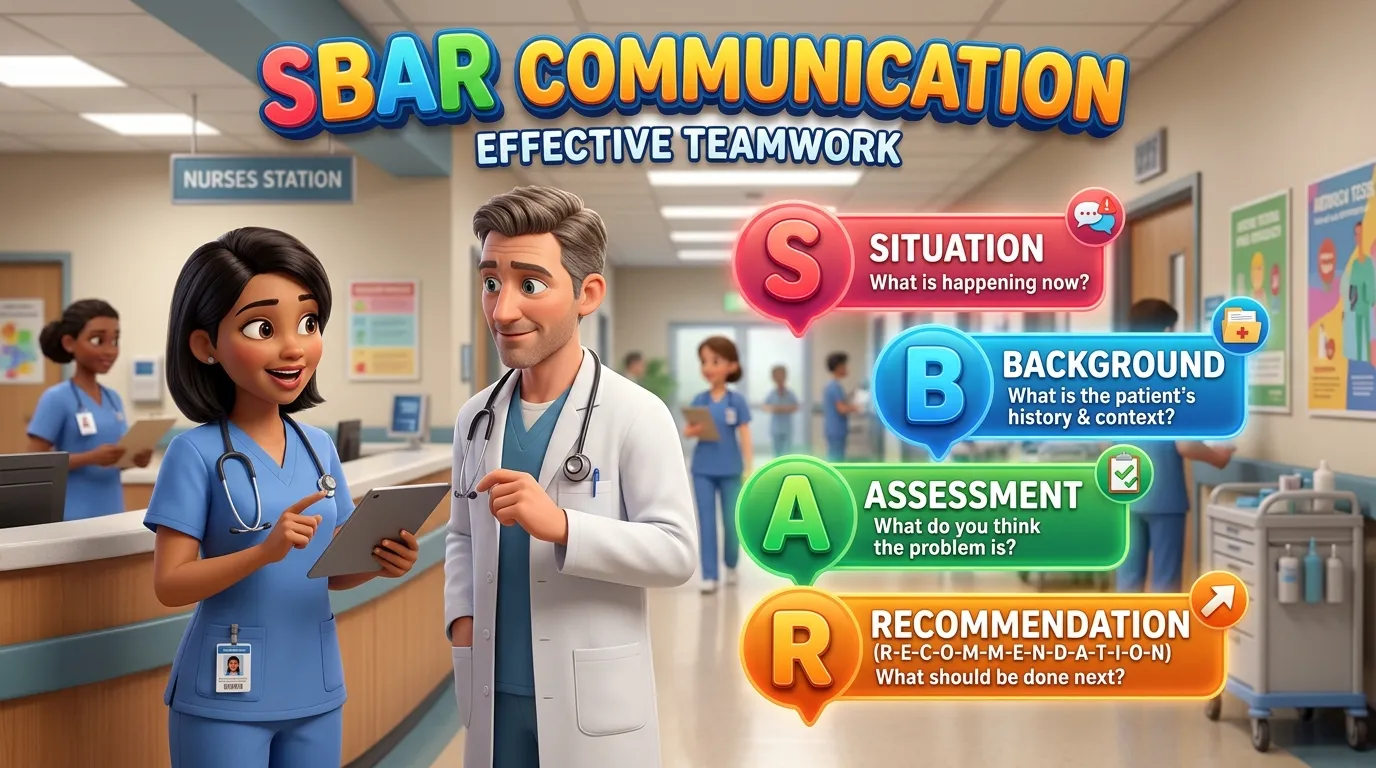
SBAR communication means using a four-part framework to communicate essential information in a clear, organized, and concise manner.
The method is especially useful when information must be transferred between healthcare professionals, such as during a nurse-to-doctor call, a patient handover, or a report about a sudden change in a patient’s condition.
Quick Definition
SBAR communication: A structured communication technique that organizes information into Situation, Background, Assessment, and Recommendation.
S
Situation
What is happening right now?
B
Background
What relevant history or context does the listener need?
A
Assessment
What do you observe, and what do you think the problem may be?
R
Recommendation
What action, decision, or assistance do you need?
The goal is not simply to speak in four sections. It is to make sure the person receiving the message understands the problem, the relevant context, the speaker’s assessment, and the action being requested.
How to Use the SBAR Communication Framework
The SBAR framework is most effective when the speaker prepares the relevant facts before communicating and clearly identifies what response is needed. The following steps explain how to apply it in practice.
S — Situation
Start by explaining the immediate issue. Identify yourself, the person or situation involved, and the reason for the communication.
Ask yourself:
What is happening right now?
Why am I contacting this person?
Does the situation need urgent attention?
Example: “Hello, this is Nurse Ali from the medical ward. I am calling because a patient’s breathing has suddenly become worse.”
B — Background
Provide only the information needed to understand the current issue. In healthcare, this may include the patient’s relevant medical history, diagnosis, medications, allergies, recent treatment, or test results.
Ask yourself:
What relevant history does the recipient need?
What has happened so far?
What information helps explain the current situation?
Example: “The patient was admitted yesterday with a chest infection and has been receiving treatment.”
A — Assessment
Explain what you have observed and what you think the problem may be. Include relevant objective information, such as vital signs, when available. Distinguish observed facts from your interpretation.
Ask yourself:
What have I observed?
How serious does the situation appear?
What concerns me most?
Example: “The patient’s breathing rate has increased, oxygen saturation has fallen, and the patient appears more distressed than earlier.”
R — Recommendation
State what action you recommend or what help you need. Be specific about the requested response and the urgency.
Ask yourself:
What needs to happen next?
Who needs to take action?
How quickly is a response required?
Example: “Could you assess the patient immediately? I am concerned about the deterioration.”
The recommendation should reflect the facts, the speaker’s role, and the organization’s clinical escalation procedures. If the situation is an emergency, follow the appropriate emergency protocol without delaying care to complete an SBAR report.
SBAR Communication Example in Nursing
The following fictional example demonstrates how a nurse could use SBAR when contacting a doctor about a patient whose condition is deteriorating. It is an educational example, not a diagnosis or treatment protocol.
S
Situation
“Doctor, this is Nurse Ali calling from Ward 2 about a patient whose breathing has become more difficult over the last 20 minutes.”
B
Background
“The patient was admitted yesterday with a chest infection. The patient was more comfortable earlier this morning.”
A
Assessment
“The patient is now breathing faster and appears increasingly distressed. The latest observations show a decline in oxygen saturation.”
R
Recommendation
“Please assess the patient urgently. I will continue monitoring the patient and follow our escalation procedure.”
This example shows how SBAR organizes a message so that the recipient hears the immediate concern, relevant history, observed deterioration, and requested action without unnecessary detail.
Why Is SBAR Communication Important?
SBAR helps teams communicate in a consistent format, particularly when information is urgent or complex. The Agency for Healthcare Research and Quality (AHRQ) identifies it as a communication tool used to support teamwork and help staff raise concerns clearly.
Its main benefits include:
Clear communication: Organizes information into four easy-to-follow sections.
Less confusion: Helps the speaker focus on the most relevant facts.
Improved teamwork: Gives different professionals a shared communication structure.
Timely escalation: Makes it easier to communicate urgent concerns and request assistance.
Safer handovers: Helps staff transfer important information when responsibility for a patient changes.
More confident speaking: Gives less experienced staff a framework for raising concerns with senior colleagues.
SBAR is a communication aid, not a guarantee against errors. Its effectiveness depends on accurate information, appropriate clinical judgment, active listening, and confirmation that the message has been understood.
Where Is SBAR Communication Used?
Although SBAR is most closely associated with healthcare, the method can be adapted to other settings.
Setting | Example of use |
|---|---|
Hospitals | A nurse reports a change in a patient’s condition to a doctor. |
Nursing homes | A care worker informs a nurse about a resident’s new symptoms. |
Patient handovers | A nurse summarizes a patient’s current condition for the next shift. |
Emergency care | A healthcare professional communicates a time-sensitive concern. |
Business workplaces | An employee explains a problem, relevant context, assessment, and proposed solution. |
Team meetings | A team member summarizes a project issue and recommends the next step. |
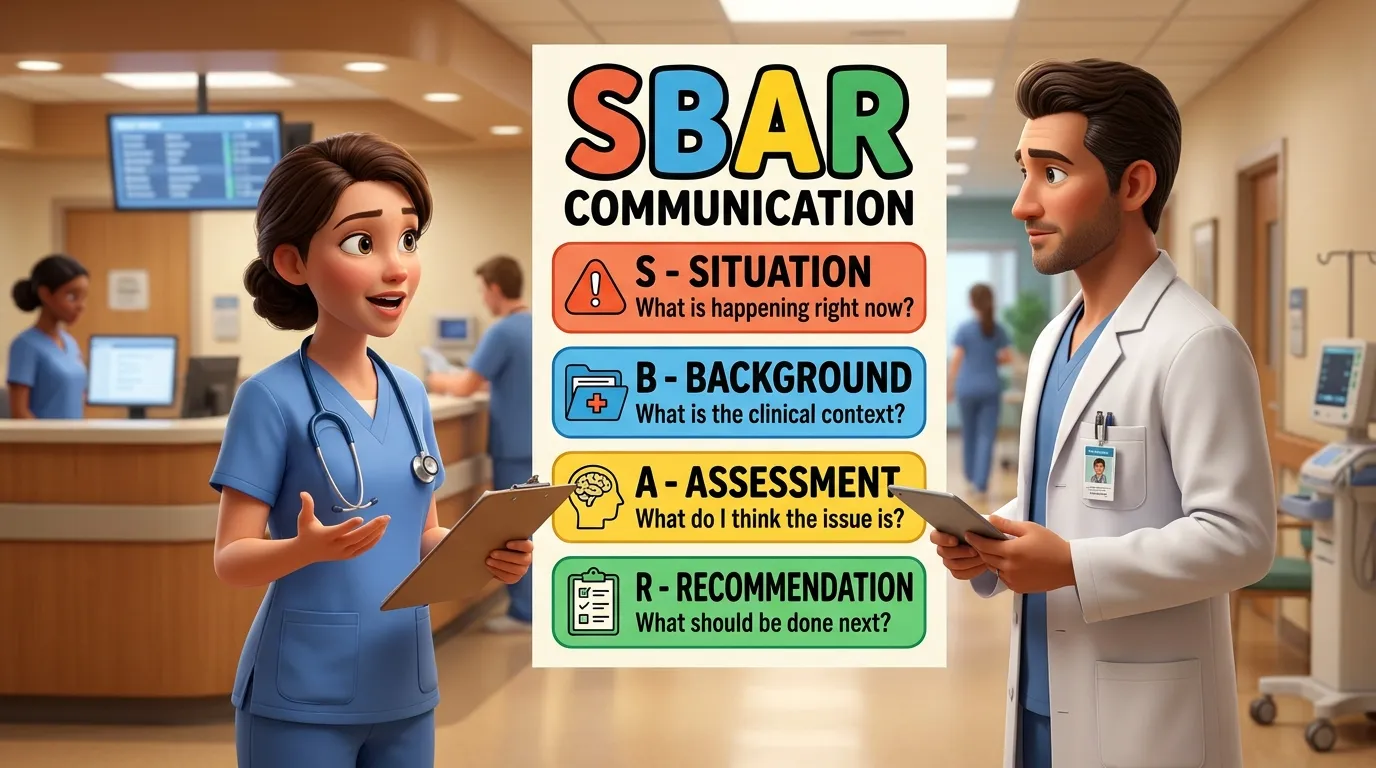
SBAR vs. Other Communication Methods
SBAR is one of several structured approaches to communication. It is useful to understand how it differs from related methods.
Term | Meaning | Main purpose |
|---|---|---|
SBAR | Situation, Background, Assessment, Recommendation | Organizes a message into four sections. |
ISBAR | Often expands SBAR with Identify | Adds explicit identification of the speaker and/or patient. |
Handover | Transfer of relevant information and responsibility | Supports continuity between people or teams. |
Closed-loop communication | Sending, repeating back, and confirming a message | Checks that important instructions have been understood correctly. |
Active listening | Listening carefully and clarifying meaning | Improves understanding and reduces miscommunication. |
Different organizations may use slightly different versions of these tools. SBAR is a framework for structuring the message, while handover describes a broader process of transferring information and responsibility.
Common SBAR Communication Phrases
These sentence starters can help someone use the framework in a conversation or report.
Situation: “I am contacting you because…”
Background: “The relevant history is…”
Assessment: “Based on my observations, I am concerned that…”
Recommendation: “I recommend that we…” or “Could you please…?”
A useful habit is to finish by confirming the agreed action, who is responsible, and the expected timeframe.