

Quick Definition
Root chakra symbolism (noun phrase)
The symbolic meanings associated with the root chakra, or Muladhara, commonly representing grounding, stability, survival, security, and connection with the physical world.
Part of speech
Noun phrase
Traditional name
Muladhara, commonly translated as “root support” or “root foundation.”
Common color association
Red in many modern chakra systems.
Simple meaning
The symbols represent grounding, safety, stability, and a strong foundation.
Main Definitions
Root chakra symbolism can be understood in several related ways:
Grounding: Feeling connected to the body, the present moment, and the physical world.
Security and survival: Representing basic needs, shelter, food, safety, and stability.
Foundation: Symbolizing the base upon which other aspects of personal or spiritual development are built.
Connection with the earth: Expressing rootedness, physical existence, and the natural world.
Stability and resilience: Representing steadiness when facing uncertainty or change.
These meanings are common in modern yoga, meditation, and wellness explanations. Specific interpretations vary across traditions, and contemporary chakra descriptions do not always correspond exactly to older Hindu texts.
Etymology and Word Origin
The term root chakra combines the English word root, meaning a base or source of support, with chakra, a Sanskrit word meaning “wheel” or “disc.”
The Sanskrit name for the root chakra is Muladhara (Mūlādhāra). It is commonly explained as a combination of mūla, meaning “root,” and ādhāra, meaning “support” or “foundation.”
The name reflects the chakra’s position as the foundational center in many modern descriptions of the seven-chakra system.
Semantic Field
Root chakra symbolism is associated with concepts such as:
Grounding
Stability
Security
Survival
Physical awareness
Earth symbolism
Foundation
Belonging
Resilience
Embodiment
These ideas form a network of related meanings rather than a single universal definition.
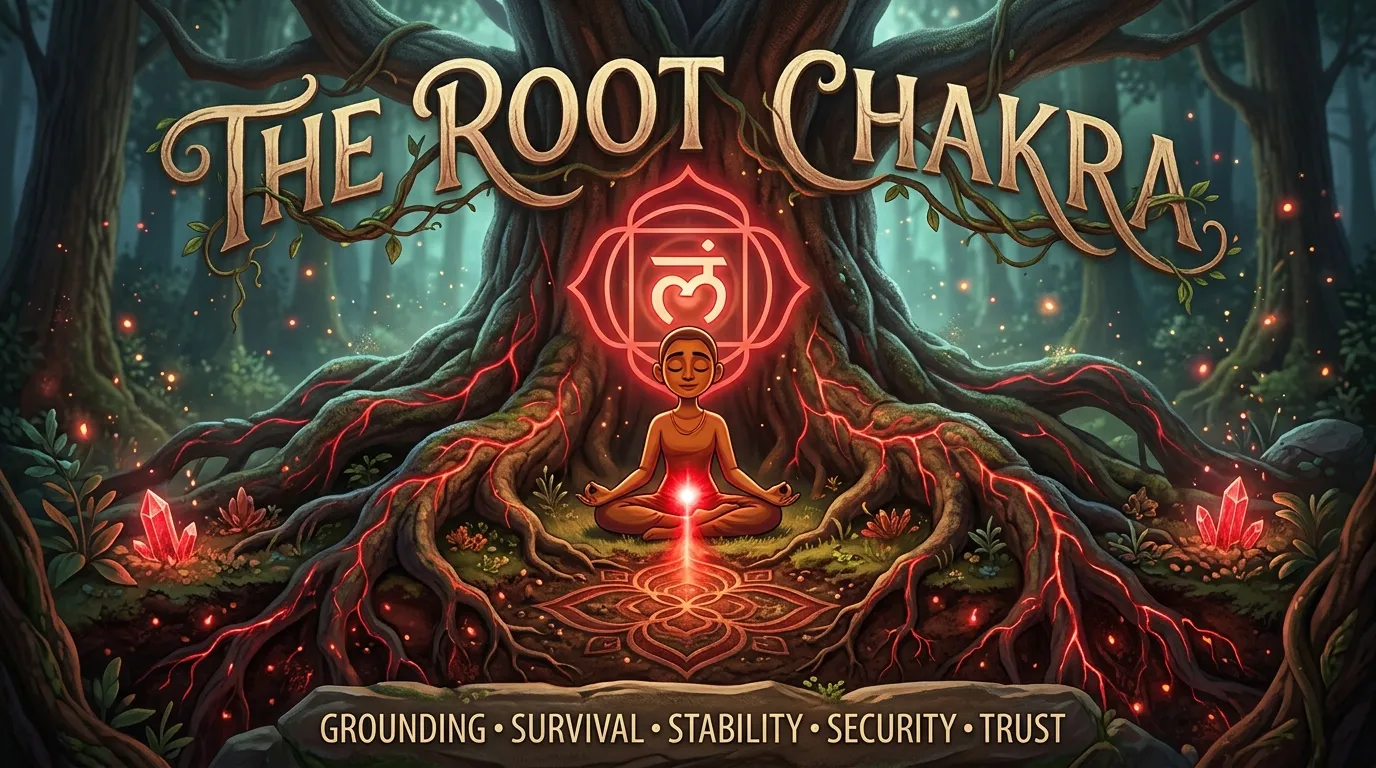
2. The Deeper Meaning and Nuance of Root Chakra Symbolism
Root chakra symbolism is often interpreted as a reminder of the importance of a stable foundation. In spiritual teachings, this foundation may relate to physical existence, basic needs, emotional steadiness, or a sense of belonging.
Grounding and Connection to the Earth
Grounding is one of the most widely recognized meanings associated with the root chakra. It refers to feeling present, connected, and aware of one’s physical surroundings.
In meditation and yoga, grounding practices may include noticing the breath, paying attention to bodily sensations, or feeling the support of the floor beneath the feet.
Symbolically, these practices reflect the idea of having a firm foundation rather than feeling scattered or disconnected.
Safety and Basic Needs
The root chakra is commonly associated with fundamental needs such as food, shelter, physical safety, and a stable living environment.
In contemporary spiritual interpretations, this association suggests that it can be difficult to feel settled when basic needs are threatened. The symbolism therefore emphasizes the value of practical security alongside inner reflection.
This is a spiritual framework for understanding personal experience, not a medically established system for diagnosing emotional or physical problems.
Stability and Personal Foundation
The root chakra is frequently described as the foundation of the chakra system. Like the roots of a tree, it symbolizes the support needed for growth.
This interpretation can apply to everyday life: stable routines, reliable relationships, realistic planning, and healthy boundaries can help people feel more secure as they pursue new goals.
Belonging and Connection
Root chakra symbolism is also associated in modern teachings with belonging—to a family, community, place, or wider natural environment.
The symbolism may encourage reflection on questions such as: Where do I feel safe? What gives me a sense of belonging? Which habits help me remain steady during change?
These are personal or contemplative interpretations rather than universally prescribed meanings.
Balance and Imbalance
In contemporary chakra language, a “balanced” root chakra is often described as a symbolic state of groundedness and security. An “imbalanced” root chakra may be used to describe feelings such as instability, fear, or disconnection.
These expressions belong to a spiritual model. There is no established scientific test that measures a root chakra or confirms that it causes particular emotions or physical symptoms.
3. Common Root Chakra Symbols and Their Meanings
The root chakra is represented through several recurring visual elements. Each carries a particular interpretation within chakra-related traditions and modern spiritual artwork.
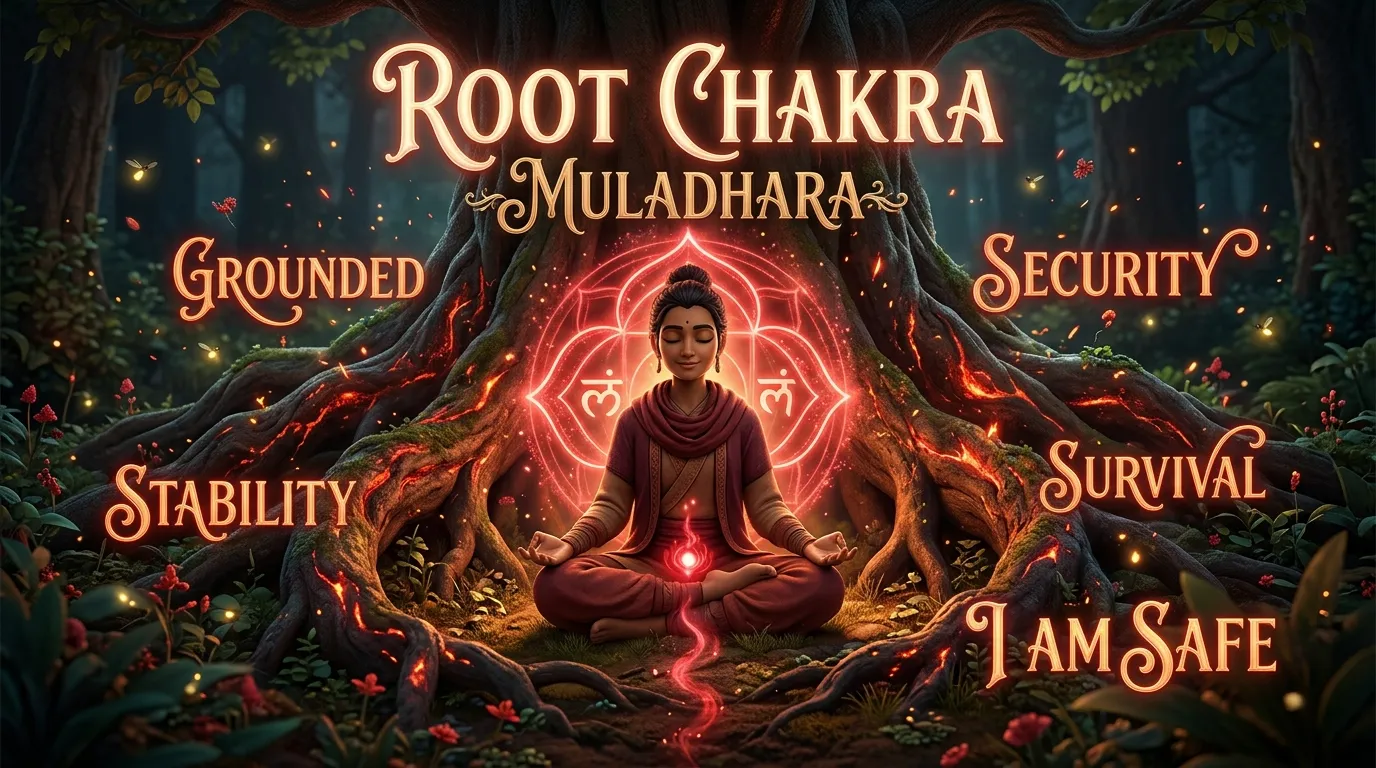
The Seed Mantra: LAM
Some traditional and contemporary chakra practices associate the root chakra with the Sanskrit seed syllable LAM (also written Laṃ). A seed mantra is a short sound used in certain meditation or ritual practices.
Within this framework, chanting or contemplating LAM may serve as a way to focus attention on the Muladhara chakra. Its use and interpretation depend on the practitioner’s tradition.
The Sanskrit Name: Muladhara
The name Muladhara reinforces the idea of a root or foundation. In diagrams and spiritual explanations, it identifies the chakra commonly placed at the base of the subtle-body system.
It is important to distinguish this traditional spiritual concept from the physical structures of human anatomy.
4. How to Use “Root Chakra Symbolism” in a Sentence
The phrase is useful in discussions of yoga, meditation, spiritual art, religious studies, symbolism, and personal reflection.
Here are 10 examples:
1. Spiritual practice: “Root chakra symbolism emphasizes grounding and a sense of security.”
2. Art: “The artist used red and a four-petaled lotus to represent root chakra symbolism.”
3. Yoga: “The instructor explained root chakra symbolism before leading a grounding meditation.”
4. Traditional imagery: “The square in the diagram contributes to the root chakra symbolism.”
5. Personal reflection: “She explored root chakra symbolism as a way to reflect on stability and belonging.”
6. Color interpretation: “Red is a prominent feature of root chakra symbolism in many modern chakra illustrations.”
7. Cultural studies: “The researcher compared traditional chakra imagery with contemporary root chakra symbolism.”
8. Meditation: “The workshop introduced root chakra symbolism alongside breath awareness and body-focused exercises.”
9. Spiritual design: “The jewelry maker incorporated root chakra symbolism into a red lotus pendant.”
10. Education: “The book explains root chakra symbolism while distinguishing spiritual interpretations from scientific evidence.”
Common Sentence Patterns
Meaning of root chakra symbolism: “The article explains the meaning of root chakra symbolism.”
Root chakra symbolism represents: “Root chakra symbolism represents grounding in many modern interpretations.”
Root chakra symbolism in art: “Root chakra symbolism in art often features red lotus imagery.”
Interpret root chakra symbolism: “Different traditions may interpret root chakra symbolism differently.”
Root chakra symbolism and grounding: “The lesson explores the relationship between root chakra symbolism and grounding.”
5. Different Ways to Say Root Chakra Symbolism
There is no exact synonym that replaces root chakra symbolism in every context. However, several related expressions can communicate similar ideas.
Term | Meaning | Best context |
|---|---|---|
Muladhara symbolism | Symbolic meanings associated with the root chakra’s Sanskrit name | Traditional or spiritual discussion |
Root chakra meaning | The general significance attributed to the first chakra | General explanations |
Chakra symbolism | Symbolic meanings associated with chakras more broadly | Yoga and spiritual studies |
Grounding symbolism | Symbols representing rootedness, stability, and connection | Meditation, art, and personal reflection |
Earth symbolism | Images or ideas associated with the earth and physical world | Nature-based or spiritual interpretation |
Spiritual symbolism | Symbols used to express spiritual concepts or beliefs | Broad religious and contemplative contexts |
Contrasting Concepts
Root chakra symbolism does not have a direct antonym. Depending on the context, contrasting ideas may include:
Instability: A lack of steadiness or security.
Disconnection: Feeling separated from one’s surroundings or community.
Uncertainty: A lack of confidence about what to expect.
Uprootedness: A metaphor for losing a familiar home, foundation, or sense of belonging.
These terms describe contrasting experiences rather than the literal opposite of a chakra symbol.
6. Root Chakra Symbolism in Different Contexts
In Hindu and Yogic Traditions
The Muladhara chakra belongs to subtle-body frameworks found in particular Hindu and yogic traditions. These frameworks use chakras as part of spiritual, meditative, or ritual systems.
Historical texts and lineages do not all describe chakras identically. Popular modern explanations—especially standardized rainbow colors and simplified psychological meanings—may reflect later interpretations rather than a single universal ancient system.
In Modern Yoga and Meditation
Contemporary yoga and meditation resources commonly present the root chakra as a focus for grounding, steadiness, and awareness of basic needs.
Practices may include standing poses, mindful breathing, body awareness, or reflection on stability. These activities may support relaxation or concentration for some people, but claims about literally opening or balancing a chakra are spiritual beliefs rather than established medical findings.
In Art and Jewelry
Root chakra imagery is often represented through red gemstones, lotus flowers, squares, earth textures, and geometric patterns. Artists may use these elements to communicate stability, strength, nature, or personal growth.
A person wearing a red lotus necklace does not necessarily follow a particular spiritual tradition; the design may be decorative or personally meaningful.
In Personal Development
Some people use root chakra symbolism as a reflective framework for thinking about security, routines, relationships, and belonging.
For example, a person may use the idea of “building a strong foundation” to set practical goals around budgeting, creating a regular routine, or strengthening supportive relationships. These are everyday applications of the metaphor rather than proof of a measurable energy center.
7. Related Concepts and Semantic Network
The following terms help explain the wider context of root chakra symbolism:
[link: Muladhara chakra] — The traditional Sanskrit name for the root chakra.
[link: chakra system] — A set of subtle-body centers described in several Indian spiritual traditions.
[link: grounding] — A concept associated with presence, steadiness, and connection to the physical world.
[link: lotus symbolism] — The meanings associated with the lotus flower in various religious and cultural traditions.
[link: earth element symbolism] — Symbolic meanings connected with earth, solidity, and material existence.
[link: meditation] — Practices involving attention, contemplation, or focused awareness.
[link: yoga] — A diverse collection of Indian philosophical, spiritual, and physical practices.
[link: spiritual symbolism] — The use of symbols to communicate religious or spiritual meanings.
These terms overlap, but they are not interchangeable. For example, lotus symbolism appears in several Asian religious traditions and does not exclusively represent the root chakra.