

Nuance — Quick Definition
Nuance (noun)
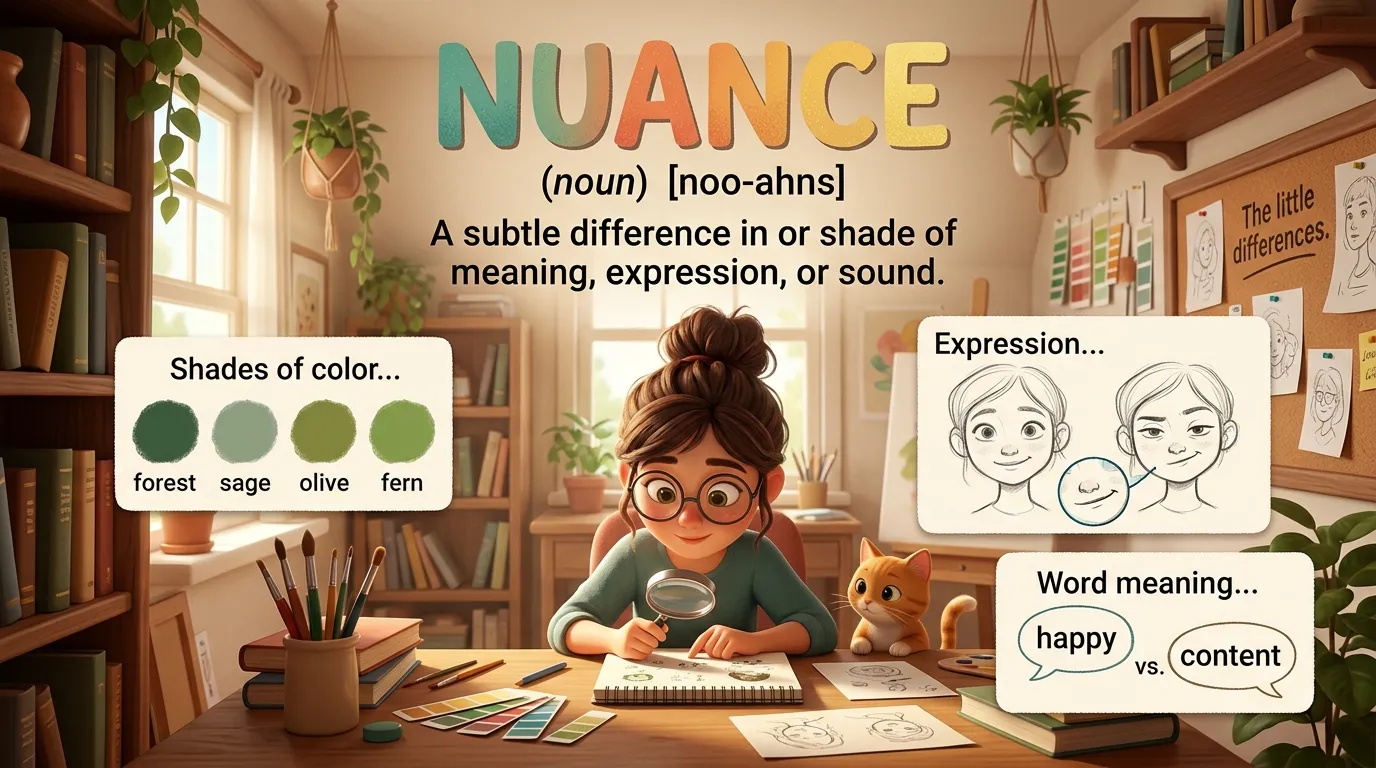
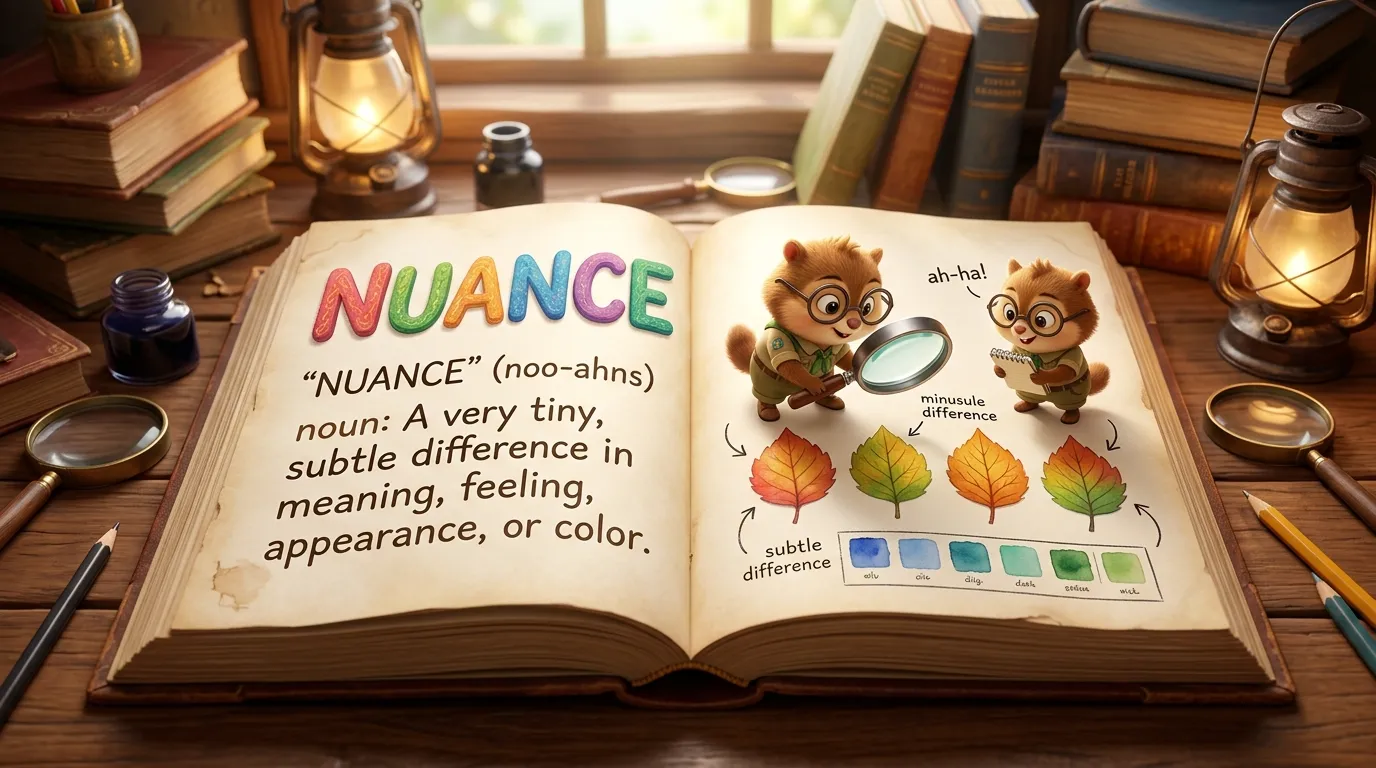
A subtle difference, variation, or shade of meaning, feeling, tone, or expression.
Simple meaning: A small but meaningful distinction that adds depth or precision to how something is understood.
Example: The writer captured the nuance of her disappointment without making her sound angry.
Part of Speech
Nuance is primarily a noun. Its plural form is nuances.
Singular: The nuance of his response was easy to miss.
Plural: The poem contains several nuances of meaning.
The related adjective nuanced describes something that recognizes or expresses subtle distinctions.
– Example: The journalist offered a nuanced explanation of the controversy.
Definition of Nuance
The word nuance has several closely connected meanings:
A subtle difference: A slight distinction between two things that may appear similar.
A shade of meaning: A small variation in what a word, statement, or expression communicates.
A fine variation in feeling or tone: A delicate emotional quality in a person’s voice, writing, or behavior.
A degree of complexity: A detail that makes an explanation, opinion, or interpretation more balanced and less simplistic.
For instance, the words dislike, resentment, and hatred all express negative feelings, but they carry different emotional nuances. Dislike may indicate a mild preference against something, resentment often suggests lingering bitterness, and hatred expresses much stronger hostility.
Pronunciation of Nuance
Pronunciation: /ˈnuː.ɑːns/ (also commonly /ˈnjuː.ɑːns/ in British English)
Phonetic spelling: NOO-ahns or NYOO-ahns
Syllables: Usually two
Word type: Noun
Etymology: Where Does Nuance Come From?
Nuance entered English through French nuance, meaning a shade, gradation, or subtle variation. The French word is associated with nuer, meaning to shade or vary in color, which is related to nue, meaning a cloud or shade of color.
The word’s history reflects its original association with fine gradations, especially in color. Over time, English extended the concept to differences in meaning, emotion, tone, interpretation, and thought.
Today, a nuance can be a delicate shift in the color of a painting, a slight change in a speaker’s voice, or a meaningful distinction between two seemingly similar ideas.
Semantic Field of Nuance
The word belongs to several related areas of meaning:
Language and meaning: subtle distinctions, connotation, implication, interpretation.
Emotion and psychology: mixed feelings, emotional shades, sensitivity.
Communication: tone, emphasis, context, indirect meaning.
Writing and analysis: complexity, precision, qualification, balance.
Art and perception: delicate variation, shading, gradation.
These connections explain why nuance is useful in both everyday conversation and academic or professional writing.
The Deeper Meaning and Nuance
Nuance is more than a small difference. It is a difference that matters because it changes how something is perceived, interpreted, or experienced. A nuance can be subtle without being insignificant.
Consider the following statements:
“She is confident.”
“She is overconfident.”
“She is quietly confident.”
All three describe a person’s relationship with confidence, but each creates a different impression. Overconfident suggests excessive self-assurance, while quietly confident suggests calm certainty without a need to show off. These distinctions are examples of nuance in language.
Nuance in Language and Communication
In communication, nuance often comes from word choice, context, emphasis, and tone of voice. The same sentence can convey different meanings depending on how it is delivered.
For example, the statement “That’s interesting” might express genuine curiosity, polite disagreement, or mild skepticism. The words alone do not settle the meaning; the speaker’s tone and the surrounding conversation help reveal the nuance.
Recognizing nuance is especially valuable when interpreting humor, sarcasm, indirect criticism, professional feedback, and culturally specific expressions.
Nuance in Emotions
Human emotions rarely fit into simple categories. A person can feel happy and sad at the same time, or experience relief mixed with regret. Nuance helps describe these layered emotional states.
For instance, disappointed does not always mean angry. Someone may be disappointed because expectations were not met while still understanding why the outcome occurred. Describing the feeling precisely communicates more than labeling the person as upset.
Nuance in Writing, Art, and Analysis
Writers use nuance to create believable characters, balanced arguments, and realistic dialogue. Artists use subtle changes in color, light, texture, or composition to produce depth. Analysts use nuance to distinguish between evidence, assumptions, exceptions, and competing explanations.
The phrase a nuanced argument usually refers to an argument that recognizes relevant complexity instead of presenting an issue as entirely simple or one-sided.
Nuance does not mean avoiding a clear position. It means expressing that position with appropriate precision and acknowledging meaningful qualifications.
How to Use Nuance in a Sentence
The word nuance most often appears in phrases such as a nuance of meaning, subtle nuances, capture the nuance, and understand the nuances. It can describe language, behavior, emotion, art, culture, and ideas.
Here are ten examples across different contexts.
1. Everyday conversation: There is a subtle nuance between being honest and being unnecessarily blunt.
2. Literature: The novelist captures the emotional nuance of a character who wants both independence and approval.
3. Professional communication: Understanding the cultural nuances of a workplace can improve teamwork.
4. Psychology: Her response contained a nuance of sadness beneath an otherwise cheerful expression.
5. Art: The painter used delicate nuances of blue and gray to suggest a cloudy afternoon.
6. Language learning: Learning a language involves understanding the nuances of idioms, tone, and word choice.
7. Academic analysis: The researcher considered the nuance between correlation and causation.
8. Film and acting: The actor conveyed the character’s uncertainty through small nuances in facial expression.
9. Politics and public debate: The issue requires a nuanced discussion rather than a simple division into right and wrong.
10. Personal relationships: She understood the nuance in his apology and recognized that he was sincere but still embarrassed.
Common Grammatical Patterns
Pattern | Example |
|---|---|
A nuance of + noun | A nuance of regret appeared in his voice. |
Nuances of + noun | The essay explores the nuances of identity. |
Subtle/fine/slight nuance | The translation preserves a subtle nuance. |
Capture a nuance | The photograph captures every nuance of her expression. |
Understand/appreciate a nuance | Experienced readers appreciate the nuances of the poem. |
Nuanced + noun | The report offers a nuanced assessment. |
Grammar tip: Use nuance for one distinction and nuances for multiple distinctions. Use nuanced when describing something that expresses or recognizes subtle differences.
Different Ways to Say Nuance
No single synonym works in every situation. The best alternative depends on whether you mean a difference in meaning, a delicate emotional quality, a minor detail, or a sophisticated interpretation.
1. Synonyms for a Subtle Difference
Subtlety: A quality or distinction that is delicate, indirect, or not immediately obvious. Best for language, behavior, art, and interpretation.
Distinction: A difference between two things, especially when the difference needs to be identified clearly.
Shade: A slight variation in meaning, tone, feeling, or color. Often appears in expressions such as a shade of doubt.
Variation: A change or difference within a general pattern. More neutral and sometimes more measurable than nuance.
Refinement: A small improvement or adjustment that makes something more precise, polished, or sophisticated.
2. Synonyms for Meaning and Interpretation
Connotation: An association or emotional implication connected with a word beyond its basic definition.
Implication: A meaning that is suggested rather than stated directly.
Undertone: A secondary feeling or attitude that exists beneath the obvious message.
Inflection: A change in the pitch or delivery of speech that may communicate emotion or emphasis.
Nicety: A fine point or subtle distinction, often in language, etiquette, or reasoning.
For example, connotation is especially appropriate when discussing the associations of a word, while undertone is often better for describing an unspoken emotional quality.
3. Related Words and Forms
Nuanced: An adjective describing something that reflects subtle distinctions or complexity.
Subtle: An adjective describing something delicate, understated, or difficult to detect.
Fine-grained: Describes an analysis or classification that recognizes small distinctions.
Multifaceted: Describes something with several different aspects, rather than merely one subtle difference.
Complexity: The state of involving multiple connected parts or considerations.
Antonyms of Nuance
Nuance has no single perfect opposite in every context, but these words express contrasting ideas:
Oversimplification: Reducing a complex subject to an overly simple explanation.
Crudeness: A lack of refinement or sensitivity to detail.
Bluntness: Directness that may leave little room for subtlety.
Uniformity: A lack of meaningful variation.
Coarseness: A lack of delicacy, refinement, or fine distinction.
The most appropriate opposite depends on the sentence. For example, oversimplification contrasts with nuance in an argument, while uniformity contrasts with nuance when discussing variations in color or sound.
Nuance in Context: Common Phrases and Collocations
Collocations are word combinations that commonly appear together. Learning them makes it easier to use nuance naturally in speech and writing.
Phrase | Meaning and example |
|---|---|
Subtle nuance | A small, easily overlooked distinction. A subtle nuance in her tone suggested uncertainty. |
Nuance of meaning | A slight difference in interpretation. The translator preserved the nuance of meaning in the original text. |
Emotional nuance | A delicate difference in emotional expression. The actor conveyed emotional nuance without speaking. |
Cultural nuances | Subtle differences in customs, expectations, and social behavior. Travelers benefit from understanding cultural nuances. |
Linguistic nuance | A fine distinction in language, grammar, or usage. The lesson explained a linguistic nuance that dictionaries often overlook. |
Capture the nuance | Express or represent a subtle distinction accurately. The documentary captures the nuance of the debate. |
Appreciate the nuances | Recognize and value subtle distinctions. Fluent speakers often appreciate the nuances of humor. |
Useful Expressions With Nuance
Without nuance: In a way that ignores relevant distinctions or complexity. The issue was presented without nuance.
Rich in nuance: Containing many subtle variations or layers of meaning. The novel is rich in nuance.
A lack of nuance: Failure to recognize important distinctions. The criticism showed a lack of nuance.
Add nuance to: Make an explanation or portrayal more precise or complex. The new evidence adds nuance to the original argument.
A nuanced perspective: A viewpoint that considers multiple relevant aspects. She offered a nuanced perspective on the disagreement.
These expressions are particularly common in literary criticism, journalism, academic discussion, cultural analysis, and professional communication.
When to Use Nuance vs. Synonyms
Although several words overlap with nuance, they are not always interchangeable. The distinction usually depends on the kind of difference being discussed.
Word | Main emphasis | Best used when | Example |
|---|---|---|---|
Nuance | A subtle, meaningful distinction | Meaning, tone, emotion, or interpretation has fine differences | The statement contains a nuance of irony. |
Subtlety | Something delicate or not immediately obvious | The quality of being understated or indirect matters | The subtlety of the performance impressed the audience. |
Distinction | A recognizable difference | Two concepts need to be separated or compared | There is a distinction between intent and impact. |
Connotation | An associated or implied meaning | Discussing the emotional or cultural associations of words | The word has a negative connotation. |
Implication | Something suggested indirectly | An unstated consequence or message is important | His comment carried an implication of blame. |
Variation | A difference or change | Differences occur across examples, measurements, or patterns | The study recorded variation in response times. |
Undertone | A secondary emotional quality | A hidden or less obvious attitude is present | There was an undertone of frustration in her reply. |
Refinement | An improvement or fine adjustment | Greater precision, polish, or sophistication is intended | The final edit brought refinement to the prose. |
Nuance vs. Subtlety
Nuance usually identifies a particular fine distinction, while subtlety can describe the delicate quality of something or the skill required to express it.
Nuance: The word choice creates a nuance of uncertainty.
Subtlety: The subtlety of the writer’s style makes the uncertainty feel natural.
Nuance vs. Connotation
Connotation is more specific to the associations or feelings attached to a word or expression. Nuance is broader and may refer to distinctions in language, emotion, sound, appearance, or ideas.
For example, home may have connotations of safety and belonging, while the nuance of a particular sentence containing home depends on its context and intended meaning.
Nuance vs. Implication
An implication is often something indirectly suggested or a consequence that follows from a statement. A nuance is a finer distinction in how something is understood.
For instance, “I expected more from you” may carry an implication of disappointment. The nuance could be affectionate concern, severe criticism, or restrained frustration, depending on the speaker and situation.
Nuance vs. Complexity
Complexity refers to having many connected parts or factors. Nuance refers to fine distinctions that help explain those parts more accurately. A subject can be complex without every detail being subtle, and a simple sentence can contain considerable nuance.
Related Concepts and Semantic Network
Understanding related terms makes it easier to recognize how nuance fits into language, interpretation, and communication.
[link: connotation]
The emotional, cultural, or associative meaning attached to a word beyond its basic definition. Connotation often explains why similar words create different impressions.
[link: subtext meaning]
The underlying message, feeling, or intention that is not expressed directly. Subtext can create nuance in dialogue, relationships, and storytelling.
[link: semantics meaning]
The study of meaning in language. Semantics helps explain how words and sentences communicate ideas and how subtle differences affect interpretation.
[link: tone of voice meaning]
The way a person’s voice communicates attitude or emotion through pitch, emphasis, pace, and delivery. Tone can change the nuance of an otherwise ordinary sentence.
[link: critical thinking meaning]
The practice of evaluating evidence, assumptions, and alternative explanations. Critical thinking helps people identify nuances instead of accepting overly simple conclusions.
These related concepts form a useful network: semantics examines meaning, connotation explores associations, subtext reveals indirect messages, tone communicates attitude, and critical thinking helps evaluate fine distinctions.