
What Does Lemon Vehicle Mean?
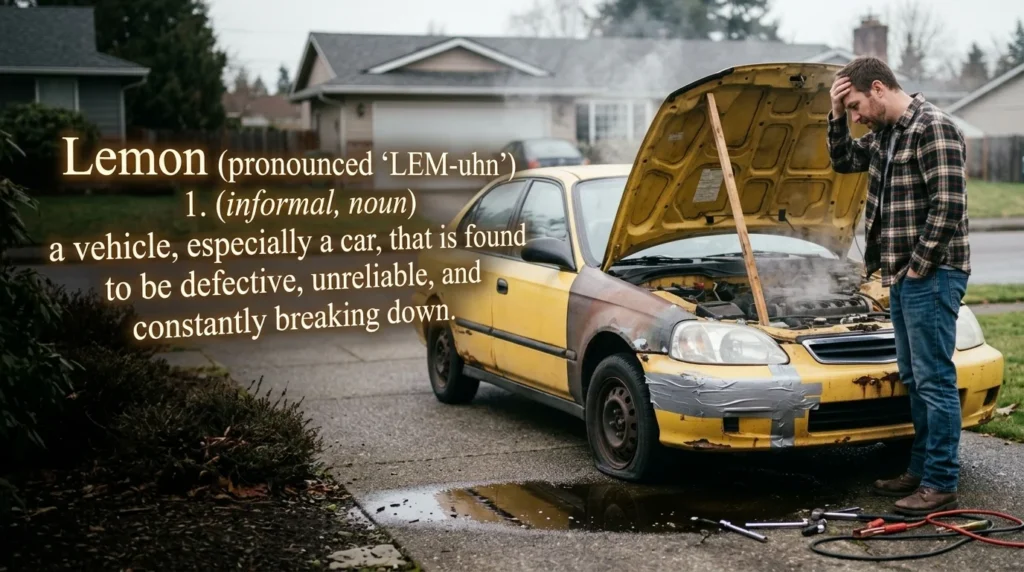
A lemon vehicle is a vehicle with significant defects or persistent mechanical or other problems that make it substantially less safe, useful, reliable, or valuable than a buyer would reasonably expect.
In ordinary conversation, someone might call a car a lemon because it repeatedly breaks down, requires expensive repairs, or has a serious defect that the manufacturer or dealer cannot successfully fix.
Quick Definition Box
- Part of speech: Noun phrase
- Primary definition: A vehicle with serious or recurring defects or problems.
- Common informal meaning: A troublesome, unreliable, or defective vehicle.
- Legal meaning: A vehicle that meets the requirements of a particular jurisdiction’s lemon law.
- Related terms: Defective vehicle, faulty vehicle, unreliable car, problem vehicle
- Typical context: Automotive purchases, warranties, consumer rights, vehicle repairs
What Does “Lemon” Mean in This Context?
Here, lemon is an informal noun meaning a product that is seriously defective, disappointing, or unreliable.
The term is not limited to automobiles. People can sometimes describe other defective products as “lemons,” although lemon vehicle and lemon car are particularly established expressions.
A vehicle may be called a lemon because of:
- repeated engine problems
- persistent transmission failures
- serious electrical defects
- recurring braking problems
- steering or suspension faults
- manufacturing defects
- safety-related defects
- problems that repeatedly return after repair
A minor inconvenience does not necessarily make a vehicle a lemon.
The Deeper Meaning and Nuance of Lemon Vehicle
The phrase has two closely related meanings: an everyday consumer meaning and a legal meaning.
Everyday Meaning of Lemon Vehicle
In everyday speech, calling a vehicle a lemon usually means that the owner believes the vehicle is unusually defective or troublesome.
For example:
“I bought a used SUV last year, and it has been a lemon ever since.”
The speaker means that the SUV has caused repeated problems and expenses.
The statement does not necessarily establish that the vehicle legally qualifies as a lemon under a particular law.
Legal Meaning of Lemon Vehicle
In legal contexts, lemon has a more specific meaning.
Lemon laws generally provide remedies for qualifying consumers who purchase or lease vehicles with substantial defects that the manufacturer cannot repair within legally prescribed requirements.
The exact rules vary by jurisdiction. Depending on the applicable law, factors can include:
- whether the vehicle is covered by the law
- whether the defect substantially affects use, safety, or value
- whether the defect is covered by a warranty
- how many repair attempts have occurred
- how long the vehicle has been unavailable for repair
- whether the manufacturer received appropriate notice
- whether the defect is attributable to misuse or unauthorized modifications
Because these requirements vary, it is inaccurate to assume that every unreliable vehicle automatically qualifies as a legal lemon.
A Lemon Is More Than an Ordinary Repair Problem
Most vehicles eventually need maintenance or repairs.
Replacing brake pads, changing a battery, repairing a punctured tire, or replacing worn suspension components does not ordinarily make a vehicle a lemon.
The phrase generally implies something more serious: persistent, substantial, or unusually troublesome defects.
A Vehicle Can Be Reliable but Still Have a Serious Defect
A lemon does not necessarily have to break down every week.
A vehicle might have one major manufacturing defect that significantly affects safety, usability, or value. If the problem is serious and meets the relevant legal criteria, it may be more important than a collection of minor repairs.
Used Vehicles and the Word “Lemon”
People commonly use lemon when discussing used cars that have turned out to be problematic.
However, legal lemon-law protections for used vehicles vary considerably by jurisdiction. Some laws primarily cover new vehicles, while others may extend protection to certain used vehicles under particular circumstances.
Therefore, “used lemon” has a clear everyday meaning but does not automatically establish a legal claim.
How to Use Lemon Vehicle in a Sentence
- [General] The buyer discovered that the car was a lemon vehicle after several major repairs.
- [Casual] I thought I had found a bargain, but the car turned out to be a lemon.
- [Automotive] Repeated transmission failures made the vehicle seem like a lemon.
- [Consumer] The owner contacted the manufacturer after experiencing persistent problems with the lemon vehicle.
- [Legal] Whether the vehicle qualifies as a lemon depends on the applicable jurisdiction’s requirements.
- [Professional] The dealership agreed to investigate the customer’s claim that the vehicle was defective.
- [Used-Car Context] The buyer later learned that the supposedly reliable sedan had been a lemon for its previous owner as well.
- [Informal] Every time I fix one problem, another appears; this car is a lemon.
- [Consumer Advice] Keep records of repairs if you believe your vehicle may qualify as a lemon under local law.
- [Automotive Review] Persistent electrical and engine problems turned the new vehicle into a costly lemon.
Different Ways to Say Lemon Vehicle
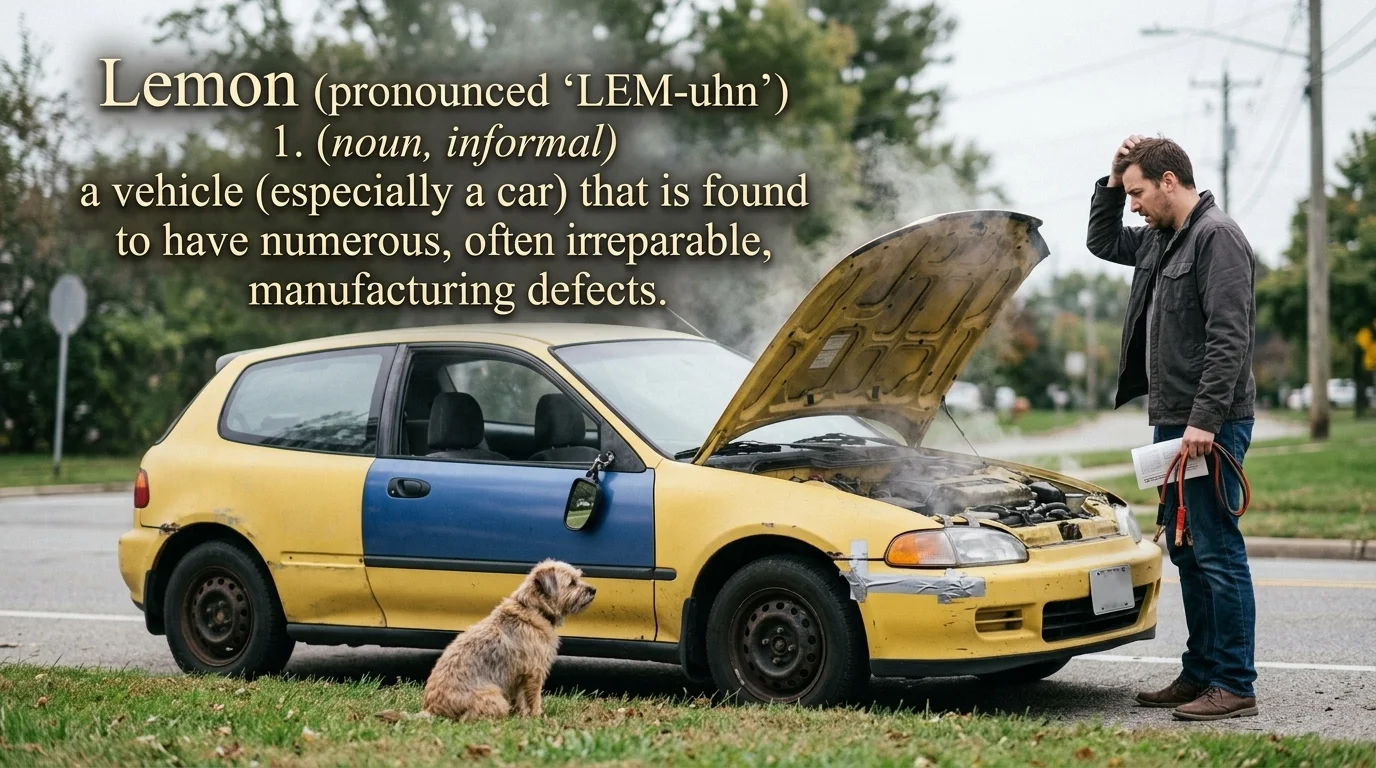
The best alternative depends on whether you are speaking casually, describing a mechanical problem, or discussing a legal claim.
Exact or Strong Alternatives
- Lemon car — the most common everyday equivalent for a defective automobile.
- Defective vehicle — directly emphasizes a significant fault or defect.
- Faulty vehicle — indicates that something is not functioning correctly.
- Problem vehicle — broad expression for a vehicle with persistent issues.
- Unreliable vehicle — emphasizes repeated failures or poor dependability.
Formal or Professional Alternatives
- Defective motor vehicle — suitable for formal or legal discussions.
- Vehicle with substantial defects — emphasizes the seriousness of the problems.
- Vehicle with recurring defects — highlights repeated problems.
- Faulty motor vehicle — formal description of a vehicle with defects.
- Deficient vehicle — broad formal expression, though less common in ordinary automotive speech.
Casual Alternatives
- Lemon car — common informal term.
- Problem car — simple and conversational.
- Bad car — very broad and informal.
- Junk car — stronger and often refers to a vehicle in very poor condition.
- Money pit — describes a vehicle that continually consumes money through repairs, although it does not necessarily mean the vehicle is legally defective.
More Specific Alternatives
- Unreliable car — best when repeated breakdowns are the main concern.
- Faulty car — useful when a particular defect is known.
- Problem vehicle — useful when several issues exist.
- Unsafe vehicle — appropriate when the central issue is a safety hazard.
- Manufacturing-defect vehicle — useful when a defect originated during production.
Antonyms and Contrasting Terms
- Reliable vehicle — performs dependably with expected maintenance.
- Trouble-free vehicle — experiences few significant problems.
- Well-maintained vehicle — kept in good condition through proper maintenance.
- Dependable car — consistently performs as expected.
- Quality vehicle — broad positive description emphasizing build or performance.
Lemon Vehicle in Context: Common Phrases and Collocations
“Lemon car”
The most common informal alternative to lemon vehicle, especially when discussing passenger automobiles.
“Buy a lemon”
Means to purchase a vehicle or other product that turns out to have serious problems.
“Lemon law”
A consumer-protection law addressing qualifying defective vehicles and, in some jurisdictions, other products.
“Lemon law claim”
A legal claim asserting that a vehicle qualifies for protection under an applicable lemon law.
“Lemon vehicle claim”
A claim that a particular vehicle meets the legal requirements for lemon status.
“Lemon vehicle problems”
A broad phrase referring to the recurring mechanical, electrical, safety, or manufacturing problems associated with a defective vehicle.
“Turned out to be a lemon”
A common expression meaning that a vehicle initially seemed satisfactory but later proved unusually troublesome.
When to Use Lemon Vehicle vs. Its Synonyms
| Term | Best use | Important nuance |
|---|---|---|
| Lemon vehicle | Serious or recurring vehicle problems | Informal unless used within a legal context |
| Lemon car | Everyday conversation | Very common for automobiles |
| Defective vehicle | Formal descriptions | Focuses on the existence of a defect |
| Unreliable vehicle | Repeated failures | Focuses on dependability |
| Faulty vehicle | Known malfunction | Focuses on something not working properly |
| Problem vehicle | General discussion | Broad and neutral |
| Unsafe vehicle | Safety concern | Focuses specifically on danger |
| Money pit | Expensive ownership | Emphasizes repair costs, not legal defects |
| Reliable vehicle | Positive comparison | Opposite idea |
If you are discussing a legal dispute, defective vehicle or vehicle that may qualify as a lemon under applicable law is often more precise than simply stating that the vehicle “is a lemon.”
Related Concepts and Semantic Network
[link: Lemon Law]
Lemon law refers to consumer-protection legislation designed to provide remedies for qualifying defective vehicles and, in some jurisdictions, other consumer products.
[link: Vehicle Warranty]
A warranty is a manufacturer’s or seller’s promise concerning specified repairs, defects, or performance for a defined period or under defined conditions. Warranty coverage can be important in lemon-related disputes.
[link: Manufacturing Defect]
A manufacturing defect occurs when a particular product does not conform to its intended design because of an error during production.
[link: Vehicle Recall]
A recall occurs when a manufacturer or relevant authority identifies a safety or compliance problem affecting vehicles and initiates corrective action.
[link: Used Car]
Used vehicles can develop ordinary age-related problems, so distinguishing normal wear from serious recurring defects is important when evaluating whether a vehicle is colloquially or legally a lemon.
Editor’s Note: Why This Definition Matters
The most important distinction in lemon vehicle terminology is between a troublesome vehicle and a legally qualifying lemon. Consumers often use the word casually after repeated repairs, but legal lemon status depends on specific rules rather than frustration alone.
A vehicle can have genuine mechanical problems without meeting a jurisdiction’s lemon-law requirements. Conversely, a vehicle does not necessarily need to be completely unusable to qualify if it has a substantial defect covered by the relevant law. Precise terminology matters when discussing consumer rights, warranty disputes, or potential legal remedies.