
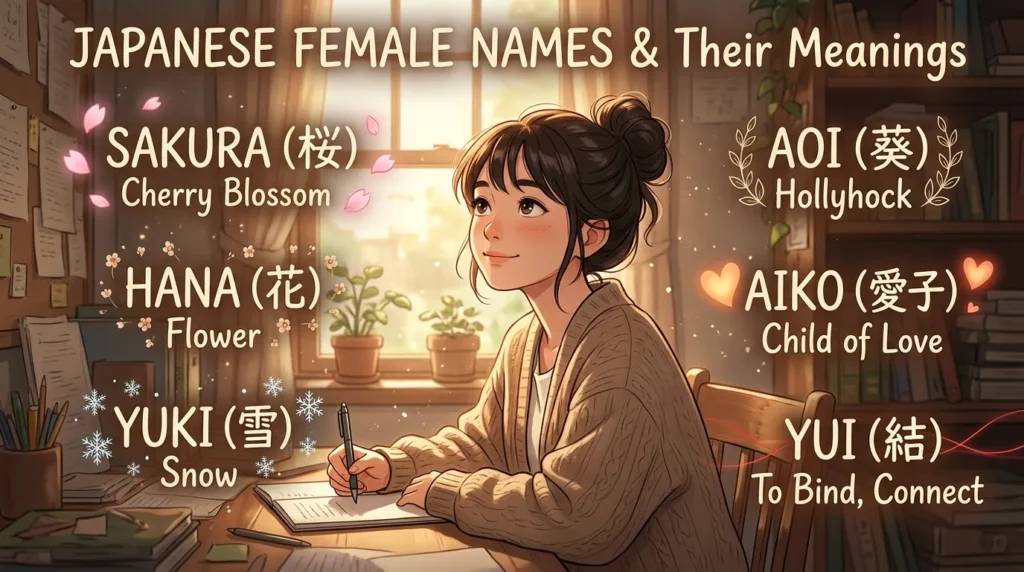
What Do Japanese Female Names Mean?
Japanese female names often draw inspiration from nature, personal qualities, beauty, family hopes, and cultural traditions. Unlike many names in languages where spelling determines a relatively fixed meaning, Japanese names can be written using different kanji combinations that change their interpretations.
For example, a name pronounced Yui can be written with characters associated with connection or gentleness, depending on the chosen spelling. Some Japanese names are also written in hiragana or katakana rather than kanji.
Common themes in Japanese female names include:
Nature: Cherry blossoms, flowers, trees, oceans, and seasons.
Light and beauty: Brightness, radiance, elegance, and clarity.
Love and kindness: Affection, compassion, and warmth.
Wisdom and strength: Intelligence, courage, and resilience.
Happiness and hope: Joy, good fortune, and positive wishes for the future.
A name’s meaning should therefore be checked against its specific Japanese spelling rather than inferred from its pronunciation alone.
Popular Japanese Female Names and Their Meanings
These names are recognizable choices with meanings commonly associated with particular Japanese words or kanji spellings.
| Japanese name | Common meaning or association |
|---|---|
| Sakura | Cherry blossom |
| Yui | Connection, binding, or other meanings depending on kanji |
| Hina | Varies by kanji; may have associations with sunlight or plants |
| Aoi | Hollyhock, blue, or other meanings depending on writing |
| Yuna | Varies by kanji; can have several interpretations |
| Rin | Dignified, cold, or other meanings depending on kanji |
| Hana | Flower |
| Akari | Light or brightness |
| Hikari | Light |
| Mei | Varies by kanji; may be associated with brightness or sprouting |
| Haruka | Distant, remote, or other meanings depending on kanji |
| Nanami | Often associated with “seven seas” when written 七海 |
| Mio | Varies by kanji; may be associated with beauty or water |
| Misaki | Often associated with a beautiful blossom or a cape, depending on kanji |
| Kaori | Fragrance when written with the relevant kanji |
| Ayaka | Often associated with color, design, or flowers, depending on kanji |
| Natsuki | May combine meanings associated with summer and hope or other characters |
| Koharu | Little spring when written 小春 |
| Shiori | May mean bookmark or have other meanings depending on kanji |
| Momoka | Often associated with peaches or flowers, depending on kanji |
These are common interpretations, not guaranteed meanings for every person with the same name.
Japanese Female Names That Mean Beautiful
Japanese names can express beauty through references to flowers, graceful qualities, elegance, or visually appealing natural elements.
1. Miyabi
Meaning: Elegance, refinement, or grace.
Miyabi is associated with a refined aesthetic and traditional ideas of elegance. It can suit a character or child whose name is intended to convey sophistication.
2. Miyuki
Meaning: Depends on the kanji; possible interpretations include beautiful happiness or beautiful snow.
Miyuki is a traditional Japanese feminine name with several possible spellings. Its meaning should be verified using the intended kanji.
3. Misaki
Meaning: Depends on the kanji; often associated with beauty and may also refer to a cape.
Misaki has a graceful sound and is used as a feminine given name. Its exact meaning varies with the characters selected.
4. Ayaka
Meaning: Depends on the kanji; possible associations include color, design, or flowers.
Ayaka is a familiar feminine name whose interpretation changes according to its written form.
5. Rena
Meaning: Varies by kanji.
Rena is a modern-sounding feminine name that can be written with different characters, giving parents flexibility in its intended meaning.
Japanese Female Names That Mean Flower or Nature
Nature is an enduring source of inspiration for Japanese names. Flowers, seasons, trees, and landscapes often evoke beauty, renewal, and harmony.
<text> </text>
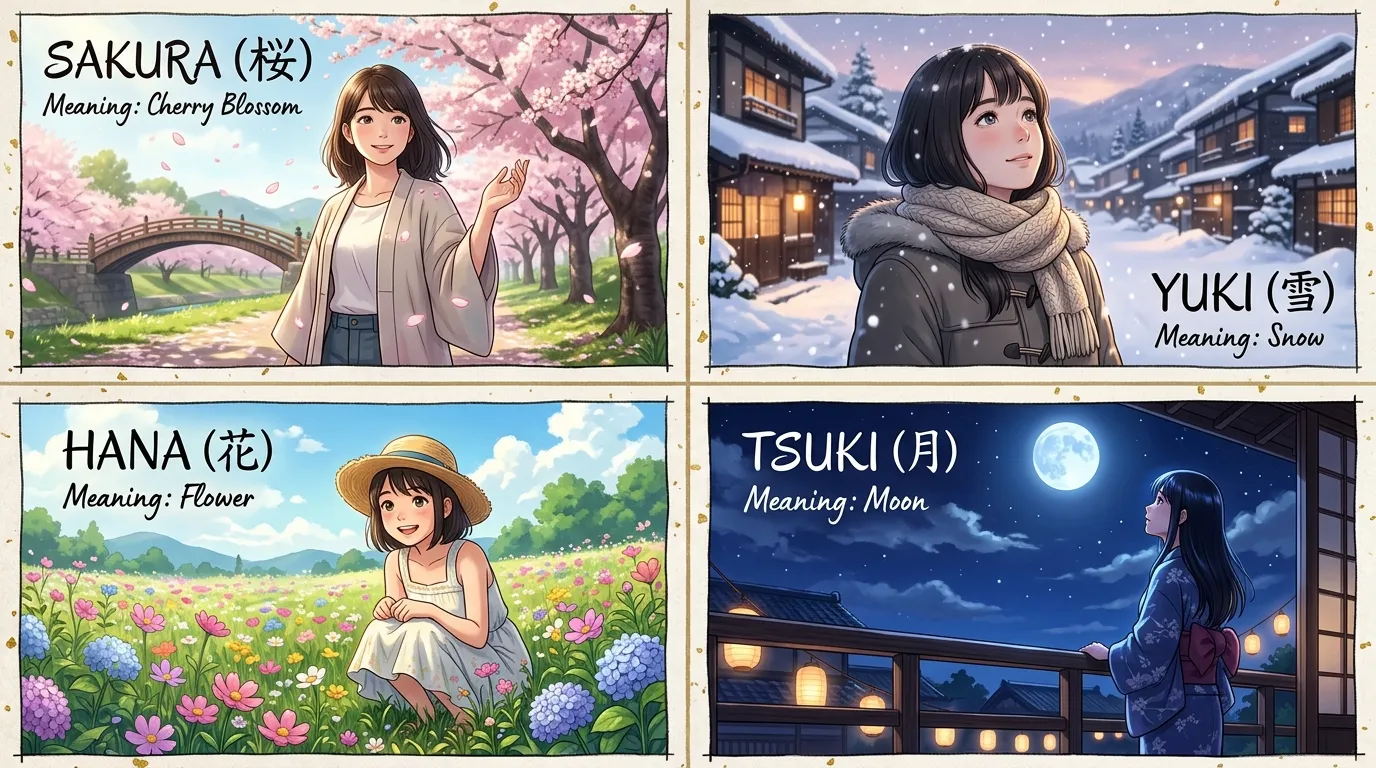
6. Sakura
Meaning: Cherry blossom.
Sakura is one of the best-known Japanese names associated with flowers. Cherry blossoms are closely connected with spring and are often interpreted as symbols of renewal and the fleeting nature of life.
7. Hana
Meaning: Flower, when written 花.
Hana is short, easy to pronounce, and directly associated with flowers through its common kanji spelling.
8. Sumire
Meaning: Violet flower, when written 菫.
Sumire is a traditional Japanese name associated with the violet. It has a gentle, nature-inspired quality.
9. Tsubaki
Meaning: Camellia, when written 椿.
Tsubaki refers to the camellia flower. It is an evocative choice for someone interested in botanical names.
10. Ayame
Meaning: Iris, when written 菖蒲.
Ayame is associated with the iris and has a long history as a Japanese feminine name.
11. Momoka
Meaning: May be associated with peaches or peach blossoms, depending on kanji.
Momoka has a soft sound and is often chosen for its association with flowers or fruit when written with suitable characters.
12. Nanohana
Meaning: Rapeseed blossom or field mustard flower.
Nanohana is a nature-related word and a more distinctive choice than many common Japanese given names.
13. Kaede
Meaning: Maple, when written 楓.
Kaede is a nature-inspired name associated with the maple tree and its changing leaves.
14. Koharu
Meaning: Little spring, when written 小春.
Koharu evokes warmth and the gentle feeling of spring. It is often appreciated for its soft, cheerful sound.
15. Botan
Meaning: Peony, when written 牡丹.
Botan refers to the peony, a flower associated with beauty in East Asian cultural traditions.
Japanese Female Names That Mean Light or Brightness
Names associated with light can suggest hope, warmth, clarity, and optimism. The precise interpretation still depends on the chosen kanji.
16. Hikari
Meaning: Light, when written 光.
Hikari is a clear and recognizable choice for someone who wants a name directly associated with brightness.
17. Akari
Meaning: Light or brightness, depending on the writing.
Akari is a popular-sounding feminine name often associated with illumination and warmth.
18. Hikaru
Meaning: To shine or radiance, depending on the characters used.
Hikaru is a unisex Japanese given name. It can be used for female characters or children and is associated with shining or brilliance in suitable spellings.
19. Akane
Meaning: Madder red or deep red, depending on the spelling and context.
Akane is associated with a rich red color traditionally obtained from the madder plant. It can evoke warmth and vivid autumn colors.
20. Hotaru
Meaning: Firefly, when written 蛍.
Hotaru is an evocative nature-related name associated with the small lights of fireflies on summer evenings.
21. Nozomi
Meaning: Hope or wish, when written 望.
Nozomi is a meaningful name associated with aspirations and positive expectations for the future.
22. Asuka
Meaning: Depends on the kanji; some spellings are associated with flying birds or fragrance.
Asuka is a well-established Japanese given name whose interpretation varies with the characters selected.
23. Tomomi
Meaning: Varies by kanji; some spellings can convey friendship or beauty.
Tomomi can express positive qualities through its chosen characters and has been used as a feminine given name.
Japanese Female Names That Mean Love, Kindness, or Happiness
Names expressing affection, compassion, or happiness can reflect a family’s hopes for a child’s future.
24. Aiko
Meaning: Often interpreted as beloved child when written 愛子.
Aiko is a traditional feminine name. In the spelling 愛子, the first character means love and the second means child.
25. Ai
Meaning: Love, when written 愛.
Ai is a short Japanese name associated with love in this spelling. The pronunciation may be simple, but the meaning is direct.
26. Megumi
Meaning: Blessing or grace, when written 恵.
Megumi is associated with kindness, blessings, and favor. It has been used as a feminine given name for many years.
27. Sachiko
Meaning: Often associated with happiness or a fortunate child, depending on kanji.
Sachiko is a traditional name that can express a wish for happiness or good fortune.
28. Emi
Meaning: Depends on kanji; some spellings can mean beautiful blessing or beautiful smile.
Emi is a concise and familiar feminine name. Its intended meaning depends on the characters chosen.
29. Yumi
Meaning: Varies by kanji; possible interpretations include beauty and other positive qualities.
Yumi has a gentle, classic sound and is used as a Japanese feminine given name.
30. Eiko
Meaning: May express prosperity, glory, or other meanings depending on kanji.
Eiko is a traditional feminine name that can convey positive wishes when written with suitable characters.
31. Fumiko
Meaning: Varies by kanji; some spellings associate the name with writing or a child.
Fumiko has a traditional quality and may appeal to people interested in classic Japanese names.
32. Yuko
Meaning: Depends on kanji; possible associations include gentleness, excellence, or a child.
Yuko is a familiar feminine name with several possible interpretations based on its spelling.
Japanese Female Names That Mean Strength or Wisdom
Some Japanese names are chosen for meanings related to intelligence, courage, discipline, or resilience. These qualities can be expressed through different kanji combinations.
33. Chie
Meaning: Wisdom or intelligence, when written 智恵 or 知恵.
Chie is associated with knowledge and good judgment in these spellings. It is a concise name with a thoughtful meaning.
34. Satomi
Meaning: Depends on kanji; some spellings can suggest wisdom or beauty.
Satomi is a feminine name whose interpretation varies according to its written form.
35. Masumi
Meaning: Varies by kanji; possible associations include purity or truth.
Masumi can express qualities such as clarity or sincerity, depending on how it is written.
36. Naomi
Meaning: Varies by kanji in Japanese; some spellings can convey honesty or beauty.
Naomi is used in several cultures, including Japan. Its Japanese interpretation depends on the selected characters and should not automatically be equated with interpretations from other languages.
37. Kaori
Meaning: Fragrance, when written 香織 or with other suitable characters.
Kaori is a familiar Japanese feminine name associated with fragrance in common spellings. The exact interpretation changes with the kanji.
38. Rei
Meaning: Depends on the kanji; possible meanings include courtesy, spirit, or gratitude.
Rei is a short, versatile name that can be feminine, masculine, or unisex depending on the individual and spelling.
39. Makoto
Meaning: Sincerity or truth, when written 誠.
Makoto is generally a unisex name and can express honesty or integrity in this spelling.
40. Kaori
Meaning: Fragrance in common spellings.
Kaori also fits names associated with gentle or refined qualities. It is listed here because of its association with fragrance, not because every spelling means strength or wisdom.
Traditional Japanese Female Names
Traditional names may evoke earlier generations, literary associations, seasonal imagery, or long-established naming conventions.
| Name | Common meaning or association |
|---|---|
| Haruko | Spring child, when written 春子 |
| Fumiko | Meaning varies by kanji |
| Keiko | Meaning varies by kanji; some spellings convey respect or blessing |
| Kimiko | Meaning varies by kanji; some spellings convey a noble or precious child |
| Sachiko | Happiness or fortunate child in some spellings |
| Yoshiko | Meaning varies by kanji; may express goodness or virtue |
| Chiyoko | May be interpreted as a child of a thousand generations, depending on kanji |
| Noriko | Meaning varies by kanji; some spellings relate to rules or principles |
| Kazuko | Often associated with harmony or peace, depending on kanji |
| Toshiko | Meaning varies by kanji; some spellings convey wisdom or alertness |
| Michiko | Meaning varies by kanji; may be associated with beauty or a path |
| Setsuko | Meaning varies by kanji; some spellings relate to seasons or sections |
These names have traditional associations, but their exact meanings cannot be established from pronunciation alone.
Modern and Cute Japanese Female Names
Modern Japanese names may favor short sounds, flexible kanji combinations, and meanings connected to beauty, nature, or hope.
| Name | Common association |
|---|---|
| Yuna | Multiple possible meanings depending on kanji |
| Riko | Multiple possible meanings depending on kanji |
| Mei | Multiple possible meanings depending on kanji |
| Hina | Multiple possible meanings depending on kanji |
| Mio | Multiple possible meanings depending on kanji |
| Rin | Multiple possible meanings depending on kanji |
| Yui | Connection or binding in some spellings |
| Saki | May be associated with a blossom or future, depending on kanji |
| Kanna | Multiple possible meanings depending on kanji |
| Rina | Multiple possible meanings depending on kanji |
| Kohane | Can be associated with a small feather when written with suitable characters |
| Miu | Multiple possible meanings depending on kanji |
A cute-sounding name does not necessarily have one fixed meaning. If you are choosing a name for a child, verify the intended kanji and consider how the full name sounds together.
Japanese Female Names Inspired by Seasons
Seasonal names are a distinctive part of Japanese naming culture. They can evoke particular times of year, landscapes, and feelings.
| Name | Meaning or association |
|---|---|
| Haruka | May suggest distance; often has other meanings depending on kanji |
| Haruko | Spring child in the spelling 春子 |
| Natsumi | Often associated with summer and beauty in some spellings |
| Natsuki | May include characters associated with summer or hope |
| Akiko | May mean autumn child in one spelling, but varies by kanji |
| Fuyuko | Winter child when written 冬子 |
| Koharu | Little spring when written 小春 |
| Kaede | Maple tree |
| Momiji | Autumn leaves or maple leaves, depending on context |
| Yukina | May be associated with snow or other meanings, depending on kanji |
Seasonal associations can be poetic, but a name’s actual meaning depends on its written form.
How Japanese Female Names Are Written
Japanese names can be written in kanji, hiragana, or katakana. Understanding these writing systems is essential for interpreting a name accurately.
Kanji
Kanji are characters used in Japanese writing that often carry meaning. Many given names use kanji to express qualities or hopes, such as love, light, flowers, or happiness.
For example:
花 (Hana): Flower.
光 (Hikari): Light.
愛 (Ai): Love.
春子 (Haruko): Spring child.
望 (Nozomi): Hope or wish.
These examples show how written characters can help establish a name’s intended meaning.
Hiragana
Hiragana is a phonetic writing system. Some Japanese names are written entirely in hiragana, giving them a softer visual appearance without directly specifying a meaning through kanji.
For instance, a name may be written さくら rather than 桜. Both are read Sakura, but the written forms differ.
Katakana
Katakana is another phonetic writing system, commonly used for foreign words and some names. It may also appear in certain personal naming contexts.
Because hiragana and katakana primarily represent sounds, a name written in these scripts may not communicate the same explicit kanji meaning.
How to Choose a Japanese Female Name
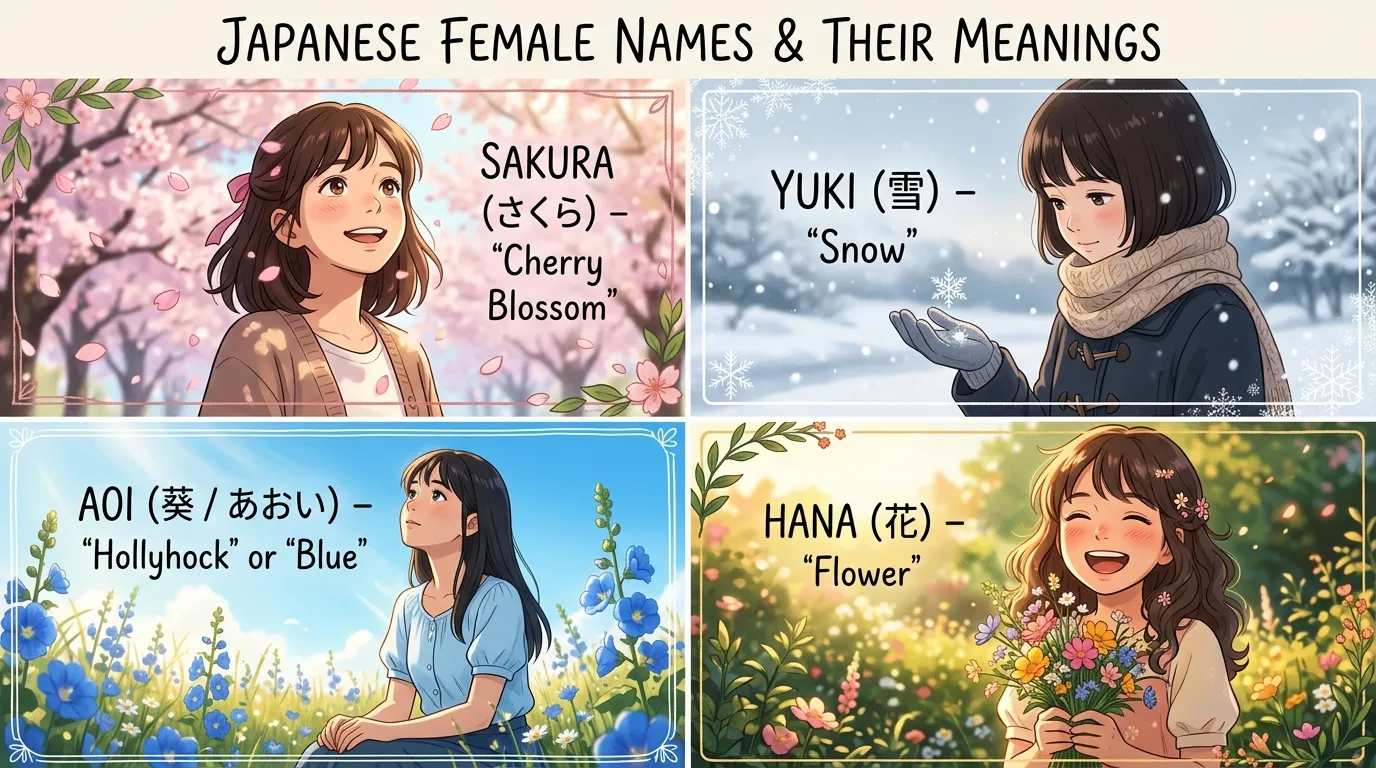
If you are selecting a Japanese name for a baby, a fictional character, or a creative project, consider more than its English translation.
Choose the intended meaning. Decide whether you prefer a name associated with flowers, light, love, wisdom, or another theme.
Verify the kanji. Check the specific characters and their natural interpretation in Japanese.
Consider pronunciation. Choose a name you can pronounce comfortably and respectfully.
Check cultural context. Learn whether the name is traditional, contemporary, uncommon, or strongly associated with a particular public figure or fictional character.
Think about the full name. The surname and given name should sound natural together.
Use reliable references. Japanese dictionaries and native-speaker guidance can help confirm meanings and avoid awkward character combinations.
If you are choosing a name for a real child, remember that the meaning depends on the actual written form. A name listed online with one English translation may have several different interpretations in Japanese.