

Insolvent — Quick Definition
Insolvent (adjective)
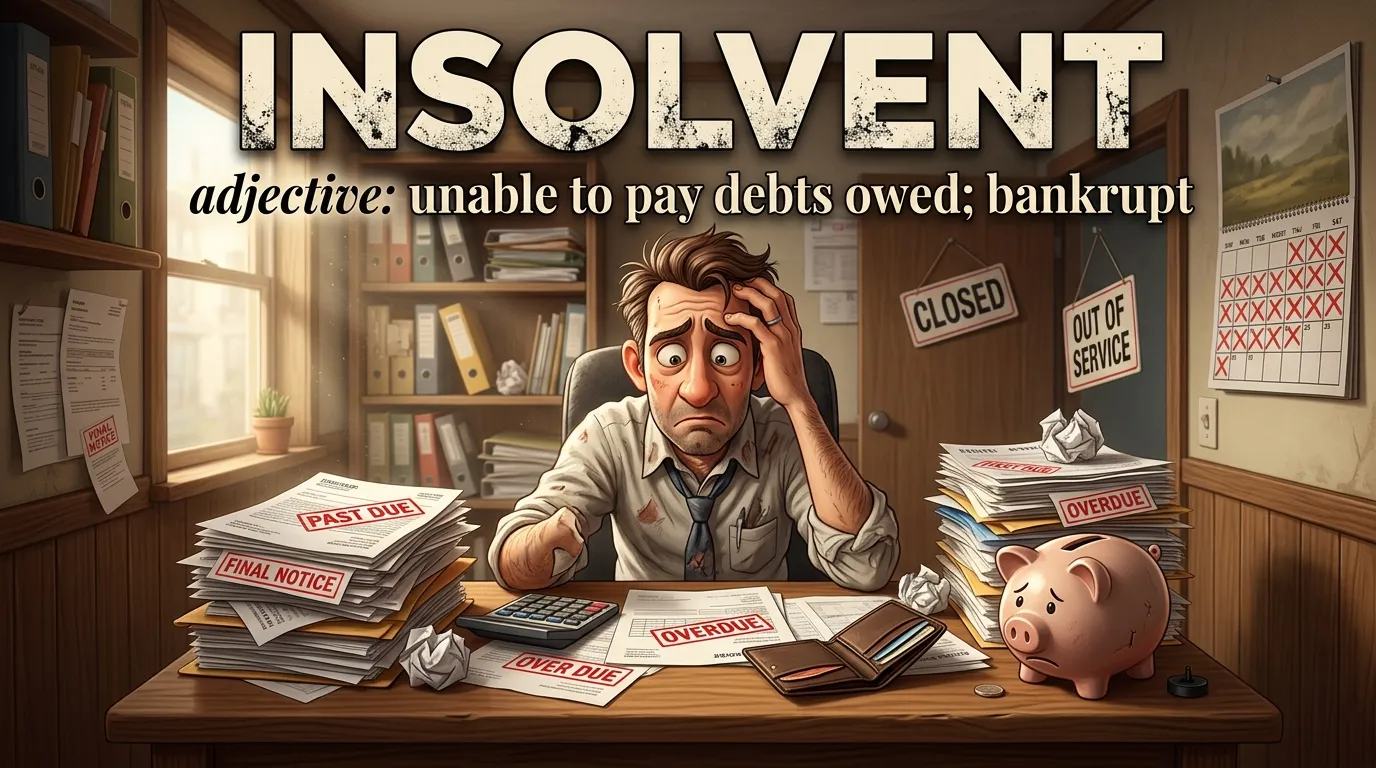
Unable to pay debts or financial obligations, or meeting a legally or financially recognized test of insolvency.
Simple meaning: Not having the financial ability to pay what you owe.
Example: The company became insolvent after its debts grew beyond what it could reasonably pay.
Part of Speech
Insolvent is an adjective. It describes the financial condition of a person, business, or organization.
Singular: The business is insolvent.
Plural subject: The companies are insolvent.
Related noun: Insolvency — the condition of being insolvent.
Related verb: Insolvency is not a verb; become insolvent is the usual expression.
Related term: Insolvent debtor — a person who cannot meet their debt obligations under the relevant legal or financial test.
Definitions of Insolvent
The word has several related meanings:
Unable to pay debts: A person or organization cannot meet financial obligations when payment is due.
Liabilities exceed assets: Under a balance-sheet approach, debts and other liabilities exceed the value of assets.
Financially distressed: An individual or company faces serious difficulty meeting payments, although the exact legal classification may require further assessment.
Legally insolvent: A person or entity meets the definition of insolvency under the law that applies to its circumstances.
These definitions overlap, but they are not identical. A person might own valuable property yet lack enough cash to pay an urgent bill. Conversely, a business may have cash available today while its total liabilities exceed its assets. Different legal systems and financial frameworks assess these situations differently.
Pronunciation of Insolvent
Pronunciation: /ɪnˈsɒlvənt/ (British English); /ɪnˈsɑːlvənt/ (American English)
Phonetic spelling: in-SOL-vuhnt
Syllables: Three
Word type: Adjective
Etymology: Where Does Insolvent Come From?
Insolvent entered English through French and Latin roots associated with the idea of not paying or discharging an obligation. It combines the negative prefix in- with a form related to Latin solvere, meaning “to loosen,” “release,” or “pay.”
The historical sense reflects the central meaning of the modern word: being unable to discharge a financial obligation.
Semantic Field of Insolvent
The word belongs to several connected areas:
Personal finance: unpaid bills, loans, arrears, and debt obligations.
Business finance: liabilities, assets, cash flow, creditors, and financial distress.
Accounting: balance sheets, working capital, and the value of assets and liabilities.
Law: insolvency proceedings, creditor claims, restructuring, and bankruptcy.
Economics: financial stability, defaults, and the ability to meet obligations.
Understanding these related concepts helps distinguish everyday financial difficulty from a legally established state of insolvency.
The Deeper Meaning and Nuance of Insolvent
The word insolvent describes more than simply being short of money. It refers to a financial condition in which obligations cannot be met, or in which a person or business satisfies a recognized insolvency test. The distinction matters because a temporary cash shortage does not always mean that someone is insolvent.
Insolvent vs. Temporarily Short of Cash
Imagine a business that owns valuable equipment and property but does not have enough cash to pay a supplier today. It might be experiencing a liquidity problem rather than being insolvent under every applicable test.
Now imagine another business whose debts substantially exceed the value of everything it owns and that cannot meet its payments. It may be insolvent under both cash-flow and balance-sheet approaches.
The two concepts are related, but a lack of immediate cash and insolvency are not always the same thing.
What Does It Mean When a Company Is Insolvent?
When a company becomes insolvent, it may struggle to pay employees, suppliers, lenders, rent, taxes, or other obligations. Depending on its financial position and local law, it may seek restructuring, negotiate with creditors, obtain new funding, or enter formal insolvency proceedings.
Insolvency does not automatically mean that a company has permanently closed. Some businesses recover through restructuring or financial support; others may eventually be liquidated.
What Does It Mean When a Person Is Insolvent?
An individual may be described as insolvent when they cannot pay their debts as they become due or meet the applicable legal test. For example, a person may owe several lenders more than they can realistically repay from available income and assets.
However, being insolvent does not necessarily mean having no money or property at all. Someone may own a house or other valuable assets and still be unable to make required payments on time.
Insolvent in Legal and Financial Contexts
In legal usage, the word can have a specific statutory meaning. In Pakistan, for example, Section 2(8) of the Sale of Goods Act, 1930, defines an insolvent person in terms that include ceasing to pay debts in the ordinary course of business or being unable to pay debts as they become due. The definition applies within that statute’s context and should not automatically be treated as the universal definition for every legal proceeding.
In financial analysis, insolvency may be assessed by looking at payment capacity, assets, liabilities, or other applicable criteria. In formal legal proceedings, the relevant legislation determines what counts as insolvency and what consequences follow.
How to Use Insolvent in a Sentence
The word insolvent is most commonly used in finance, business, law, banking, and discussions about debt.
1. Business: The company became insolvent after losing several major customers.
2. Banking: Regulators investigated whether the bank was insolvent or simply facing a temporary shortage of cash.
3. Personal finance: He feared becoming insolvent after missing several loan payments.
4. Law: The court considered evidence about whether the business was insolvent under the applicable legislation.
5. Creditors: The insolvent firm could not pay all its suppliers on time.
6. Accounting: The auditor examined the company’s assets and liabilities to assess whether it was insolvent.
7. Economic reporting: Several struggling businesses were at risk of becoming insolvent.
8. Debt recovery: The creditor sought legal advice after discovering that the debtor might be insolvent.
9. Financial planning: The owners introduced cost reductions to prevent the business from becoming insolvent.
10. General usage: A person can face serious financial difficulties without necessarily being legally declared insolvent.
Common Grammatical Patterns
Pattern | Example |
|---|---|
Become insolvent | The business became insolvent after years of losses. |
Be declared insolvent | The company was declared insolvent under the relevant procedure. |
Insolvent company | The lender reviewed the company’s financial position. |
Insolvent debtor | The insolvent debtor sought professional legal advice. |
Insolvent business | Suppliers stopped extending credit to the insolvent business. |
Nearly insolvent | The organization was nearly insolvent after a sharp decline in revenue. |
Technically insolvent | The company’s liabilities exceeded its assets under the test being applied. |
Insolvent estate | The estate did not have sufficient assets to cover all its liabilities. |
Grammar tip: Use insolvent after linking verbs such as be, become, remain, and appear. The related noun insolvency describes the condition itself: “The business faced insolvency.”
Different Ways to Say Insolvent
The closest synonym depends on whether you mean an inability to pay debts, severe financial hardship, or a formal legal status.
Synonyms for Insolvent
Unable to pay: A plain-English description that focuses on missed or unaffordable obligations.
Bankrupt: Often used in everyday language to mean unable to pay debts; in legal contexts, it can refer to a formal status or process that differs by jurisdiction.
Financially distressed: Describes a person or business experiencing serious financial pressure, without necessarily establishing insolvency.
In default: Describes failure to meet a particular contractual or financial obligation, such as a loan payment. Default does not always mean the borrower is insolvent.
Overindebted: Describes a situation in which debt is excessive relative to income, assets, or repayment capacity.
Broke: An informal expression for having little or no money available; it is not a precise legal or accounting term.
Related Words
Insolvency: The condition or state of being insolvent.
Insolvent debtor: A debtor who meets the relevant insolvency criteria.
Liquidation: A process involving the realization of assets and distribution of proceeds to creditors, where applicable.
Restructuring: A process of reorganizing debts, operations, or finances to improve the chances of continued operation or repayment.
Default: Failure to meet an obligation according to its terms.
Antonyms of Insolvent
The most direct antonym is solvent.
Solvent: Financially able to meet obligations or satisfying the relevant solvency test.
Financially stable: Having a relatively secure financial position.
Creditworthy: Considered sufficiently reliable to receive credit, according to a lender’s assessment.
Liquid: Having cash or assets that can readily be converted into cash to meet near-term obligations.
These terms are not perfect opposites in every context. For example, a person may be solvent overall but temporarily lack liquidity.
Insolvent in Context: Common Phrases and Collocations
These common word combinations help explain how insolvent is used in legal, financial, and business writing.
Phrase | Meaning and example |
|---|---|
Become insolvent | Enter a state of insolvency. The company became insolvent after its debts increased. |
Declared insolvent | Formally recognized as insolvent through a relevant legal or regulatory process. The firm was declared insolvent under the applicable procedure. |
Insolvent company | A business that meets the relevant insolvency criteria. The insolvent company began discussions with its creditors. |
Insolvent debtor | A debtor unable to meet obligations under the applicable test. The creditor sought advice regarding the insolvent debtor. |
Risk of insolvency | The possibility that a person or organization may become insolvent. Falling sales increased the risk of insolvency. |
Insolvency proceedings | Formal legal procedures dealing with insolvency. The company entered insolvency proceedings. |
Avoid insolvency | Take steps intended to prevent insolvency. The business reduced costs to avoid insolvency. |
On the brink of insolvency | Very close to becoming insolvent. The retailer was on the brink of insolvency after months of losses. |
Useful Expressions With Insolvent
Technically insolvent: Describes a situation where an entity meets a particular technical insolvency test, even if it continues operating.
Declared insolvent by a court: Indicates a formal judicial determination, where the relevant legal system provides for one.
An insolvent estate: An estate whose available assets are insufficient to cover its liabilities under the relevant assessment.
Prevent a company from becoming insolvent: Take financial or operational measures to try to maintain the company’s ability to meet its obligations.
Insolvent but still operating: Describes a business that continues trading despite its financial condition; whether it may lawfully continue operating depends on local law.
When to Use Insolvent vs. Similar Terms
Although insolvent, bankrupt, in default, and financially distressed are related, each term emphasizes a different situation.
Term | Main meaning | Best used when | Example |
|---|---|---|---|
Insolvent | Unable to pay debts or meeting a recognized insolvency test | Discussing a person’s or organization’s financial condition | The company was insolvent under the applicable test. |
Bankrupt | Unable to pay debts in ordinary usage; may also indicate a formal legal status | Referring to financial failure or a specific bankruptcy process | The individual filed for bankruptcy. |
In default | Failed to meet a particular obligation | Discussing missed loan payments or contractual duties | The borrower was in default on the loan. |
Financially distressed | Experiencing serious financial difficulty | Describing a warning stage or general financial pressure | The company was financially distressed after losing a major contract. |
Overindebted | Carrying debts that are excessive relative to repayment capacity or assets | Emphasizing the burden of debt | The household was overindebted. |
Illiquid | Lacking readily available cash or cash-equivalent resources | Discussing short-term payment difficulties | The company was illiquid despite owning valuable property. |
Solvent | Able to meet obligations or passing the applicable solvency test | Describing the opposite financial condition | The business remained solvent after restructuring its loans. |
Insolvent vs. Bankrupt
Insolvent generally describes a financial condition, while bankrupt may describe financial failure or a formal legal status. In everyday English, the words sometimes overlap. Legally, however, insolvency and bankruptcy are not necessarily interchangeable, and the distinction depends on the jurisdiction.
Insolvent vs. In Default
A borrower can be in default because a payment was missed, even if they have sufficient assets to repay the debt. Insolvency is broader and concerns the person’s or organization’s ability to meet obligations or its status under a recognized test.
Insolvent vs. Illiquid
An illiquid business may have valuable assets but insufficient cash to pay bills immediately. An insolvent business may be unable to meet obligations or may fail an asset-liability test. The two conditions can occur together, but neither word should automatically be substituted for the other.
Related Concepts and Semantic Network
[link: insolvency meaning]
The state of being unable to meet debts or obligations under the relevant financial or legal test. It is the noun form related to insolvent.
[link: bankruptcy meaning]
A term that commonly describes serious financial failure and may refer to a formal legal process for dealing with debts.
[link: default meaning in finance]
Failure to make a payment or satisfy another obligation under an agreement. Default may be a warning sign of financial trouble but does not always establish insolvency.
[link: liquid assets meaning]
Assets that can readily be converted into cash with relatively little loss of value. Liquid assets help individuals and businesses meet immediate financial obligations.
[link: debt restructuring meaning]
The process of changing the terms or structure of debts to make repayment more manageable or support a business’s financial recovery.
These concepts are connected but distinct. Insolvency describes a financial condition, bankruptcy and insolvency proceedings concern legal processes, default refers to an unmet obligation, liquidity concerns access to cash, and restructuring is one possible response to financial distress.