
Conversion Meaning in Farsi
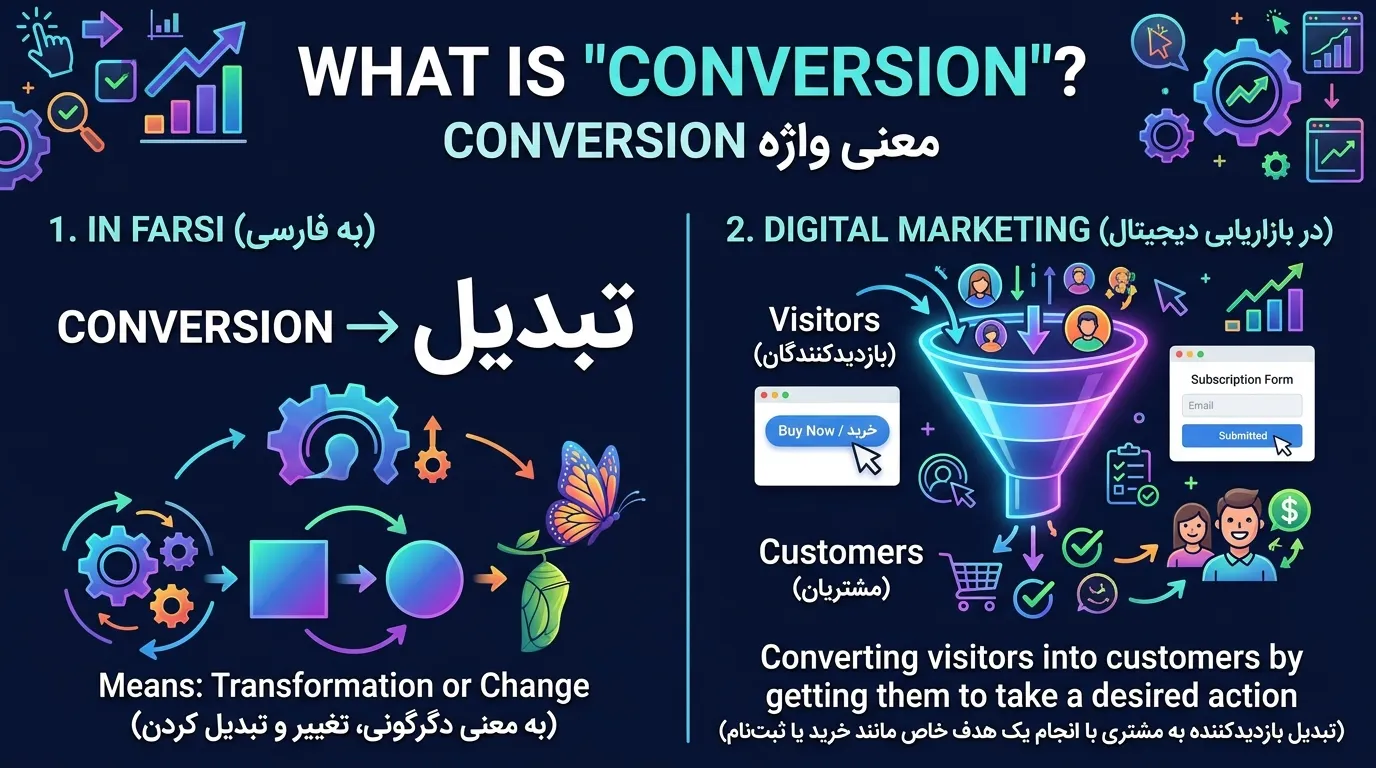
The English word conversion means changing something from one form, condition, system, or purpose into another. In Farsi (Persian), its most common translation is تبدیل (Tabdil). Depending on the context, it can also mean تغییر (Taghyir) or دگرگونی (Degarguni).
Farsi translations of conversion:
English | Farsi | Meaning in Urdu |
|---|---|---|
Conversion | تبدیل | تبدیلی |
Change | تغییر | تبدیلی |
Transformation | دگرگونی | بدلاؤ |
Exchange | مبادله | تبادلہ |
Religious conversion | تغییر مذهب | مذہب کی تبدیلی |
Example sentences:
Currency conversion: تبدیل ارز
Data conversion: تبدیل دادهها
Conversion to Islam: گرویدن به اسلام
Conversion of energy: تبدیل انرژی
The exact Farsi word depends on what is being changed or converted.
Conversion Meaning in Digital Marketing
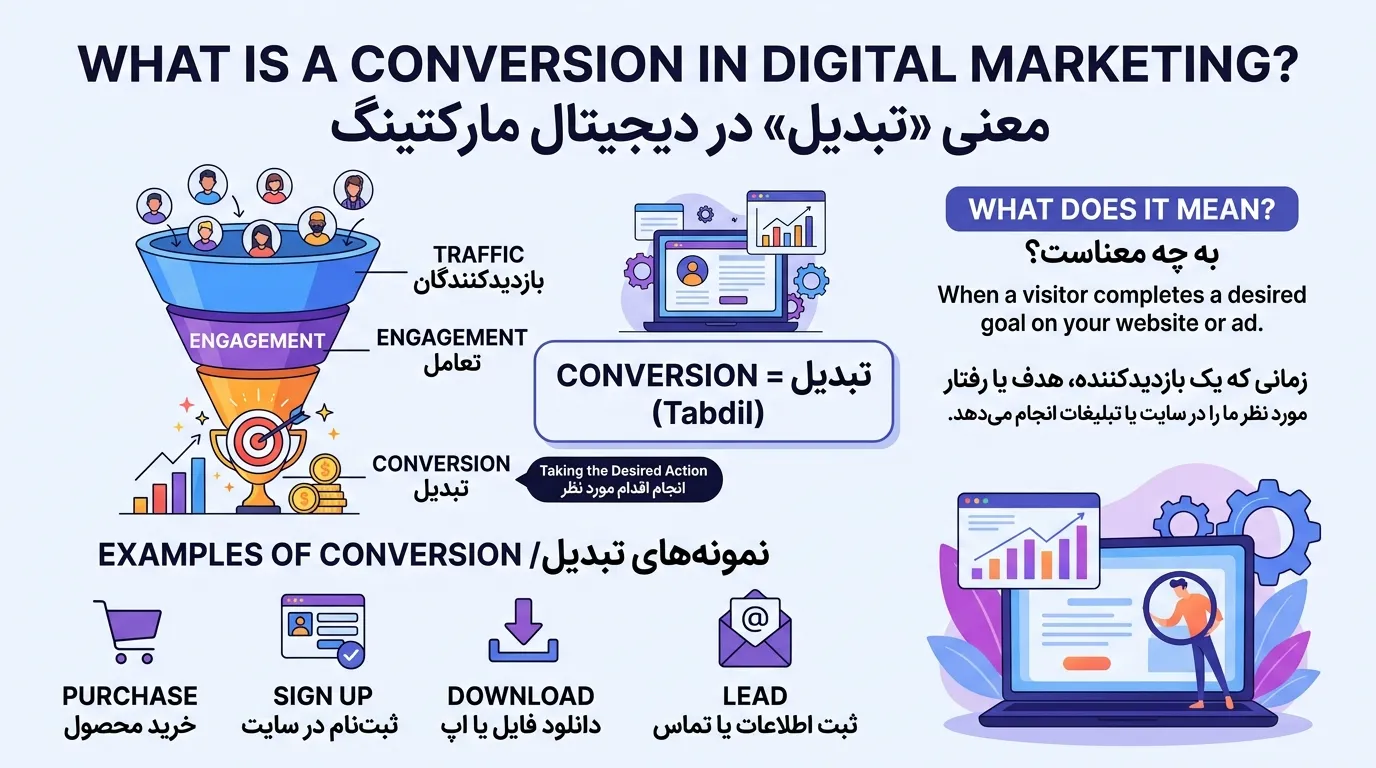
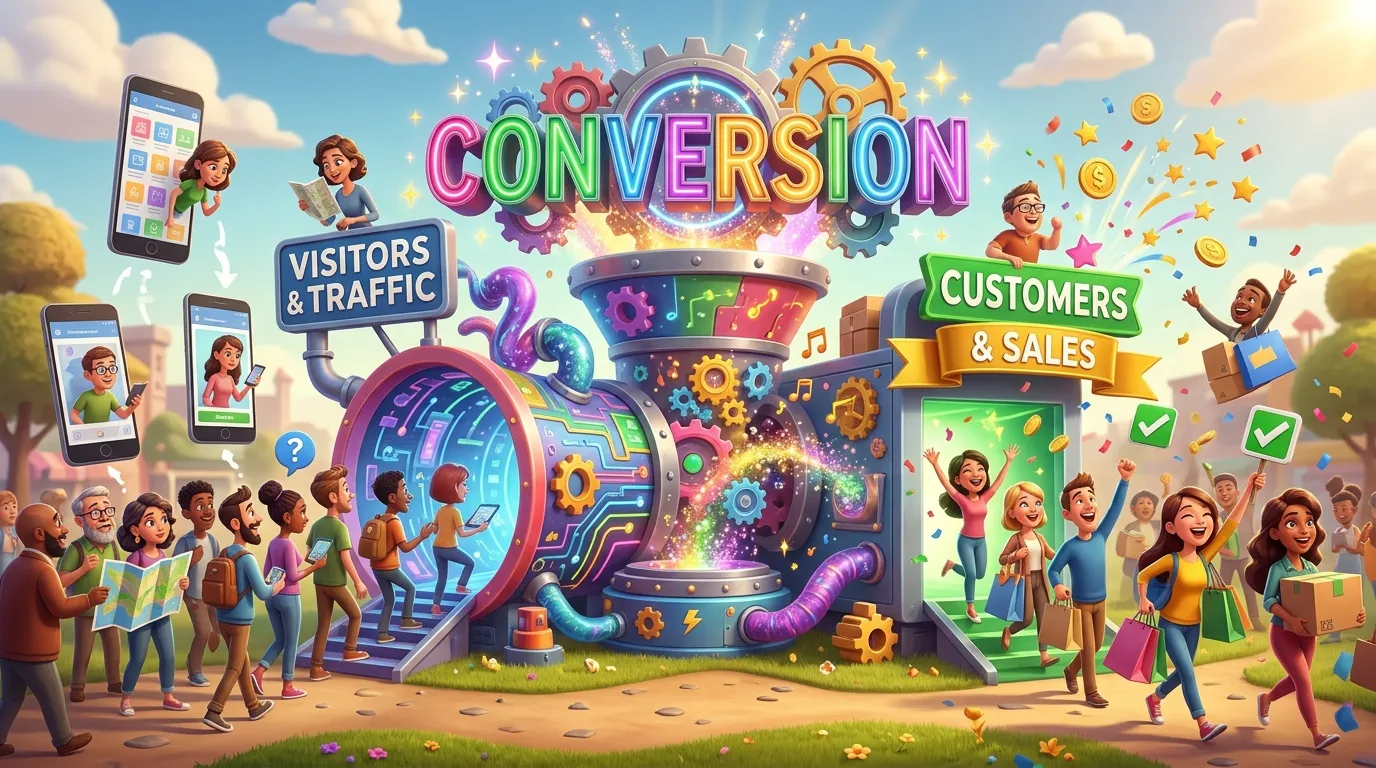
In digital marketing, conversion means when a website visitor or potential customer completes a specific action that a business wants them to take.
In simple English, a conversion happens when someone takes a desired action after seeing an advertisement, visiting a website, or interacting with a marketing campaign.
Examples of digital marketing conversions:
Buying a product from an online store.
Signing up for an email newsletter.
Filling out a contact form.
Downloading an ebook or guide.
Registering for an online course.
Booking a consultation.
Installing a mobile application.
What is a conversion rate?
Conversion rate is the percentage of visitors or users who complete the desired action.
For example, if 1,000 people visit a website and 50 purchase a product, the conversion rate is:
Example sentence: The company improved its website design to increase conversions and attract more paying customers.
Conversion Meaning in Hospital
In a hospital, conversion can have different meanings depending on the medical situation. It generally refers to changing from one medical state, treatment method, or form into another.
Common medical uses include:
1. Conversion from IV to Oral Medication
Changing a patient’s medicine from an intravenous (IV) form, given through a vein, to an oral form, taken by mouth.
2. Conversion from Intensive Care to General Care
Moving a patient from intensive care to a regular hospital ward when their condition improves enough.
3. Conversion of Treatment
Changing a treatment plan from one method to another based on the patient’s condition or response.
4. Conversion in Surgery
Changing from one surgical approach to another when necessary. For example, a surgeon may convert a laparoscopic procedure into open surgery if continuing the original approach is not safe or practical.
Example sentences:
The doctor approved the conversion from IV medication to oral medication.
The patient was transferred to a general ward after improving.
The surgeon decided on conversion to open surgery.
The exact meaning depends on the medical report or conversation in which the word appears.
Conversion Meaning in Sales
In sales, conversion means turning a potential customer or interested person into someone who completes a desired sales action, usually purchasing a product or service.
In simple words, sales conversion happens when a prospect becomes a customer.
Examples of sales conversion:
A person visits a store and buys a laptop.
A customer contacts a salesperson and purchases a service.
Someone who requested a product quote decides to place an order.
A free-trial user becomes a paying subscriber.
A potential customer signs a contract.
What is a sales conversion rate?
It measures the percentage of potential customers who make a purchase.
For example, if a salesperson talks to 100 potential customers and 20 buy something, the sales conversion rate is 20%.
Example sentences:
The sales team is working to improve its conversion rate.
Good customer service can help increase sales conversions.
The company converted several interested prospects into paying customers.
Conversion Meaning in Job
In a job or employment context, conversion usually means changing a worker’s employment status, role, or work arrangement into another form.
The exact meaning depends on the company’s policies and the situation.
Common examples include:
1. Contract to Permanent Conversion
When a company changes an employee’s contract position into a permanent job.
2. Temporary to Permanent Conversion
When a temporary worker receives permanent employment status.
3. Internship to Full-Time Job Conversion
When a company offers an intern a regular paid position after completing an internship.
4. Part-Time to Full-Time Conversion
When an employee’s working arrangement changes from part-time hours to full-time hours.
5. Career Conversion
When someone changes their career path and moves into a different profession or industry.
Example sentences:
The company approved the conversion of his temporary position into a permanent role.
She received a full-time job offer after her internship conversion.
The employee requested conversion from part-time to full-time work.
In job advertisements or HR documents, conversion often refers to a change in employment status rather than getting a completely new job.
Conversion Meaning in Biology
In biology, conversion means changing one biological substance, structure, form, or state into another. It can describe processes that happen inside cells, organisms, or biological systems.
The exact meaning depends on the biological topic.
Examples of conversion in biology:
1. Glucose Conversion
Cells break down glucose through metabolic processes to release usable energy.
2. Energy Conversion
Plants convert light energy from the sun into chemical energy through photosynthesis.
3. Food Conversion
The digestive system breaks food into smaller nutrients that the body can absorb and use.
4. Genetic Conversion
Gene conversion is a process in which genetic information from one DNA sequence replaces or changes information in another similar sequence.
5. Seroconversion
Seroconversion occurs when specific antibodies become detectable in the blood after an immune response, such as following an infection or vaccination.
Example sentences:
Photosynthesis involves the conversion of light energy into chemical energy.
The body uses metabolic processes to convert nutrients into energy.
Researchers studied gene conversion during DNA repair.
In simple terms, biological conversion means a change involving living organisms, cells, genes, or biological substances.
Conversion Meaning in Physics
In physics, conversion means changing one form of energy, measurement, unit, or physical quantity into another.
It is commonly used when studying energy, motion, electricity, heat, and measurement systems.
Common examples of conversion in physics include:
1. Energy Conversion
Changing energy from one form into another.
For example, an electric heater converts electrical energy into heat energy.
2. Unit Conversion
Changing a measurement from one unit to another without changing its actual value.
Examples:
1 kilometer = 1,000 meters.
1 hour = 60 minutes.
1 kilogram = 1,000 grams.
3. Electrical Energy Conversion
A battery converts chemical energy into electrical energy.
4. Potential to Kinetic Energy Conversion
When an object falls, its gravitational potential energy decreases while its kinetic energy increases.
5. Heat Conversion
A machine or engine can convert thermal energy into mechanical work.
Example sentences:
Energy conversion is an important concept in physics.
The experiment demonstrated the conversion of electrical energy into heat.
Students learned how to perform unit conversion in physics.
The main idea is that conversion changes how a physical quantity is expressed or how energy is transferred from one form to another.
Conversion Meaning in Rugby
In rugby, a conversion is an attempt to score extra points after a team scores a try. A player kicks the ball from a position in line with where the try was scored, aiming to send it over the crossbar and between the two goalposts.
In simple English, a rugby conversion is a kick taken after a try to earn additional points.
How does a rugby conversion work?
A team scores a try by grounding the ball in the opponent’s in-goal area.
The team receives an opportunity to attempt a conversion kick.
A player kicks the ball toward the goalposts.
If the ball passes above the crossbar and between the posts, the kick is successful.
How many points is a conversion worth?
In rugby union, a successful conversion is worth 2 additional points after a try, which is worth 5 points.
Example:
A team scores a try worth 5 points.
The player successfully kicks the conversion.
The team receives 2 more points.
Total score from the try and conversion: 7 points.
Example sentences:
The player scored a try and successfully completed the conversion.
The team missed the conversion kick.
A successful conversion increased the team’s score by two points.
The word conversion in rugby refers specifically to the extra scoring kick after a try.
What Does Conversion Mean?
Conversion is a noun that describes the act or process of changing something from one form, condition, system, or purpose into another. It can also refer to the result of that change.
According to the Cambridge Dictionary, the word covers several uses, including changes in systems, currency exchange, religious beliefs, and business performance.
Quick Definition
Word: Conversion
Part of speech: Noun
Pronunciation: kuhn-VUR-zhuhn or kuhn-VUR-shuhn
Primary meaning: The process of changing something into a different form or state.
Common contexts: Business, finance, mathematics, technology, religion, construction, and sports.
Common synonyms: Transformation, change, alteration, adaptation, and modification.
Related verb: Convert.
Plural form: Conversions.
For example, converting a paper document into a digital file is a type of conversion because the information moves from one format to another.
The meaning depends on context. In finance, conversion may involve exchanging currencies. In religion, it can describe adopting a new faith. In digital marketing, it often means completing an action that a business wants a visitor to take.
The Deeper Meaning of Conversion
Conversion is a broad term because different fields use it to describe different kinds of change.
1. Conversion as a Change in Form
In its general sense, conversion means changing something into another form or condition while giving it a new appearance, structure, or function.
For example, a warehouse may undergo conversion to become an apartment building. The physical structure remains, but its purpose changes.
This meaning is common in construction, manufacturing, education, technology, and everyday conversation.
2. Conversion as an Exchange
In finance, conversion often means exchanging one type of value for another.
Examples include changing US dollars into British pounds or converting one type of financial security into another. The goal is to obtain an equivalent or different form of value according to the applicable exchange terms.
The amount received may depend on exchange rates, fees, and other conditions.
3. Conversion as a Change in Beliefs
Conversion can describe a significant change in someone’s religious faith, political views, or personal convictions.
For example, a person who adopts a new religion may describe the experience as a religious conversion.
This use often suggests a meaningful change in identity, beliefs, or the way someone understands the world.
4. Conversion as a Business Result
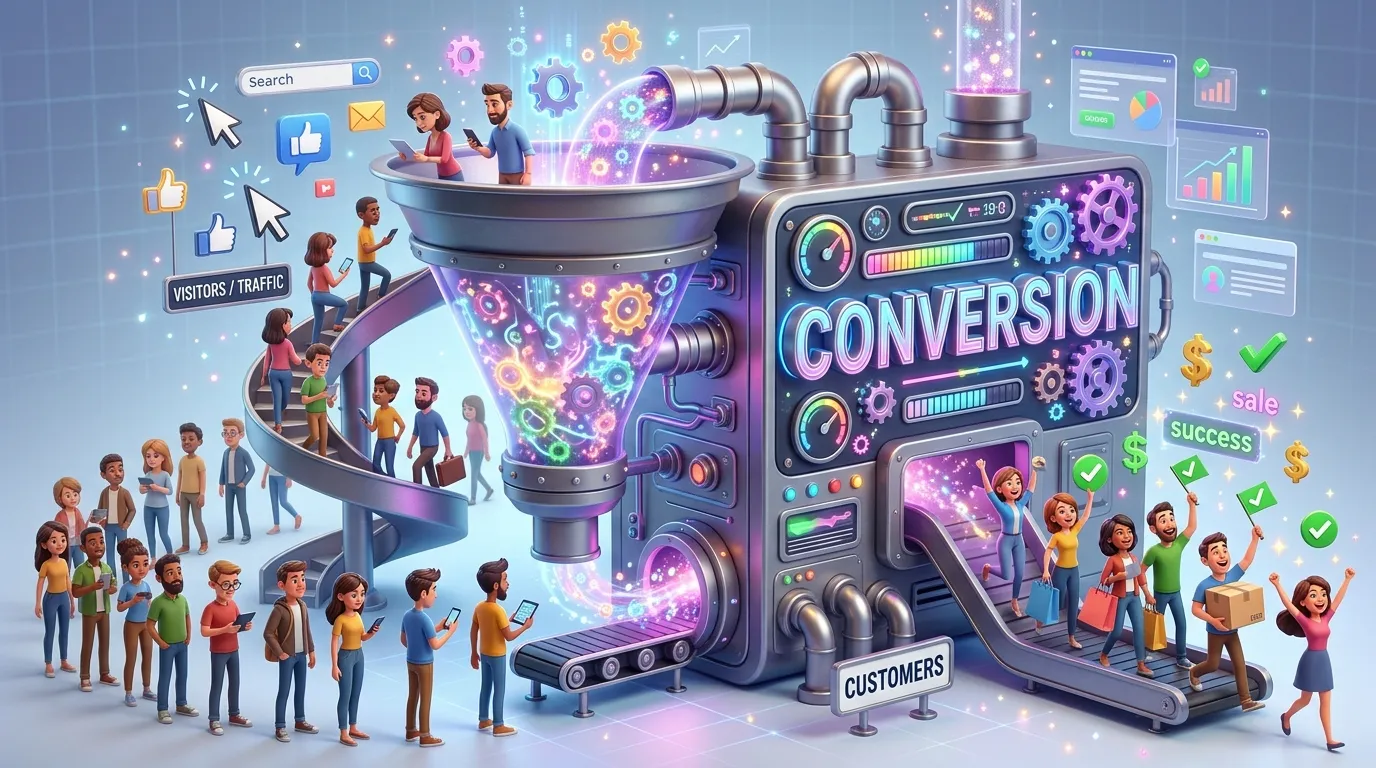
In business and digital marketing, a conversion occurs when someone completes a desired action.
Depending on the organization’s goal, that action might be purchasing a product, booking an appointment, submitting a form, downloading a resource, or subscribing to a service.
A website can receive thousands of visitors, but its conversion performance depends partly on how many visitors complete the intended action.
5. Conversion as a Change in Use
Conversion can also describe adapting something for a new purpose.
For example, turning an unused attic into a bedroom is an attic conversion. Changing a traditional paper-based process into a digital workflow is another example.
The original object or system may remain recognizable, but its function changes.
Examples of Conversion in a Sentence
These examples show how the word is used in different situations.
Everyday life: The conversion of the spare bedroom into a home office gave the family more working space.
Finance: The currency conversion fee increased the total cost of the international transaction.
Mathematics: The conversion of meters into centimeters helped the student solve the problem.
Technology: The software supports the conversion of video files into different formats.
Business: The company improved its website conversion rate by simplifying the checkout process.
Religion: Her conversion to a new faith followed years of personal reflection.
Construction: The conversion of the old factory into apartments took several months.
Energy: Solar panels allow the conversion of sunlight into electrical energy.
Education: The conversion of printed records into digital files made information easier to search.
Sports: The player scored a conversion after the team completed a successful try.
Manufacturing: The conversion of raw materials into finished products required specialized equipment.
Transportation: The vehicle underwent a conversion to accommodate a different type of fuel.
Each example involves a change, but the exact process and outcome differ.
Types of Conversion in Different Fields
Conversion in Mathematics
Mathematical conversion means changing a quantity, unit, or numerical representation into another form without changing its underlying value when the conversion is exact.
For example:
1 meter = 100 centimeters.
1 hour = 60 minutes.
1 kilogram = 1,000 grams.
A student may convert 3 meters into 300 centimeters to express the same length using a different unit.
Conversion is important in calculations because measurements must often use compatible units before they can be compared or combined.
Conversion in Finance
Financial conversion refers to exchanging one currency, asset, or financial instrument for another.
Currency conversion is a familiar example. A traveler may exchange Pakistani rupees for euros before visiting Europe.
Other financial contexts include converting certain securities into another type of security under specified terms.
The exact result depends on the transaction, applicable rates, fees, and contractual conditions.
Conversion in Digital Marketing
In digital marketing, a conversion happens when a visitor completes a desired action on a website, landing page, or advertisement.
Common conversions include:
Buying a product.
Registering for an account.
Subscribing to a newsletter.
Completing a contact form.
Booking a consultation.
Downloading an application.
A conversion does not always involve a purchase. The business defines the desired action based on its marketing objective.
What Is a Conversion Rate?
The conversion rate measures the proportion of visitors or users who complete a specified action.
The basic formula is:
[
\text{Conversion Rate}=\frac{\text{Conversions}}{\text{Total Visitors}}\times100
]
For example, if 50 out of 1,000 website visitors make a purchase, the conversion rate is 5%.
Different analytics platforms may define the denominator differently, using visitors, sessions, clicks, or another eligible population. Comparisons are most useful when the measurement method stays consistent.
Conversion in Technology
Technology uses conversion to describe changing data, files, systems, or formats.
Examples include converting a Word document into a PDF, changing an image from PNG to JPEG, or moving information from an older database format into a newer one.
Successful conversion usually aims to preserve the information needed in the new format, although some formatting, features, or metadata may not transfer perfectly.
Conversion in Religion
Religious conversion refers to adopting a different religion or changing one’s religious beliefs or affiliation.
The process can be gradual or sudden. It may involve personal reflection, study, spiritual experiences, participation in a religious community, or formal religious practices.
The term describes a change in faith or religious commitment; the circumstances vary from person to person.
Conversion in Construction and Real Estate
In construction, conversion means changing a building or space so it can serve a different purpose.
Examples include:
Converting an attic into a bedroom.
Turning a warehouse into apartments.
Transforming an office into a residential property.
Adapting a barn into a family home.
Building conversions may require structural work, safety improvements, planning permission, or other approvals depending on local rules.
Conversion in Energy and Science
In science, conversion often describes changing energy or materials from one form into another.
For example, a solar panel converts light energy into electrical energy. A power station may convert chemical energy into heat and then into electricity.
The exact process depends on the technology or scientific system involved.
Conversion vs. Transformation vs. Modification
These words are related, but each emphasizes a different aspect of change.
| Word | Main meaning | Example |
|---|---|---|
| Conversion | Changing something into another form, system, or use | Converting a PDF into a Word document |
| Transformation | A significant or often extensive change | Transforming an empty lot into a public garden |
| Modification | Changing or adjusting part of something | Modifying a website’s layout |
| Adaptation | Adjusting something to suit a new purpose or condition | Adapting a lesson for younger students |
| Alteration | Making a change to an existing object or arrangement | Altering a jacket to improve its fit |
| Transition | Moving from one state, stage, or situation to another | Transitioning from school to university |
The words sometimes overlap. However, conversion often emphasizes the new form or function, transformation highlights the extent of the change, and modification usually suggests an adjustment to something that already exists.
Synonyms and Antonyms of Conversion
Common Synonyms
The best synonym depends on the kind of change being described.
Transformation: A substantial change in form, character, or appearance.
Change: A general shift from one state or condition to another.
Alteration: A change made to something existing.
Modification: An adjustment to improve or change a feature.
Adaptation: A change made to suit a new purpose or environment.
Exchange: Giving one thing and receiving another.
Transition: Moving between stages or conditions.
Reformation: A change intended to improve something, or a significant change in beliefs in certain contexts.
For example, transformation may fit a major redesign, while exchange is often more precise for swapping one currency for another.
Antonyms of Conversion
There is no single opposite that fits every meaning of conversion. Depending on the context, useful contrasting terms include:
Preservation: Keeping something in its existing condition.
Retention: Keeping or maintaining something.
Continuity: Maintaining an ongoing state or process.
Stability: Remaining steady without significant change.
Reversal: Returning a change toward an earlier state or undoing its effects.
For example, preserving a building in its original condition contrasts with converting it into a different type of property.
Common Phrases and Collocations With Conversion
A collocation is a combination of words that commonly appear together.
Currency Conversion
The exchange of one currency for another.
Example: The bank displayed the currency conversion rate before processing the transfer.
Data Conversion
The process of changing data from one format or representation into another.
Example: Data conversion helped the organization move records into its new software system.
Conversion Rate
A percentage or ratio measuring how often a desired action occurs among a defined group of users or visitors.
Example: The online store improved its conversion rate after making the checkout process easier.
Religious Conversion
The process of adopting a new religion or changing religious beliefs.
Example: His religious conversion followed a long period of study and reflection.
Energy Conversion
The process of changing energy from one form into another.
Example: The device uses energy conversion to turn sunlight into electricity.
Building Conversion
The process of changing a building’s structure or use for a new purpose.
Example: The building conversion created modern apartments inside an old industrial property.
Conversion Process
A series of steps used to change something from one form, system, or purpose to another.
Example: The conversion process preserved most of the original document’s formatting.
Related Words and Word Forms
Understanding the related forms of conversion helps expand vocabulary.
Convert
Convert is a verb meaning to change something into another form, use, or condition.
Example: The application can convert images into several file formats.
Converted
Converted is the past tense and past participle of convert. It can also function as an adjective.
Example: The converted warehouse now serves as a community center.
Converting
Converting is the present participle of convert and can describe an ongoing process.
Example: The team is converting paper records into digital files.
Convertible
Convertible is an adjective describing something that can be changed into another form or use. It can also be a noun for certain types of cars.
Example: The furniture is convertible, allowing the sofa to become a bed.
Conversional
Conversional is a rare adjective related to conversion. In most everyday writing, a more specific phrase such as conversion-related is clearer.