

The Deeper Meaning and Nuance of Concentration
The meaning of concentration changes depending on what is being focused, measured, or gathered. Although the different definitions share the idea of directing or bringing something together, the context determines the precise interpretation.
Mental concentration: Giving attention to one thing
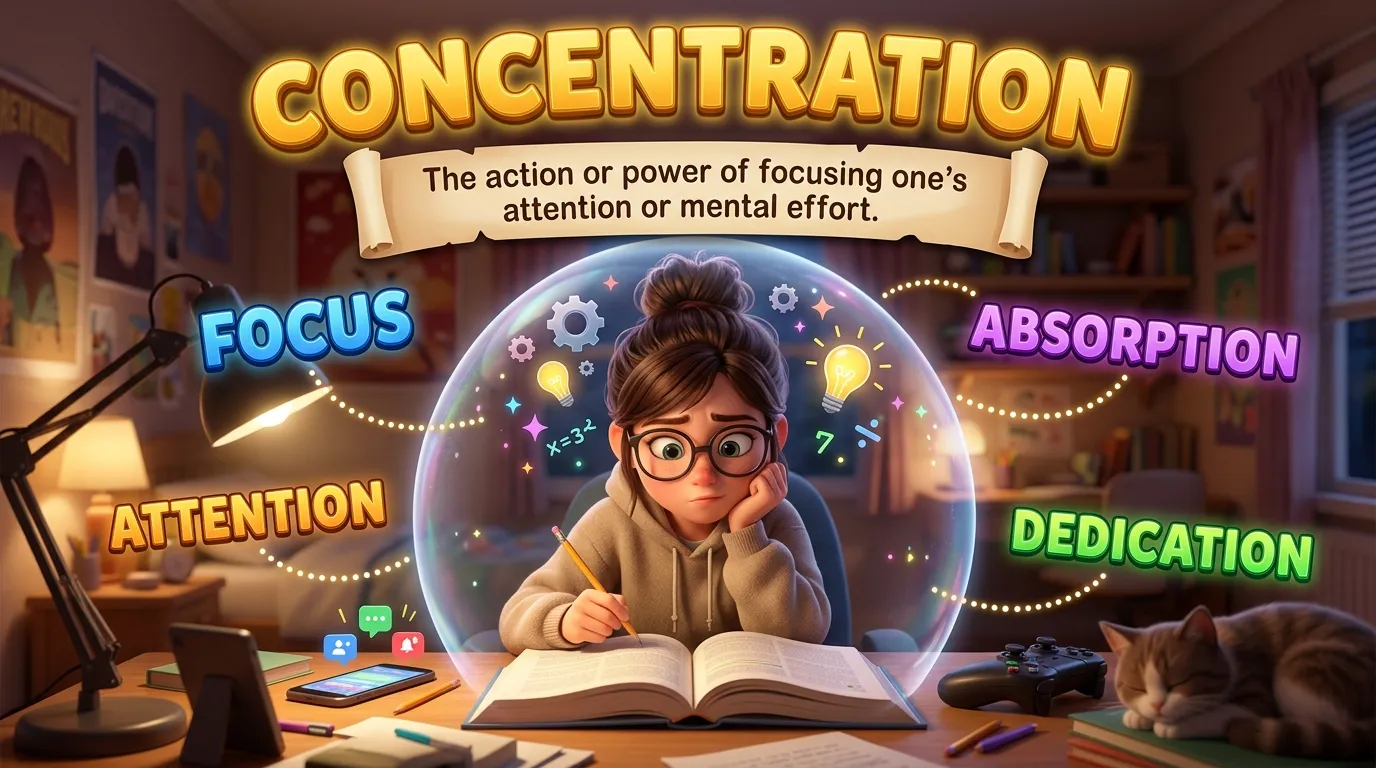
Mental concentration is the ability to direct attention toward a particular activity, thought, or problem while limiting distractions. It plays an important role in reading, studying, problem-solving, sports, and skilled work.
For example, a student solving a difficult mathematics problem needs to keep relevant information in mind instead of repeatedly shifting attention to unrelated notifications. The concentration involved is not simply looking at the page; it is actively processing information and maintaining attention long enough to complete the task.
Concentration can also vary in intensity. A person may concentrate lightly while listening to familiar music or intensely while performing a complex surgical procedure. The amount of attention required depends on the task.
Scientific concentration: Measuring the amount of a substance
In chemistry, concentration refers to the amount of a particular substance present in a specified quantity of a mixture or solution. The substance being measured is often called the solute, while the substance that dissolves it is the solvent.
For example, saltwater with more dissolved salt per liter of solution has a higher salt concentration than saltwater with less salt per liter.
Concentration can be expressed in several ways, including molarity, mass concentration, and parts per million. The correct measurement depends on the substance and the purpose of the experiment.
This scientific meaning is different from mental focus, even though both involve a kind of directed intensity.
Concentration as a large amount in one place
Concentration can also describe the clustering of people, resources, businesses, wealth, or other things within a particular area or group.
Examples include:
A high concentration of hospitals in a major city.
A concentration of technology companies in an industrial district.
A concentration of wealth among a small number of individuals.
A concentration of wildlife around a reliable water source.
In these cases, the word describes distribution rather than attention or chemical composition. A high concentration means that many items or a large amount of something are found in a particular place or group relative to the relevant area or population.
Formal versus informal usage
In academic and professional writing, concentration can be used precisely to describe attention, chemical composition, or the distribution of resources.
In everyday speech, it most often refers to mental focus.
Formal: “The experiment measured the concentration of dissolved minerals in the sample.”
Informal: “I can’t concentrate with the television on.”
The word also appears in education. A student’s concentration may mean the ability to focus, while an academic concentration at a university can refer to a specialized area of study within a degree program.
A real-world analogy
Imagine a flashlight shining on a wall. When its beam is spread across a large area, the light is less concentrated. When the beam is focused on a smaller area, the light becomes more concentrated.
This analogy illustrates the general idea of gathering something into a narrower focus. Mental concentration works similarly in a loose sense: attention is directed toward one task rather than spread across multiple distractions.
However, concentration does not always mean narrowing. In chemistry, it refers to the amount of a substance relative to a defined quantity; in geography, it describes how densely things are distributed.

How to Use Concentration in a Sentence
These examples demonstrate the word’s different meanings across everyday conversation, academic writing, professional work, and science.
[Formal] The report examined the concentration of economic resources among a small number of corporations.
[Academic] Regular practice can help students maintain concentration during demanding examinations.
[Casual] I need a quiet room because I lose concentration whenever people talk nearby.
[Professional] The task requires a high level of concentration and careful attention to detail.
[Scientific] Researchers measured the concentration of salt in each water sample.
[Business] The concentration of technology companies in the region has attracted skilled workers and investors.
[Educational] Her chosen concentration in university was environmental science.
[Literary] He stared at the letter with such concentration that he barely noticed the rain against the window.
[Environmental] Scientists discovered a high concentration of pollutants near the industrial discharge point.
[Sports] The goalkeeper maintained concentration throughout the match and reacted quickly to the final shot.
Grammar tip: Common patterns
Concentration is generally an uncountable noun when it refers to mental focus, but it can be countable when referring to particular measured concentrations or concentrations of people and things.
Common constructions include:
Concentration on something: “The team’s concentration on quality improved the final result.”
Concentration of something: “The concentration of minerals exceeded the expected level.”
A high concentration of: “The area contains a high concentration of small businesses.”
Loss of concentration: “A sudden noise caused a brief loss of concentration.”
Power of concentration: “The athlete’s power of concentration helped her perform under pressure.”
Concentration in a field: “His academic concentration is in economics.”
A useful distinction is that concentrate is the verb, while concentration is the noun. You concentrate on a task, and your concentration helps you complete it.
Different Ways to Say Concentration (Synonyms & Alternatives)
The best synonym depends on whether concentration means mental attention, the strength of a solution, or the gathering of people and resources.
Exact and strong synonyms
Focus: The act of directing attention toward a particular task, topic, or objective; usually the closest everyday alternative for mental concentration.
Attention: The mental process of noticing and processing information, although attention does not always imply sustained effort.
Absorption: A state of deep involvement in an activity, where awareness of surrounding distractions may decrease.
Intensification: An increase in strength or degree, useful when concentration refers to something becoming more intense.
Density: The amount of something within a given space or volume, particularly when describing how closely things are packed together.
These alternatives overlap with concentration but emphasize different aspects. Focus emphasizes direction, absorption emphasizes involvement, and density emphasizes how much is present in a space.
Formal and academic alternatives
Attentional focus: A technical expression for directing mental resources toward relevant information.
Mental application: The deliberate use of thought and attention to complete a task or solve a problem.
Accumulation: The gradual gathering of resources, materials, or quantities over time.
Prevalence: The frequency or proportion of something within a population; it is useful for population studies but is not a direct synonym for concentration.
Molarity: A scientific measure of concentration defined as the amount of solute, in moles, per liter of solution.
Use these terms when the context requires precision. For instance, molarity is appropriate for a chemistry calculation, whereas attentional focus may be suitable in a psychology paper.
Casual and informal alternatives
Paying attention: A straightforward expression for directing the mind toward what is happening.
Staying focused: Emphasizes maintaining attention over time.
Being absorbed: Suggests becoming deeply involved in something.
Keeping your mind on the task: An everyday phrase for avoiding distractions.
Locking in: An informal expression meaning to become fully focused, particularly in sports, gaming, or studying.
For example, “I need to lock in before the exam” is casual, while “I need to maintain concentration before the examination” is more formal.
Powerful and intense alternatives
Intense focus: Emphasizes unusually strong mental attention.
Total absorption: Suggests deep engagement with little awareness of distractions.
Single-mindedness: Describes persistent dedication to one objective, sometimes with the implication that other priorities are being ignored.
Immersion: Emphasizes being deeply engaged in an experience, activity, or subject.
Attentional control: Highlights the ability to direct and regulate attention deliberately.
These alternatives are useful when ordinary concentration does not adequately express the intensity or sustained nature of the mental effort.
Milder and softened alternatives
Awareness: Emphasizes noticing or recognizing something rather than maintaining intense attention.
Interest: Describes curiosity or engagement with a subject, which may support concentration without guaranteeing it.
Engagement: Suggests active involvement in a task or activity.
Attentiveness: Emphasizes being alert to information, instructions, or other people.
Consideration: Highlights thoughtful attention to an issue rather than narrow mental focus.
Antonyms of concentration
The opposite of concentration depends on the intended meaning.
Antonym | Meaning and context |
|---|---|
Distraction | Something that draws attention away from the task at hand. |
Inattention | Failure to give something the necessary attention. |
Dispersal | The spreading of people, resources, or objects over a wider area. |
Dilution | A reduction in the concentration of a solution, commonly by adding solvent. |
Scattering | Distribution across different places rather than gathering in one location. |
For example, distraction is the natural opposite of mental concentration, while dilution is the relevant opposite when discussing the strength of a chemical solution.
Concentration in Context: Common Phrases and Collocations
Collocations are combinations of words that commonly appear together. Learning them makes it easier to recognize and use concentration naturally.
Phrase or collocation | Meaning and example |
|---|---|
Deep concentration | Strong mental focus. Example: “The artist worked in deep concentration.” |
Loss of concentration | A reduction in the ability to focus. Example: “The interruption caused a loss of concentration.” |
Power of concentration | The ability to direct and sustain attention. Example: “Chess can require considerable power of concentration.” |
High concentration of | A large amount of something within a specified quantity or area. Example: “The sample contained a high concentration of iron.” |
Concentration of wealth | The accumulation of wealth among relatively few people or organizations. Example: “The report examined the concentration of wealth in major cities.” |
Concentration on a task | The act of directing attention toward a particular activity. Example: “Concentration on the assignment helped her finish early.” |
Molar concentration | The number of moles of a substance per unit volume of solution, commonly expressed in moles per liter. Example: “The chemist calculated the molar concentration of the acid.” |
Concentration versus dilution in chemistry
In chemistry, concentration and dilution describe related but contrasting changes in a solution.
A concentrated solution contains a relatively large amount of solute compared with a specified quantity of solution. A dilute solution contains a relatively small amount.
For example, adding more water to a salt solution generally lowers its concentration because the same amount of dissolved salt is distributed through a greater volume. This process is called dilution.
The distinction is useful in laboratory work, water-quality testing, medicine, and environmental science, where knowing the amount of a substance can be essential to interpreting results.
When to Use Concentration vs. Its Synonyms
Choosing the right word means identifying whether you are discussing attention, a measurable quantity, or the distribution of things.
Situation | Best word | Why it fits |
|---|---|---|
Paying sustained attention while studying | Concentration or focus | Both describe directed mental attention. |
Noticing a sound or instruction | Attention | Emphasizes awareness rather than prolonged mental effort. |
Becoming deeply involved in a book | Absorption | Highlights engagement and reduced awareness of distractions. |
Measuring a substance in a solution | Concentration or molarity | Concentration is the general term; molarity is a specific measurement. |
Describing many businesses in one district | Concentration or clustering | Highlights the gathering of businesses in a particular area. |
Describing the amount of material packed into a space | Density | Emphasizes the amount per unit of space or volume. |
Describing a diluted chemical solution | Dilution | Focuses on the process that reduces concentration. |
A practical decision framework
Ask yourself three questions before selecting a word:
What is being concentrated? If it is attention, focus may be suitable. If it is a substance, concentration or a specific measurement such as molarity may be more accurate.
Are you describing a process or a state? Concentration can describe the state of being focused, while focusing describes the act of directing attention.
Do you need technical precision? In scientific writing, use the relevant measurement or technical term rather than a general synonym.
Consider these examples:
“Her concentration improved after she turned off her phone.” This refers to mental attention.
“The concentration of salt increased as water evaporated.” This refers to the amount of salt relative to the solution.
“The city has a high concentration of universities.” This refers to the clustering of institutions in one area.
The same noun works in all three sentences because each describes something becoming focused, stronger, or more densely present within a particular context.
Related Concepts and Semantic Network
Concentration connects to several important concepts in psychology, education, chemistry, and economics. Understanding these relationships helps clarify its meaning across different disciplines.
1. Focus
Focus is the direction of attention toward a particular subject or objective. It is the closest everyday alternative to concentration when discussing studying, working, or problem-solving. Focus describes where attention is directed, while concentration often emphasizes maintaining that attention.
Suggested internal link: [link: focus meaning].
2. Attention
Attention is the mental process of selecting and processing particular information. Concentration depends on attention, but it often involves sustaining attention over a longer period or through a demanding task.
Suggested internal link: [link: attention meaning].
3. Density
Density describes the amount of mass or material within a given volume, or more generally how closely things are packed together. It overlaps with concentration when discussing the amount of material in a space, but the two terms are not interchangeable in every scientific context.
Suggested internal link: [link: density meaning].
4. Molarity
Molarity is a specific chemical measure of concentration, calculated as the number of moles of solute per liter of solution. It provides a standardized way to express the amount of a dissolved substance in laboratory calculations.
Suggested internal link: [link: molarity meaning].
5. Dilution
Dilution is the process of reducing a solution’s concentration, usually by adding more solvent. It is particularly relevant in chemistry, pharmaceutical preparation, and water-quality analysis.
Suggested internal link: [link: dilution meaning].
Frequently Asked Questions About Concentration
1. What is the definition of concentration in simple words?
Concentration means giving your attention to one thing, having a certain amount of a substance within a mixture, or having many things gathered in one place. The intended meaning depends on the context. In everyday conversation, concentration usually refers to mental focus, while science often uses it to describe measurable quantities.
2. What is the difference between concentration and focus?
Concentration and focus are closely related when discussing mental attention. Focus generally describes directing attention toward a particular subject, while concentration often emphasizes sustaining that attention. For example, choosing to read a book involves focus, while continuing to read carefully despite distractions demonstrates concentration.
3. What does concentration mean in chemistry?
In chemistry, concentration describes the amount of a substance present in a specified quantity of a mixture or solution. It can be measured using units such as molarity, mass per volume, or parts per million. The appropriate measurement depends on the substance, the sample, and the purpose of the analysis.
4. What are some synonyms for concentration?
Common synonyms for mental concentration include focus, attention, absorption, and attentiveness. In scientific contexts, terms such as molarity may be more precise, while density or clustering may be appropriate when discussing the distribution of things. The best synonym depends on whether concentration refers to attention, chemical composition, or the gathering of resources.
5. What is the opposite of concentration?
The opposite depends on the context. Distraction and inattention are suitable opposites when concentration means mental focus. Dilution is appropriate when discussing the strength of a solution, while dispersal describes things spreading apart rather than remaining gathered in one place.
6. Why is concentration important in everyday life?
Concentration helps people process information, follow instructions, learn new skills, solve problems, and complete tasks accurately. It is particularly useful when activities require sustained attention or careful decisions. In science and industry, concentration measurements also help determine whether mixtures, solutions, or environmental samples meet specific requirements.
7. What is the difference between concentration and dilution?
Concentration describes how much of a substance is present relative to a specified quantity of a mixture or solution. Dilution is the process of lowering that concentration, usually by adding solvent. For example, adding water to a salt solution reduces the salt concentration per unit volume, assuming no salt is added or removed.