
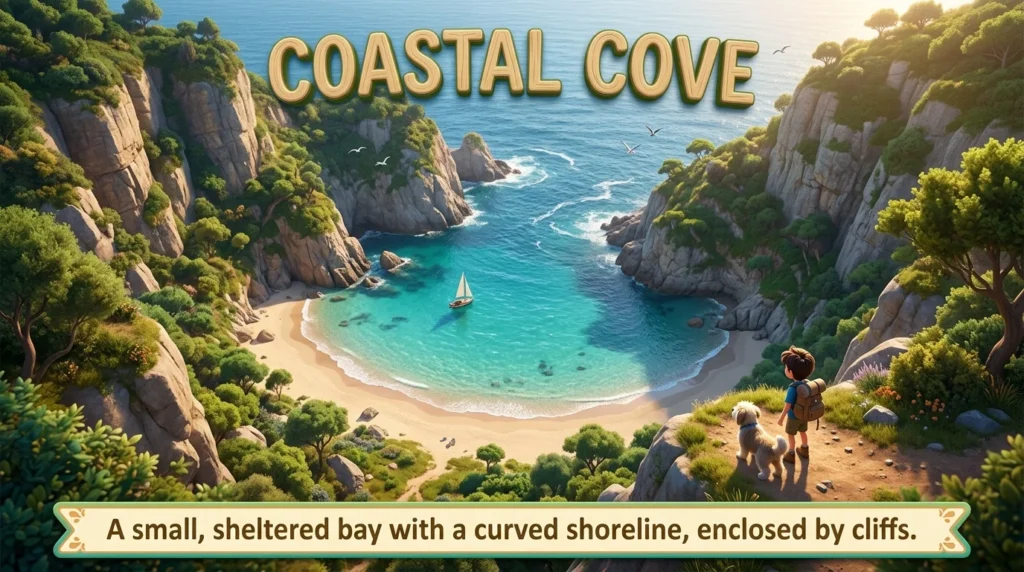
What Does Coastal Cove Mean?
The phrase coastal cove refers to a small inlet or recessed area along the coast where the sea extends into the land. It is commonly characterized by a curved shoreline, partially enclosed water, and a narrower entrance than the surrounding coastline might suggest.
The word coastal relates to the coast, where land meets the sea. A cove is a small, sheltered indentation in a shoreline. Together, the words describe a particular type of coastal feature.
For example, a small body of seawater surrounded by rocky cliffs, with a narrow entrance and a little beach inside, could be described as a coastal cove.
Quick Definition Box
| Feature | Explanation |
|---|---|
| Term | Coastal cove |
| Part of speech | Noun phrase |
| Basic definition | A small, sheltered inlet along a coastline |
| Location | Along an ocean or sea shoreline |
| Common features | Curved shoreline, sheltered water, rocky sides, or a small beach |
| Formation | Coastal erosion, wave action, and geological processes |
| Related terms | Inlet, bay, harbor, shoreline, and coastal landform |
| Common uses | Geography, tourism, recreation, and environmental description |
What Is a Cove in Geography?
In geography, a cove is a coastal indentation where water extends into the land. It is often relatively small and enclosed, although its exact size and shape vary from one region to another.
Some coves are surrounded by steep cliffs, while others have gentle slopes, sandy beaches, or low rocky shores. Their defining characteristic is the shape of the coastline and the degree to which the surrounding land encloses the water.
The word cove can also describe certain sheltered inlets beside lakes or rivers, depending on local usage. However, a coastal cove specifically refers to one along a sea or ocean coast.
How Does a Coastal Cove Form?
Coastal coves develop through geological processes that gradually shape the boundary between land and water. Their formation depends on the type of rock, the energy of the waves, the local coastline, and the history of erosion.
1. Erosion by Waves
Waves repeatedly strike coastal rocks and gradually wear them away. Softer rock may erode faster than harder rock, creating an indentation in the shoreline.
Over time, this indentation can deepen and become a sheltered inlet. The exact shape depends on the direction of the waves, the structure of the rocks, and the surrounding coastal environment.
2. Differences in Rock Resistance
Some coastlines contain alternating bands of hard and soft rock. Softer material may erode more quickly, while harder rock remains relatively resistant.
This differential erosion can produce curved coastal features, including small inlets and coves. However, not every cove forms through this process; some develop through other geological mechanisms.
3. Changes in Sea Level
Changes in sea level can alter the relationship between the land and the sea. Rising sea levels may flood low-lying coastal valleys or depressions, creating sheltered inlets along the shoreline.
In some locations, the resulting coastal features may resemble coves, although their formation history differs from that of coves created primarily by wave erosion.
4. Weathering and Rock Fractures
Rain, temperature changes, salt crystallization, and other forms of weathering can weaken coastal rock. Waves then remove loosened material and gradually reshape the shoreline.
Natural fractures and weaknesses in rock formations can influence where erosion occurs, helping create irregular coastal outlines.
5. Deposition of Sand and Sediment
Waves and currents transport sand, gravel, and other sediments along the coast. When these materials accumulate, they can create beaches or partially shelter an inlet.
Sediment deposition does not always create a cove directly, but it can change the shape and degree of shelter of an existing coastal inlet.
Key Features of a Coastal Cove
Although no two coves are exactly alike, several features commonly distinguish them from other coastal landforms.
Sheltered Water
Many coves provide some protection from waves because surrounding land reduces direct exposure to the open sea. However, shelter depends on the shape of the inlet, the direction of incoming waves, and local weather conditions.
A cove can still experience strong currents, high waves, or dangerous surf during storms.
Curved or Recessed Shoreline
A cove usually has a shoreline that curves inward rather than extending in a straight line. The surrounding land partly encloses the water, giving the feature its recognizable shape.
Some coves are nearly circular, while others are long, narrow, or irregular.
Rocky Cliffs or Sloping Land
Many famous coves are bordered by cliffs or rocky headlands. These features can make the inlet look dramatic and secluded.
Other coves have low coastal vegetation, dunes, or gently sloping ground instead of steep rock walls.
Sandy or Pebbled Beaches
A cove may contain a small beach formed by the accumulation of sand, pebbles, or gravel. These beaches can be popular for recreation because the surrounding land may make the setting feel more sheltered.
Not all coves have beaches. Some have rocky shorelines that extend directly into the water.
Marine and Coastal Habitats
Coves can provide habitats for fish, crabs, mollusks, seaweeds, and other coastal organisms. The particular species present depend on water temperature, salinity, depth, wave exposure, and habitat type.
Sheltered areas may also support seagrass beds, salt-tolerant plants, or other ecologically important communities where local conditions permit.
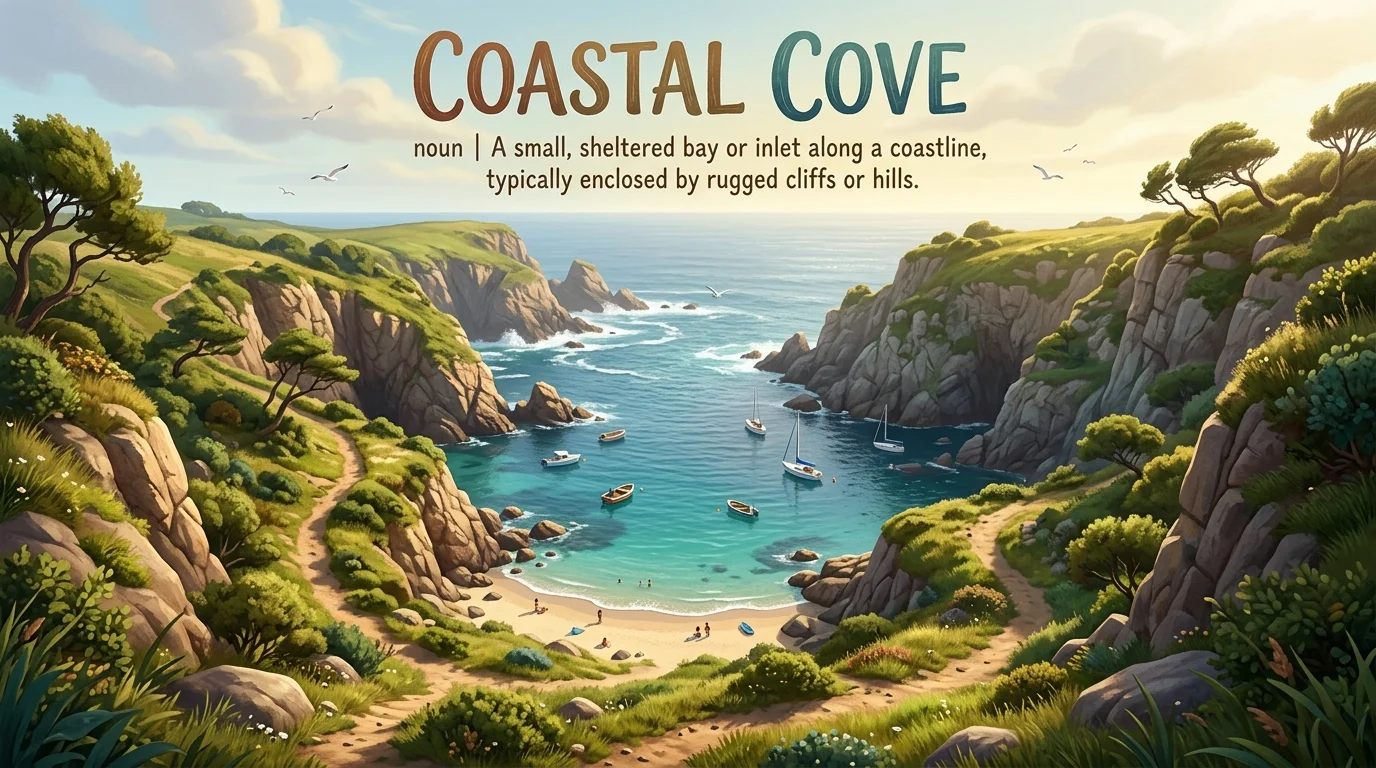
Coastal Cove Examples Around the World
Coves occur along many different coastlines, from rocky Mediterranean shores to rugged Atlantic landscapes. The following locations illustrate the variety of coastal inlets and sheltered shoreline settings.
1. Lulworth Cove, England
Lulworth Cove in Dorset, England, is a well-known example of a rounded coastal inlet. Its curved shape reflects the geological structure of the coastline and the effects of erosion.
The surrounding area is part of a landscape valued for its coastal geology and scenic views.
2. Cala Macarella, Menorca, Spain
Cala Macarella is a picturesque inlet on the Mediterranean island of Menorca. It is known for its clear blue water, pale sandy beach, and surrounding limestone landscape.
The setting illustrates how a coastal cove can combine a curved shoreline with a beach and relatively sheltered water.
3. Cathedral Cove, New Zealand
Cathedral Cove, on New Zealand’s Coromandel Peninsula, is known for its coastal rock formations, sandy shore, and dramatic natural arch.
It is a useful example of how coastal erosion can produce distinctive scenery around sheltered shoreline areas.
4. Emerald Cove, California, United States
Emerald Cove is associated with the scenic coastal environment of Catalina Island, California. Rocky shorelines and clear water characterize many of the island’s small coastal inlets.
Local conditions vary, and not every cove in the area offers the same degree of shelter or access.
These examples demonstrate that coves can differ greatly in appearance. Some are famous for beaches and swimming, while others are better known for geological formations, marine habitats, or scenic viewpoints.
Coastal Cove vs. Bay vs. Inlet
The terms cove, bay, and inlet all describe places where water extends into land, but they differ in typical size, shape, and usage.
| Feature | Coastal Cove | Bay | Inlet |
|---|---|---|---|
| Typical size | Often small | Often larger | Varies considerably |
| Shape | Commonly curved and enclosed | Broad indentation in the coast | A passage or indentation connecting water areas |
| Shelter | Often relatively sheltered | Depends on its shape and exposure | Depends on the surrounding geography |
| Opening | Often relatively narrow | May have a broad opening | May be narrow or broad |
| Common setting | Rocky coasts and small beaches | Large coastal regions and harbors | Coastal passages, lagoons, and waterways |
These distinctions are general rather than absolute. Geographic naming conventions vary, so a feature called a cove in one region may resemble a small bay or inlet elsewhere.
Is a Cove Smaller Than a Bay?
Generally, yes. A cove is usually smaller and more enclosed than a bay. However, there is no single worldwide size limit that separates every cove from every bay.
The name often reflects local geographic convention as much as strict measurements.
Is Every Cove a Harbor?
No. A cove is a natural coastal landform, while a harbor is a place where vessels can find shelter or anchor. Some coves are suitable for boats, but others are too shallow, exposed, rocky, or difficult to access.
A cove may become part of a harbor if its natural shape and local facilities support maritime activity.
Why Are Coastal Coves Important?
Coastal coves matter for ecological, geological, recreational, and sometimes economic reasons.
Ecological Importance
Coves may support marine organisms by providing sheltered habitats, shallow-water environments, and areas where sediments or organic matter accumulate.
Some coves contain sensitive ecosystems, including seagrass beds, rocky intertidal zones, and habitats used by juvenile fish. Pollution, coastal development, and excessive tourism can threaten these environments.
Geological Importance
Coves offer opportunities to study erosion, sediment transport, rock formations, and sea-level changes. Their shapes can reveal how waves and geological structures have influenced the coastline over time.
Geologists may compare neighboring coves to understand why different sections of a coast erode at different rates.
Recreational Value
Many coves attract visitors for swimming, snorkeling, kayaking, photography, and coastal walking. Their enclosed appearance and scenic surroundings can make them especially appealing.
However, calm-looking water should not automatically be considered safe. Hidden rocks, sudden changes in depth, rip currents, and rapidly changing weather can create hazards.
Economic and Cultural Value
Coves may contribute to local tourism and support activities such as small-scale fishing and boating. Some also hold historical significance because sheltered inlets have provided landing places or temporary protection for vessels.
The importance of an individual cove depends on its accessibility, natural environment, local history, and community use.
How to Use Coastal Cove in a Sentence
The phrase is commonly used in geography, travel writing, environmental descriptions, and everyday conversation.
[Geography] The coastal cove formed where waves gradually eroded weaker sections of rock.
[Travel] We discovered a quiet coastal cove surrounded by cliffs and clear blue water.
[Environment] The coastal cove provides habitat for several species of marine life.
[Tourism] Visitors travel to the coastal cove to swim, snorkel, and enjoy the scenery.
[Photography] The photographer captured the coastal cove at sunrise.
[Geology] Researchers examined the coastal cove to study erosion and sediment movement.
[Literary description] The village stood beside a secluded coastal cove protected by rocky headlands.
[Conservation] Local authorities introduced measures to reduce pollution in the coastal cove.
[Adventure] The kayakers paddled into a narrow coastal cove to explore its rocky shoreline.
[Everyday usage] We stopped at a small coastal cove during our drive along the seaside road.
These examples show how the phrase can describe a physical landform, a travel destination, or an environmentally important coastal area.
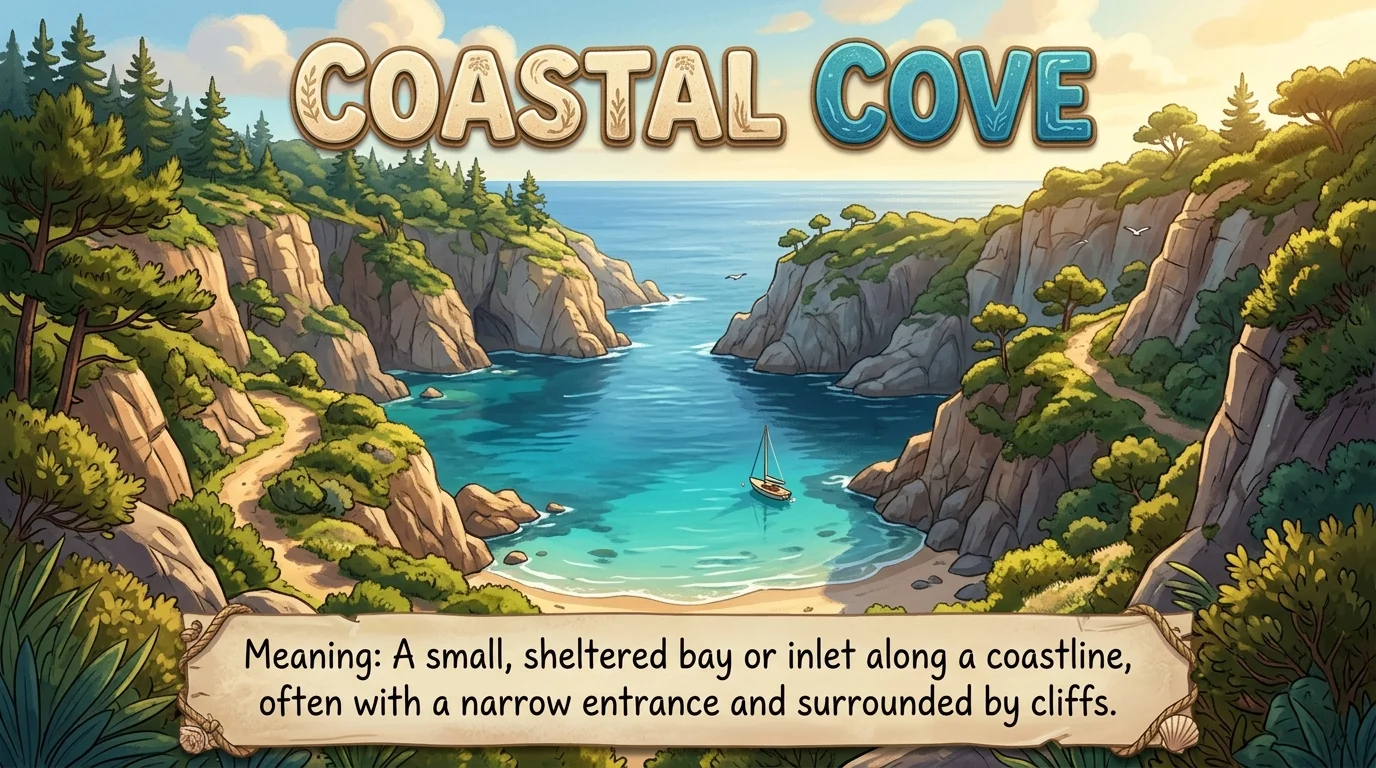
Different Ways to Say Coastal Cove
There is no perfect synonym for coastal cove, because each related term can describe a slightly different geographic feature.
Closest Alternatives
Coastal inlet: A general term for a section of water extending into the land.
Small bay: A small coastal indentation, often similar in appearance to a cove.
Sheltered inlet: Emphasizes protection from waves and open-sea exposure.
Secluded cove: Highlights the sense of privacy or remoteness rather than a different landform.
Rocky inlet: Describes a coastal indentation with a predominantly rocky shoreline.
Related Geographic Terms
Estuary: A coastal area where river freshwater mixes with seawater.
Lagoon: A shallow body of water separated from a larger water body by a barrier such as a sandbar or reef.
Harbor: A sheltered area of water where vessels can anchor or seek protection.
Fjord: A long, deep coastal inlet typically formed by glacial erosion.
Gulf: A large area of sea extending into land, often partly enclosed.
These features can share visual similarities, but they should not be treated as exact synonyms.
Common Phrases Related to Coastal Cove
The following expressions are useful in descriptions of coastal landscapes.
Secluded coastal cove: A cove that is relatively isolated or difficult to reach.
Rocky coastal cove: An inlet surrounded primarily by rocks or cliffs.
Sandy cove: A cove with a sandy shoreline or beach.
Sheltered coastal cove: An inlet that receives some protection from waves or wind.
Hidden coastal cove: A small inlet that is not immediately visible or widely known.
Coastal cove ecosystem: The plants, animals, and physical environment associated with a cove.
Coastal cove erosion: The wearing away of rock or sediment that shapes or changes the inlet.
These phrases help communicate specific characteristics without changing the basic meaning of the term.