
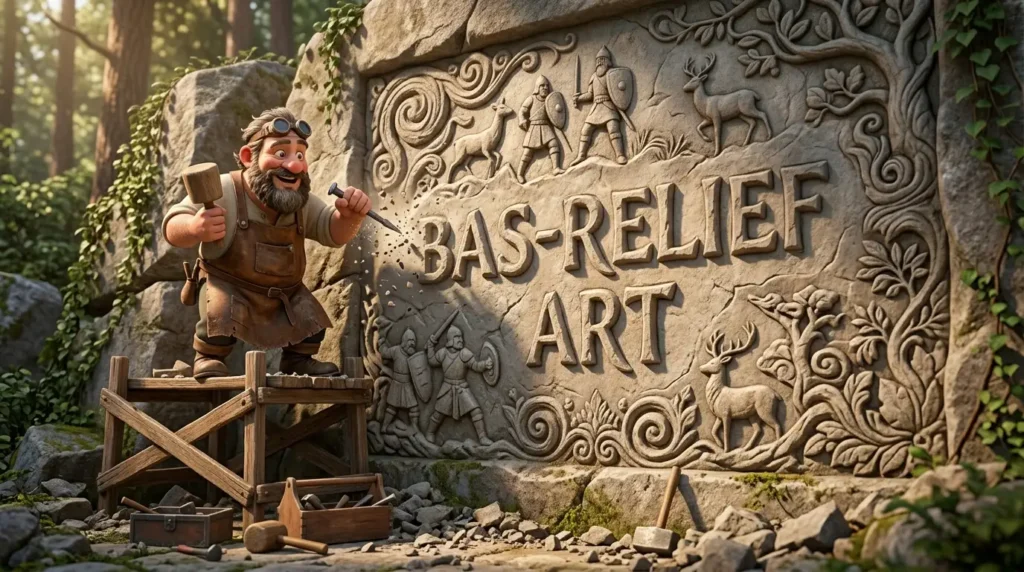
What Does Bas-Relief Art Mean?
Bas-relief art is a form of sculpture in which the design rises only a small distance above its background. The artist carves, models, or shapes the material so that selected areas stand forward while the rest remains comparatively flat.
The term comes from the French bas-relief, meaning “low relief.” The word relief in sculpture describes a design that projects from a supporting surface rather than forming a fully three-dimensional sculpture that can be viewed independently from every side.
| Feature | Explanation |
|---|---|
| Art form | Relief sculpture |
| Alternative name | Low relief |
| Main characteristic | Figures project slightly from a background |
| Common materials | Stone, wood, plaster, clay, metal, and concrete |
| Common uses | Architecture, monuments, decorative panels, coins, and storytelling |
| Visual effect | Depth, texture, and dimension on a relatively flat surface |
For example, a carved stone panel showing people, animals, or plants raised slightly above the surrounding stone is a typical example of bas-relief art.
Unlike a freestanding statue, bas-relief usually remains attached to a background. The artist uses differences in depth, contour, texture, and shadow to make the image appear three-dimensional.
How Does Bas-Relief Art Work?
Bas-relief creates the illusion of depth by making some parts of a design project farther from the background than others. Although the overall sculpture may remain shallow, these small differences can make figures and objects appear distinct.
Shallow Projection
The defining feature of bas-relief is its limited projection. A face, leaf, animal, or human figure may rise only slightly above the surrounding surface. The amount of projection varies depending on the artist, material, and intended effect.
Light and Shadow
Light plays an important role in relief sculpture. Raised areas catch the light, while recessed lines and spaces create shadows. These contrasts help viewers recognize shapes and distinguish foreground elements from the background.
Contour and Detail
Artists use outlines, grooves, surface textures, and carefully shaped edges to suggest form. For example, a carved face may use shallow ridges for the nose, recessed lines for the eyes, and subtle curves around the mouth.
Perspective and Layering
Some bas-relief artworks use overlapping figures and varying depths to suggest distance. Objects in the foreground may project slightly farther than objects behind them, creating a sense of space within a relatively shallow composition.
What Is the Difference Between Bas-Relief and High Relief?
Bas-relief and high relief are both types of relief sculpture, but they differ in how far the subject projects from the background.
| Feature | Bas-Relief (Low Relief) | High Relief |
|---|---|---|
| Projection | Slight | Pronounced |
| Depth | Generally shallow | Often considerably deeper |
| Connection to background | Usually strongly integrated | Some parts may project substantially |
| Shadows | Often subtle | Usually more dramatic |
| Common appearance | Flat, decorative, and finely detailed | Bold, dramatic, and sculptural |
| Typical examples | Coins, shallow stone panels, decorative carvings | Monumental figures and deeply carved architectural scenes |
Example: A coin showing a ruler’s profile is a familiar example of low relief. A monumental stone figure whose head, arms, or body project strongly from a wall is closer to high relief.
The distinction is not based on one universal measurement. Artists and art historians generally classify relief according to the degree of projection and how much the forms stand out from the background.
Bas-Relief vs. Other Types of Sculpture
Understanding related art terms makes the meaning of bas-relief clearer.
Bas-Relief vs. Freestanding Sculpture
Bas-relief remains attached to a supporting surface, such as a wall, slab, or panel. A freestanding sculpture, such as a statue, occupies three-dimensional space independently and can often be viewed from multiple sides.
Bas-Relief vs. Engraving
Engraving usually involves cutting lines or grooves into a surface to create an image. Bas-relief creates an image through raised forms and recessed areas. The techniques can overlap, but they produce different visual effects.
Bas-Relief vs. Intaglio
In intaglio, the image is formed primarily by incised or recessed areas below the surface. Bas-relief works in the opposite visual direction because its main forms rise above the background.
Bas-Relief vs. Carving
Carving is a broad technique involving the removal of material to create a shape. Bas-relief is a particular sculptural format that can be produced through carving or other methods. Therefore, a bas-relief can be carved, but not every carving is a bas-relief.
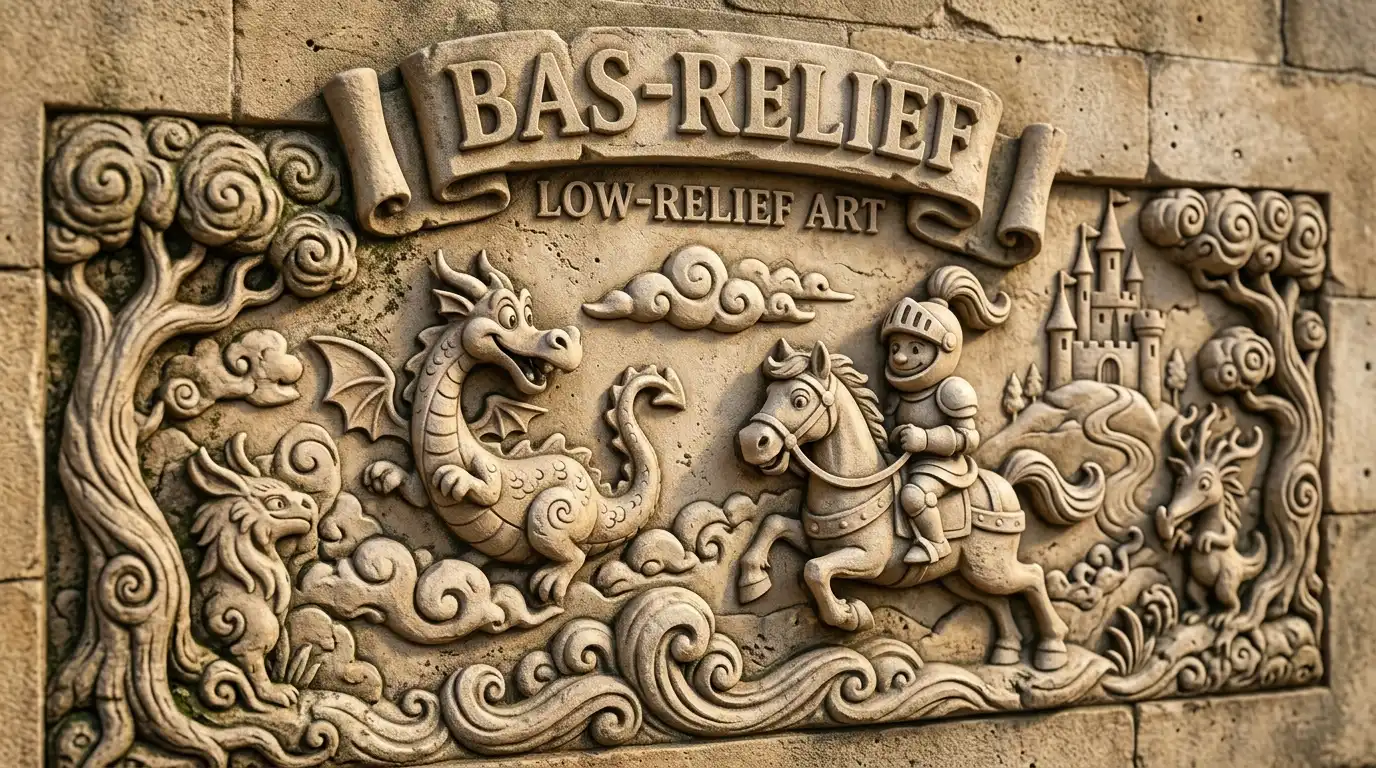
A Brief History of Bas-Relief Art
Bas-relief has been used across many civilizations for religious, political, decorative, and historical purposes. Its long history shows how artists have used shallow sculpture to communicate stories and preserve cultural ideas.
Ancient Egypt
Ancient Egyptian temples and tombs contain relief scenes depicting rulers, deities, ceremonies, agricultural activities, and daily life. These images often followed established artistic conventions and served religious or commemorative purposes.
Egyptian relief work demonstrates how a relatively flat surface can carry detailed figures, symbolic objects, and complex narratives.
Ancient Mesopotamia
Civilizations in Mesopotamia used carved reliefs on palace walls and monuments. These works sometimes depicted royal ceremonies, battles, hunting scenes, and religious subjects. Relief sculpture allowed artists to decorate large architectural surfaces while presenting figures and events in an organized visual sequence.
Ancient Greece and Rome
Greek and Roman artists developed relief sculpture for temples, public monuments, sarcophagi, coins, and commemorative structures. Their works often explored mythology, civic identity, military achievements, and human figures.
Relief sculpture also allowed historical events to be shown in continuous scenes across a single surface.
Medieval and Renaissance Art
During the medieval period, relief sculpture appeared on church entrances, altars, tombs, and religious objects. Artists used it to communicate biblical stories and religious themes.
Renaissance artists further explored perspective, anatomy, and spatial depth in relief sculpture. Some works created convincing three-dimensional effects despite remaining attached to a flat background.
Modern and Contemporary Art
Bas-relief continues to appear in architecture, public art, interior decoration, memorials, jewelry, and experimental sculpture. Modern artists may use traditional materials such as stone and wood or newer materials such as resin, concrete, and digitally fabricated composites.
The technique remains useful because it combines sculptural depth with the space-saving qualities of a flat panel.
Common Materials Used in Bas-Relief Art
Artists choose materials according to the design, durability, level of detail, and intended location of the work.
Stone
Stone is associated with historical monuments, temples, memorials, and architectural decoration. It can support fine detail and withstand long periods of exposure when the stone and installation are suitable for the environment.
Wood
Wood relief carving is popular for decorative panels, furniture, doors, frames, and handmade artwork. Different wood species offer different textures, hardness levels, and carving characteristics.
Clay and Plaster
Clay and plaster are useful for modeling reliefs, creating prototypes, and producing decorative wall panels. Artists can shape these materials by adding or removing material before the work is finished.
Metal
Metal relief appears in coins, medals, plaques, architectural features, and decorative objects. Designs may be produced through casting, stamping, embossing, or other metalworking techniques.
Concrete and Resin
Contemporary artists and designers use concrete and resin for wall installations, architectural panels, and modern decorative pieces. These materials can support a range of surface textures and finishes.
How to Recognize Bas-Relief Art
You can often identify bas-relief by looking for several visual clues:
A supporting background: The image is part of a panel, wall, slab, or another surface.
Slightly raised forms: Figures and objects project above the surrounding material.
Visible depth differences: Some areas are raised, while other areas are recessed.
Directional shadows: Lighting reveals the contours and helps define the design.
A shallow overall profile: The artwork does not project as deeply as a typical high-relief sculpture.
For example, if a decorative wall panel shows flowers whose petals rise slightly above the background, it may be bas-relief. If the flowers extend far outward with deep undercuts and strongly projecting forms, the work may be closer to high relief.
How to Use Bas-Relief Art in a Sentence
Here are examples showing how the term appears in different contexts.
[Art history] The museum displayed an ancient bas-relief depicting a royal ceremony.
[Architecture] The entrance was decorated with bas-relief carvings of leaves and flowers.
[Interior design] A bas-relief wall panel added texture and visual interest to the living room.
[Sculpture] The artist used bas-relief to create a detailed portrait on a stone slab.
[History] The monument’s bas-relief illustrated an important event from the city’s past.
[Education] Students studied bas-relief to understand how sculptors create depth on flat surfaces.
[Craft] She made a clay bas-relief featuring birds resting on tree branches.
[Restoration] Specialists carefully repaired the damaged bas-relief on the historic building.
[Art appreciation] The shallow projections and delicate shadows gave the bas-relief a lifelike appearance.
[Contemporary art] The gallery featured a modern bas-relief made from concrete and recycled materials.
These examples show that the term can describe both historical artworks and contemporary decorative or artistic objects.
Different Ways to Describe Bas-Relief Art
There is no perfect synonym for bas-relief in every context, but several related expressions can help explain the technique.
Low Relief
Low relief is the closest equivalent and the most common alternative term. It describes sculpture in which forms project only slightly from the background.
Relief Sculpture
Relief sculpture is the broader category that includes bas-relief, high relief, and other forms of sculpture attached to a background.
Carved Panel
A carved panel describes an artwork or decorative surface shaped through carving. It may be a bas-relief, but the term does not specify how far the design projects.
Raised Design
A raised design is a general descriptive phrase for shapes that stand above a surface. It is understandable in everyday writing, although it is less precise as an art-history term.
Sculpted Wall Decoration
This phrase describes decorative sculpture applied to or integrated into a wall. It may refer to bas-relief, but it can also include other sculptural techniques.
Important distinction: When precision matters, use bas-relief or low relief. Terms such as carving and raised design describe related features but do not always identify the same art form.
Why Is Bas-Relief Art Important?
Bas-relief is valuable because it combines visual storytelling with architectural and decorative function.
Historical documentation: Reliefs can preserve images of rulers, ceremonies, battles, religious practices, and everyday activities.
Cultural expression: Artists use relief sculpture to communicate beliefs, traditions, myths, and community identity.
Architectural decoration: Relief panels add detail to buildings, monuments, entrances, and public spaces.
Visual storytelling: Multiple figures and scenes can be arranged across a single surface.
Artistic experimentation: Artists can explore form, texture, light, and shadow without creating a fully freestanding sculpture.
The technique also illustrates how depth can be suggested through relatively small changes in a surface. This makes it an important subject in sculpture, architecture, design, and art education.
Related Concepts and Semantic Network
These related topics can help deepen your understanding of bas-relief art.
Relief sculpture: The broad sculptural category to which bas-relief belongs. [link: relief sculpture meaning]
High relief: A sculptural technique in which figures project more prominently from the background. [link: high relief art meaning]
Stone carving: The process of shaping stone to create figures, patterns, or decorative designs. [link: stone carving meaning]
Sculpture: The wider art form involving three-dimensional forms and spatial relationships. [link: sculpture meaning]
Intaglio: A technique in which an image is formed through incised or recessed areas. [link: intaglio art meaning]