

What Does the Name Avery Mean?
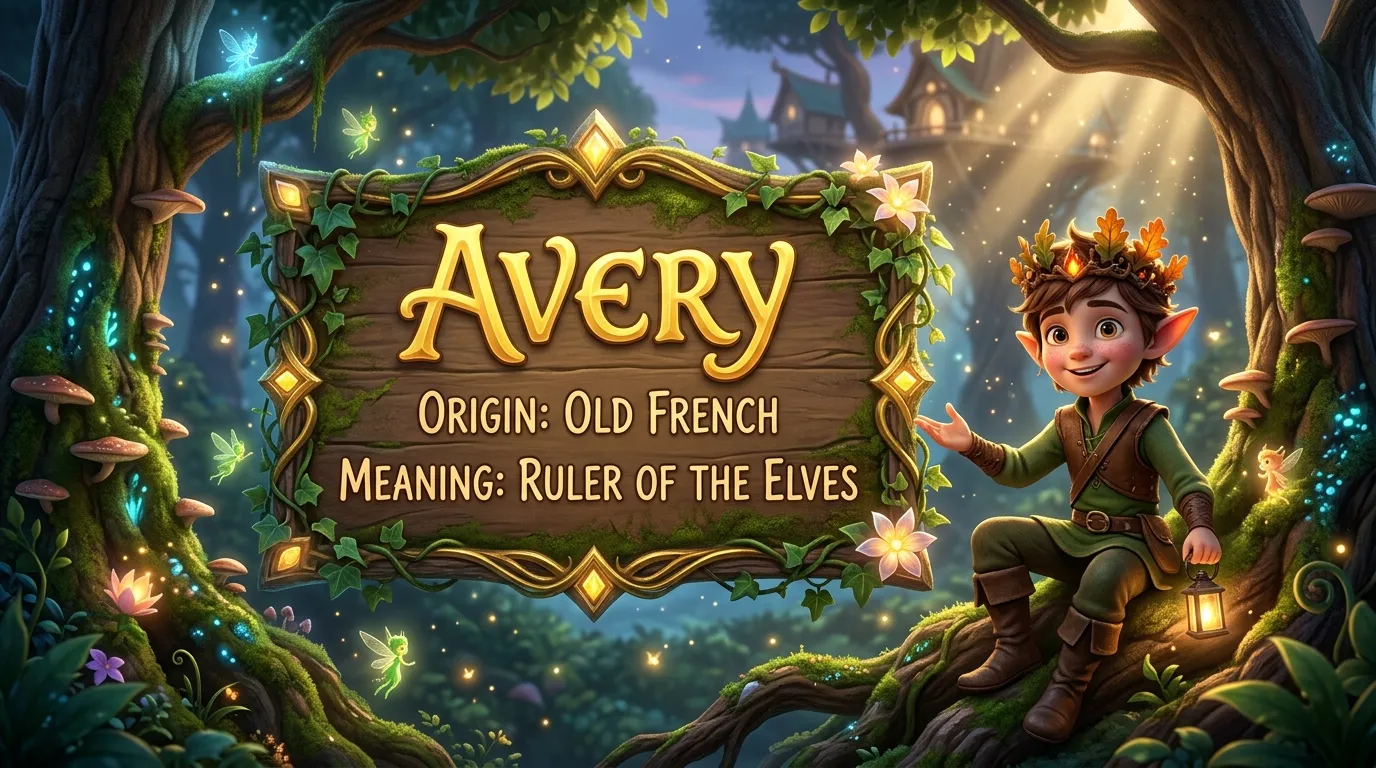
Avery is a gender-neutral given name of English usage with roots in Norman French and older Germanic names. It is commonly associated with the meanings “elf-counsel” or “wise counsel,” through its connection with Alfred, while some name references connect it with Alberich, a Germanic name associated with elves and rulership. The precise interpretation depends on which historical root is followed.
In everyday use, Avery is often appreciated for its combination of a soft, flowing sound and a confident, traditional history. It began as a form of a personal name and developed into a surname before becoming widely used as a first name for both boys and girls.
Quick Definition Box
Name
Avery
Commonly cited meaning
“Elf-counsel” or “wise counsel”; sometimes interpreted as “ruler of the elves” through an alternative etymological association.
Origin
English usage; derived through Norman French from older Germanic personal names.
Gender
Unisex — used for boys and girls.
Pronunciation
AY-vuh-ree or AYV-ree.
IPA: /ˈeɪ.və.ri/, /ˈeɪv.ri/
Common variants
Averi, Averie
Name category
Originally a surname, now widely used as a first name.
Etymological details: Behind the Name and Wiktionary.
The origin of Avery: From medieval names to a modern first name
The history of Avery is more layered than a single-word translation suggests.
One well-supported explanation traces the name to the Norman French form of Alfred. Alfred ultimately comes from the Old English elements ælf, meaning “elf,” and ræd, meaning “counsel” or “advice.” The historical sense is therefore closer to “elf-counsel” than to a literal modern phrase such as “wise ruler.”
Another etymological explanation connects Avery with Alberich, a Germanic name formed from elements associated with elves and power or rulership. This connection helps explain why baby-name websites sometimes present Avery as meaning “ruler of the elves.” However, it is important to distinguish that interpretation from the Alfred derivation rather than treating both meanings as equally certain.
Avery also has a long history as a surname in English-speaking communities. During the medieval period, variations such as Averey and Averay appeared in records. Like many surnames derived from personal names, Avery eventually crossed into use as a given name.
This shift from surname to first name is part of a broader naming tradition in English: names once used to identify family lines or ancestry later became independent choices for children.

The Deeper Meaning and Symbolism of Avery
A name’s historical meaning and its modern associations are not quite the same thing. Avery’s etymology provides a linguistic history, while its contemporary appeal reflects sound, cultural trends, personal taste, and the associations people attach to names.
What does Avery symbolize?
Through its association with counsel and wisdom, Avery can suggest thoughtful judgment, intelligence, and a measured approach to decisions. The alternative interpretation involving elves and rulership may evoke imagination, leadership, or folklore.
These are symbolic associations, not established personality traits. A person’s name cannot reliably predict whether they will be wise, confident, creative, or naturally suited to leadership.
Is Avery a boy’s name or a girl’s name?
Avery is a gender-neutral name, meaning it can be used for a child of any gender.
Historically, Avery was used as a masculine given name and developed from a surname. In modern North American naming culture, it became particularly popular for girls during the late 20th century, while continuing to be used for boys.
This flexibility is one reason Avery appeals to parents looking for a name that does not feel strongly restricted to a single gender. Its overall impression can also change with a middle name, surname, family tradition, or cultural context.
What personality is Avery associated with?
Baby-name discussions often associate Avery with qualities such as:
Wisdom: Inspired by the name’s traditional connection with counsel.
Confidence: Reinforced by the name’s short, clear sound.
Creativity: Sometimes linked to its folkloric associations with elves.
Approachability: Suggested by its familiar pronunciation and gentle ending.
Independence: A modern cultural association with choosing a name that works across genders.
These descriptions are subjective impressions rather than facts about people named Avery. They can help explain why a name appeals to parents, but they should not be used to judge an individual’s character.
How Avery feels in different contexts
Avery works in formal and informal settings because it is easy to pronounce, recognizable in English, and adaptable across age groups.
Professional: Avery fits comfortably on a résumé, in a business introduction, or in an academic setting.
Casual: Its two- or three-syllable pronunciation gives it a friendly, conversational quality.
Literary: The name can suit contemporary fiction, romance, fantasy, and coming-of-age stories.
International: English speakers generally find it straightforward to pronounce, although the vowel sounds may vary across languages.
Unlike names strongly associated with one historical period, Avery can feel both traditional and contemporary. Its surname heritage provides historical depth, while its modern unisex use gives it a current identity.
How to Use Avery in a Sentence
Avery is a proper noun, so it is capitalized when used as a person’s name. The following examples illustrate its use in everyday conversation, family contexts, professional communication, and creative writing.
[Casual] Avery is coming over this afternoon to help us prepare dinner.
[Family] We chose the name Avery because we wanted something timeless and gender-neutral.
[Professional] Avery will lead the project meeting and present the team’s recommendations.
[Academic] Avery researched the historical development of English surnames for a university assignment.
[Literary] Avery stood beneath the old oak tree, wondering what the next chapter of life would bring.
[Creative] The author chose Avery for the main character because the name suited a curious, independent protagonist.
[Conversational] Do you think Avery sounds better with James or Alexander as a middle name?
[Naming discussion] Avery is a popular choice for parents who prefer names that work for boys and girls.
[Introduction] “Hi, I’m Avery. It’s nice to meet you,” she said with a smile.
[Historical] The family traced the surname Avery through several generations of English records.
Grammar and capitalization tips
Capitalize Avery because it is a proper name.
Use possessive forms such as Avery’s book or Avery’s family.
Do not add an article before the name when referring to a specific person: “Avery arrived early,” not “The Avery arrived early,” unless the phrase has a special contextual meaning.
The name does not change its spelling according to gender.
Different Ways to Say Avery: Variants and Related Names
Personal names do not have synonyms in exactly the same way ordinary words do. Instead, parents and writers may choose spelling variants, names with similar sounds, or names that share historical roots.
Common spelling variants
Averi: A simplified alternative spelling that retains Avery’s pronunciation.
Averie: A variant with a more decorative ending, often selected for a feminine style.
Avery: The standard and most widely recognized spelling among these forms.
The spellings may be pronounced similarly, but their popularity can differ by region and generation. They should not automatically be assumed to have identical usage statistics.
Names with related origins
Alfred: The closest historical connection in the derivation that traces Avery to the Old English name associated with “elf-counsel.”
Aubrey: A name with historical connections to Germanic personal names, including Alberich in some etymological accounts.
Alberich: An older Germanic name associated with elves and rulership; relevant to one proposed explanation of Avery’s origins.
Ellery: A name with a somewhat similar sound and a surname-style feel, though it is not simply another spelling of Avery.
Emery: Another modern given name with a surname heritage and a similar contemporary style, but a distinct etymology.
These names are alternatives rather than exact equivalents. Choosing between them depends on sound, heritage, spelling preference, and personal significance.
Antonyms of Avery?
Proper names do not generally have antonyms. Avery is an identifier, not a descriptive word with an opposite meaning. Instead of searching for an opposite, it is more useful to compare names by their origins, meanings, sounds, gender associations, and cultural backgrounds.
Avery in Context: Naming Traditions and Cultural Associations
Avery as a surname
Avery developed as an English surname from medieval personal-name forms, including forms related to Alfred. Historical surname records document spellings such as Averay and Auvrey, reflecting the variation common in medieval English writing.
This surname history matters because it helps explain why Avery can feel established even when used as a modern first name. It belongs to the wider tradition of adopting family names as given names, alongside names such as Taylor, Morgan, and Parker.
Avery in popular culture
Television and film helped familiarize audiences with Avery as a first name. Behind the Name notes its use for both a mother and her son in the American sitcom Murphy Brown, which aired from 1988 to 1998. A character in the 1996 film Jerry Maguire may also have contributed to the name’s increasing use for girls in the United States.
Popular culture rarely explains a name’s entire trajectory, but recognizable characters can make an unfamiliar name seem approachable and memorable.
Avery as a modern unisex name
Avery illustrates a broader shift in English-language naming: names that once appeared mainly as surnames or masculine given names can become popular across genders.
Its appeal comes partly from its flexibility. It has a recognizable spelling, a familiar sound, and a historical background without being tied exclusively to one gender in contemporary usage.
That does not mean Avery is used equally for boys and girls everywhere. Gender associations and popularity vary by country, community, and generation.
When to Choose Avery vs. Similar Names
If you are considering Avery for a child, a fictional character, or another naming purpose, comparing its qualities with related names can help you decide.
Name | Main association | Best suited to someone who prefers |
|---|---|---|
Avery | Modern, gender-neutral, surname-derived | A versatile name with a familiar English sound. |
Alfred | Traditional, historic, linked to “elf-counsel” | A classic masculine name with a well-established history. |
Aubrey | Traditional yet contemporary; used across genders | A softer, more lyrical name with its own historical background. |
Emery | Modern, surname-style | A name with a similar rhythm but a distinct origin. |
Averie | A spelling variant of Avery | A more decorative spelling while retaining a similar pronunciation. |
A practical naming checklist
Before choosing Avery, consider these questions:
Does the pronunciation work with your surname? Say the full name aloud to check its rhythm and clarity.
Do you prefer a gender-neutral name? Avery is established for both boys and girls, though regional usage differs.
Does the historical meaning matter to you? If so, remember that “elf-counsel” and “ruler of the elves” arise from different etymological explanations.
Would you prefer a conventional spelling? Avery is generally more recognizable than variants such as Averi or Averie.
Will the name suit different stages of life? Consider how it sounds for a child, a student, and an adult professional.
The strongest name choice is usually one that fits your preferences and cultural context rather than one selected solely because of a popular personality description.
Avery Name Popularity and Modern Usage
Avery has become a familiar given name in North America, particularly in the United States, where it has been used for both boys and girls. Its growing acceptance as a unisex name reflects changing naming preferences and the popularity of surnames as first names.
The name’s popularity is not identical across countries. A name that is common in the United States may be less familiar in other English-speaking regions or in countries with different naming traditions.
For current American statistics, the Social Security Administration maintains an official baby-name database based on birth-related Social Security applications. Its records extend back to 1880, allowing users to explore how the use of Avery has changed over time.
You can explore the data through the official US baby-name database
Frequently Asked Questions About the Name Avery
1. What does the name Avery mean?
Avery is commonly associated with “elf-counsel” or “wise counsel,” through its historical connection with Alfred, an Old English name. Some references connect Avery with Alberich and the interpretation “ruler of the elves.” These explanations reflect different proposed roots, so the precise meaning depends on the etymology being followed.
2. What is the origin of the name Avery?
Avery has English usage and Norman French roots, with historical connections to older Germanic personal names. It developed as a surname from medieval forms related to Alfred and later became established as a first name. Its transition from surname to given name is part of a wider English-language naming tradition.
3. Is Avery a boy’s name or a girl’s name?
Avery is a gender-neutral name used for both boys and girls. It was historically used as a masculine given name before becoming increasingly popular for girls in modern North America. Its gender associations depend on the country, generation, and community in which it is used.
4. How do you pronounce Avery?
Avery is generally pronounced AY-vuh-ree or AYV-ree in English. The exact rhythm can vary slightly between speakers, but the first syllable is stressed. The spelling is consistent across genders, and most English speakers find the name relatively straightforward to pronounce.
5. Is Avery a biblical name?
Avery is not traditionally classified as a biblical name. Its documented history points to English, Norman French, and older Germanic naming traditions rather than a direct origin in the Bible. Parents may still choose Avery for religious or personal reasons, but its historical etymology is distinct from biblical names.
6. What are the alternative spellings of Avery?
Common variants include Averi and Averie. These spellings retain a similar sound but may have different levels of popularity depending on the region. Avery is the standard spelling most commonly recognized in English-language naming references.
7. Is Avery a good name for a baby?
Avery may appeal to parents who want a name that is recognizable, adaptable, and suitable for any gender. It combines a long surname history with modern usage and straightforward English pronunciation. Whether it is the right choice ultimately depends on personal preference, family heritage, cultural context, and how it sounds with the child’s full name.